

How to Clean Gemstone Jewelry: A Material-Safe Guide
Table of Contents
- Why Material Safety Comes Before Any Cleaning Method
- Gemstone Hardness and Toughness Guide: What Your Stone Can Take
- Safe Jewelry Cleaning Tools for Home Use
- How to Clean Gemstone Jewelry: A Step-by-Step Process
- Cleaning Porous Gemstones Like Turquoise and Opal
- When to Take Jewelry to a Professional Jeweler
- When in Doubt: A Short Decision Rule
- Frequently Asked Questions
Last Updated: September 26, 2026
Why Material Safety Comes Before Any Cleaning Method
Learning how to clean gemstone jewelry starts with one principle: the stone decides the method, not the other way around. The same cleaning routine can restore one stone and ruin another. Gemstone jewelry care is really material care.
- Gemstone: species, hardness, and known treatments
- Metal: gold, sterling silver, or plated
- Setting: prongs, bezel, or glue
- Stone condition: fractures, inclusions, or coatings
Gemstone Hardness and Toughness Guide: What Your Stone Can Take
A gemstone hardness and toughness guide matters because hardness and toughness are two different things. Hardness measures scratch resistance. Toughness measures resistance to breaking or chipping. A stone can be hard and still brittle.
Reading the Mohs Scale for Cleaning Decisions
The Mohs hardness scale ranks minerals from 1 (talc) to 10 (diamond). It tells you what can scratch the stone, including household dust, which contains quartz at 7. Anything softer than your stone is safe to handle. Anything harder can leave marks.
Practical translation:
- Mohs 7-10 (diamond, ruby, sapphire): tolerant of most home methods
- Mohs 5-6 (turquoise, opal, moonstone): gentle handling only
- Mohs 3-4 (pearl, coral, malachite): minimal intervention
Treatments, Inclusions, and Fractures That Change the Rules
Two stones of the same species can behave differently. Treatments like fracture filling, dyeing, or coating change how a stone reacts to heat, water, and chemicals. Inclusions and fractures create weak points where cleaning solutions can seep in.
Safe Jewelry Cleaning Tools for Home Use
Safe jewelry cleaning tools for home use are simpler than most people expect, but the reasoning behind each choice matters more than the list itself. The right tools are the ones that remove grime without introducing new scratches, chemical reactions, or residue.
What Each Tool Does and Why It Matters
- Mild dish soap (fragrance-free, no moisturizers): Surfactants lift oils and skin residue without the dyes and emollients that leave film on stones and settings. Moisturizing formulas are the most common cause of dull luster after a home cleaning.
- Lukewarm water: Warm water dissolves soap and oils more effectively than cold, but hot water can expand metal settings and stress fracture-filled stones. Lukewarm is the safe middle ground.
- Soft-bristled toothbrush (baby-soft, dedicated to jewelry): The bristles reach behind prongs and into filigree without abrading metal or softer stones. A toothbrush that has touched toothpaste carries abrasive residue.
- Microfiber cloth: The split fibers trap grit rather than dragging it across the surface. Cotton towels and paper products can leave lint and micro-scratches on polished metal.
- Wooden toothpick: For lifting compacted grime from the gap between stone and setting. Metal tools, including dental picks, scratch both metal and stone.
- Small bowl (one per stone type): Prevents cross-contamination of grit and cleaning solution between pieces.
Water Quality: The Variable Most Guides Skip
Tap water varies significantly in mineral content. Hard water, water with high dissolved calcium and magnesium, leaves mineral deposits on gemstones and metal as it dries. These deposits appear as a cloudy film that can be mistaken for a dirty stone. If your tap water leaves spots on glassware, it will leave spots on jewelry.
What to Skip and Why
- Ultrasonic cleaners: Safe for some stones, damaging to others. The vibration can propagate existing fractures, loosen settings, and strip treatments. Never use one without confirming your specific stone is safe.
- Steam cleaners: High heat can damage fracture-filled stones, dyed materials, and porous gems. Even some durable stones with treatments are vulnerable.
- Ammonia: Brightens diamond and some hard stones but dulls pearls, opals, turquoise, and any porous or organic material. It also strips protective coatings.
- Bleach and chlorine: Damages metal alloys and can pit gold. Chlorine is particularly harmful to white gold and sterling silver.
- Abrasive cleaners (baking soda paste, toothpaste): Scratches metal and softer stones. Even on diamond, abrasives can dull the polish on the metal setting.
- Boiling water: Can crack stones with inclusions or fractures and warp thin metal.
Building a Minimal Kit
You do not need a drawer of specialty products. A bottle of fragrance-free dish soap, a dedicated soft toothbrush, a microfiber cloth, a wooden toothpick, and a small bowl cover the majority of home cleaning needs for durable stones. Add distilled water if your tap water is hard. For porous and organic gems, a dry soft cloth and a damp cloth are sufficient, no soap, no soak, no brush.
How to Clean Gemstone Jewelry: A Step-by-Step Process
The safest general method for durable stones takes about ten minutes. Here is a process recommended for hard stones like diamond, ruby, and sapphire in good condition, followed by what to do when the standard method does not solve the problem.
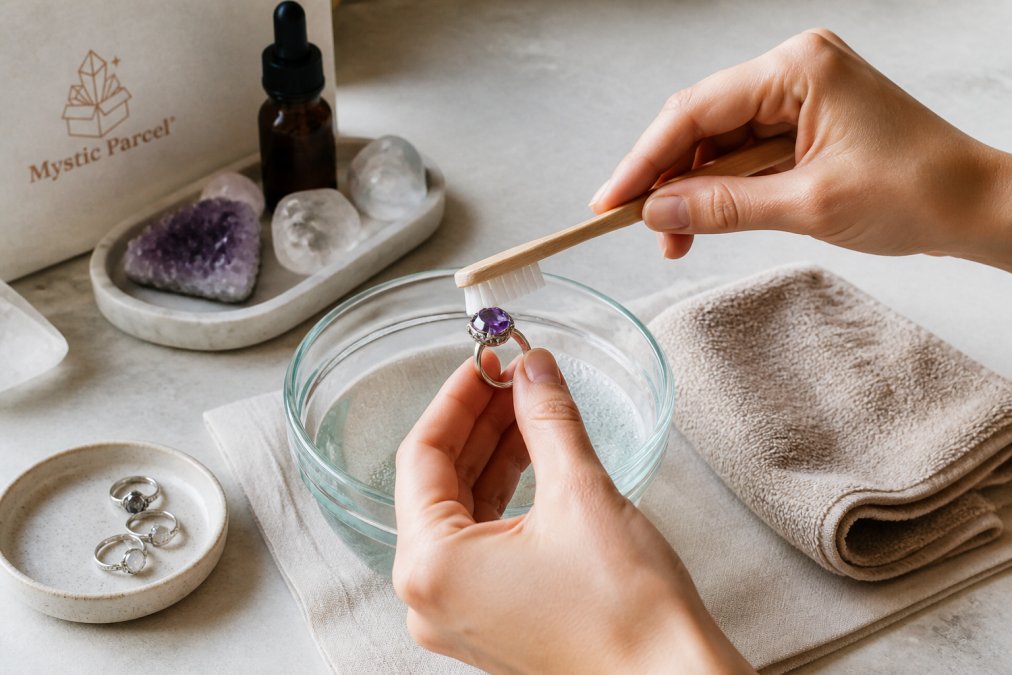
- Inspect first. Look for loose prongs, cracks, or cloudy patches. A stone that moves in its setting should not be cleaned at home, the agitation can work it loose.
- Mix the solution. A few drops of mild dish soap in lukewarm water. More soap does not clean better; it just leaves more residue.
- Soak briefly. Five to ten minutes for hard stones only. Longer soaking does not improve results and increases the risk of solution seeping into fractures or behind settings.
- Brush gently. Soft toothbrush, light pressure, back and front. Focus on the underside of the stone where skin oils and soap residue collect.
- Rinse clean. Lukewarm running water, bowl underneath to catch loose stones. If your tap water is hard, a final rinse in distilled water prevents mineral spotting.
- Pat dry. Microfiber cloth, no rubbing on fragile settings. Rubbing can catch prongs and bend them.
- Polish. Buff with a dry section of the cloth for luster. A separate dry cloth prevents reintroducing moisture.
Cleaning Settings, Prongs, and the Space Behind the Stone
Grime hides behind the stone, where soap and skin oils collect. Use a wooden toothpick to gently lift buildup from the gap between the stone and its setting. Never push metal prongs with force; a bent prong means a lost stone.
Troubleshooting: When the Standard Process Does Not Work
The stone still looks cloudy after cleaning. This is usually one of three things: mineral film from hard water, residue from a moisturizing soap, or surface wear that cleaning cannot reverse. Rinse with distilled water and dry with a clean microfiber cloth. If the haze remains, the issue is likely surface abrasion or a coating that has worn, a jeweler can confirm.
Drying and Polishing for Lasting Luster
Drying matters as much as cleaning. Water left in the gap between stone and setting evaporates slowly and can leave mineral deposits or encourage tarnish on silver. Pat dry, then use a dry section of the microfiber cloth to buff the metal and stone surface. For silver, a treated polishing cloth removes light tarnish without abrasives. Store the piece only after it is fully dry, trapped moisture is a common cause of cloudy stones and tarnished settings.
Cleaning Porous Gemstones Like Turquoise and Opal
Cleaning porous gemstones like turquoise and opal requires a different approach: no soaking, no soap, no ultrasonic. These stones absorb liquids, and once absorbed, water or chemicals can discolor them from the inside.
- Turquoise: wipe with a dry soft cloth only
- Opal: damp cloth, dry immediately, never soak
- Pearl: soft damp cloth, dry flat, away from heat
- Larimar and coral: same as turquoise
When to Take Jewelry to a Professional Jeweler
Take jewelry to a professional jeweler when the stone is loose, the setting is bent, or the piece has sentimental or significant value. A jeweler can also confirm whether your stone tolerates an ultrasonic cleaner or steam cleaner, which are not safe for every gem.
When in Doubt: A Short Decision Rule
If you cannot confirm a stone's identity, treatment, or condition, do the least invasive thing possible. Wipe with a dry soft cloth, store it separately, and ask a jeweler before trying anything else.
Stone Type |
Method |
Frequency |
Avoid |
|---|---|---|---|
Diamond, ruby, sapphire |
Soap soak + soft brush |
Weekly if worn daily |
Chlorine, harsh acids |
Turquoise, opal, pearl |
Dry or damp cloth |
After each wear |
Soaking, soap, ultrasonic |
Emerald, treated stones |
Damp cloth, no soak |
Monthly |
Heat, ultrasonic, steam |
Silver with hard stones |
Soap soak + polish cloth |
Weekly |
Abrasive polishes |
Frequently Asked Questions
Is hydrogen peroxide or rubbing alcohol better for cleaning jewelry?
Neither is a good default for gemstone jewelry. Rubbing alcohol can dull some treated stones and damage certain organic gems, and hydrogen peroxide is an oxidizer that can affect metal finishes and some treatments over time. For most durable stones and metals, mild dish soap with lukewarm water and a soft-bristled toothbrush is safer. Reserve alcohol for occasional metal-only wiping, and only after confirming the stone and setting tolerate it.
Can ultrasonic cleaners damage natural gemstone jewelry?
Yes. Ultrasonic cleaners use vibration that can worsen existing fractures, loosen prongs, and harm porous or treated stones. Avoid them for opals, emeralds, turquoise, pearls, and any stone with visible inclusions or fracture lines. Even for hard stones like diamond or sapphire, an ultrasonic cleaner is only appropriate when the setting is secure and the stone has no known treatments that make it vulnerable.
Which gemstones are too porous for liquid cleaning solutions?
Porous and organic gems absorb liquids and can stain or degrade. This includes turquoise, opal, pearls, coral, amber, and often lapis lazuli. For these, skip soaking entirely. Use a barely damp soft cloth to wipe the surface, then pat dry immediately. Avoid detergents, ammonia, and ultrasonic or steam cleaners. If grime is trapped in settings, have a professional jeweler handle it rather than risking the stone.
How does metal type affect my gemstone cleaning process?
Metal type determines which cleaners are safe. Sterling silver may tarnish and respond well to a silver polishing cloth, but ammonia-based dips can harm some stones. Gold and platinum are generally tolerant of mild soap and water, though plated pieces can wear with repeated scrubbing. Always clean the stone and metal together only when both tolerate the same method, otherwise clean the metal with a dry polishing cloth and the stone separately.


