

Benefits of Using Crystals for Daily Mindfulness
Table of Contents
- How Crystals Support Mindfulness Practice
- The Benefits of Incorporating Crystals into Mindfulness
- How to Use Meditation Crystals in Your Daily Routine
- Building a Daily Crystal Ritual
- Popular Crystals for Meditation and Mindfulness
- How to Cleanse Crystals Before and After Use
- Setting Intentions with Your Crystals
- Realistic Expectations and Mindfulness Outcomes
- Frequently Asked Questions
- Conclusion
Last Updated: October 11, 2026
Mindfulness begins with a simple act: paying attention. Yet in a world filled with constant demands and distractions, finding those moments of presence can be challenging. Sometimes, something as simple as a crystal resting in your palm can offer a reason to pause.
At Mystic Parcel, I approach crystals from two perspectives: as remarkable natural minerals, each with its own geological character, and as meaningful companions for intentional living. The way light moves through quartz, the natural banding of fluorite, or the comforting weight of a polished palm stone can invite us to slow down and observe.
Working with crystals for daily mindfulness brings these two perspectives together. Through meditation, grounding rituals, and intention-setting, a stone becomes a personal reminder to reconnect with the present moment.
You don't need an elaborate ritual or extensive crystal collection to begin. You need only a willingness to be present, a few quiet moments, and a stone that holds meaning for you.
How Crystals Support Mindfulness Practice
Mindfulness is the practice of bringing awareness to the present moment without judgment. It encourages us to observe our thoughts, emotions, and surroundings rather than moving through the day on autopilot.
Crystals can serve as physical anchors within this practice.
Holding a stone provides something tangible to focus on. Its weight, temperature, texture, and natural patterns engage the senses, offering a point of attention when the mind begins to wander.
For those who incorporate metaphysical traditions into their spiritual practice, crystals may also carry symbolic or energetic associations. Amethyst, for example, is traditionally associated with calm and spiritual awareness, while smoky quartz is often selected for grounding and protection.
These associations can help give personal meaning to a mindfulness ritual. However, the benefits of mindful attention come from actively engaging in the practice, rather than from the physical presence of a crystal alone.
A stone can remind you of an intention, but it is your awareness and participation that bring the practice to life.
The Benefits of Incorporating Crystals into Mindfulness
One of the most appealing aspects of crystal-based mindfulness is its simplicity. A single stone can become part of a consistent, meaningful practice without requiring special equipment or elaborate preparation.
Creating a Tangible Point of Focus
Mindfulness often involves returning attention to the breath, a sound, or a physical sensation. A crystal offers another sensory focal point.
Notice its surface against your skin. Observe its natural variations in color or transparency. Feel its weight in your hand.
This deliberate observation encourages you to direct your attention to something happening in the present moment.
Reinforcing Personal Intentions
A crystal can become a physical reminder of an intention you wish to cultivate.
If your intention is patience, for example, carrying a stone associated with that quality gives you an opportunity to reconnect with your commitment throughout the day.
The stone itself does not create patience. Rather, the personal meaning you assign to it can remind you to practice responding with greater awareness.
Encouraging Ritual and Consistency
Establishing a regular mindfulness habit can be difficult, particularly when daily responsibilities compete for attention.
Incorporating a favorite crystal into a morning or evening routine creates a recognizable ritual. Over time, the act of picking up that stone may become a familiar cue to pause, breathe, and reconnect with yourself.
The value lies in the consistency of the practice and the personal significance it develops.
Connecting with the Natural World
Crystals are tangible expressions of geological processes, formed through the interaction of minerals, chemistry, and their surrounding environments.
Every natural specimen carries evidence of its formation, whether through crystal structure, growth patterns, inclusions, or variations in color.
Taking time to observe these characteristics encourages curiosity and appreciation for the natural world.
At Mystic Parcel, this connection between the geological and the intentional is fundamental. Appreciating a mineral for what it is can be just as meaningful as exploring what it represents.
How to Use Meditation Crystals in Your Daily Routine
Incorporating crystals into your mindfulness practice doesn't require changing your schedule dramatically. Begin with a stone that appeals to you and identify moments when you can give it your attention.
Some people prefer holding a polished palm stone during meditation. Others carry a small tumbled stone or keep a crystal on their desk as a visual reminder to pause.
To begin:
- Select your stone. Choose a crystal that feels comfortable in your hand or has a personal meaning connected to your intention.
- Identify a consistent time. Morning, lunch breaks, or evening reflection can all become opportunities for mindfulness.
- Create a comfortable space. Find somewhere you can sit without distractions, even for a few minutes.
- Engage your senses. Hold your crystal and notice its weight, texture, and temperature while breathing naturally.
- Return to your practice. Revisit your stone and intention regularly, allowing the ritual to become familiar.
Consistency is valuable, but your practice doesn't need to be rigid. Mindfulness is not another obligation to complete perfectly.
Even a brief moment of deliberate attention can be worthwhile.
Choosing the Right Stone for Your Practice
There is no single crystal that everyone must use for meditation. Personal preference, physical characteristics, and traditional energetic associations can all influence your selection.

Size and weight: Palm stones, often approximately 2–2.5 inches, are comfortable for holding during meditation. Smaller tumbled stones are convenient for carrying throughout the day.
Texture: Polished stones offer smooth surfaces, while natural crystals may have distinct faces, striations, or irregular formations that encourage visual observation. Select a stone that is comfortable and safe to handle.
Visual character: Color, translucency, inclusions, and crystal habit can make a specimen especially engaging. A clear quartz crystal may invite attention to its internal veils and reflections, while smoky quartz offers depth through its natural coloration.
Traditional associations: Some practitioners choose stones based on qualities such as clarity, grounding, intuition, or emotional balance. Others prefer to assign their own meaning through personal experience.
The Clear Quartz Palm Stone from Mystic Parcel, for example, is polished for comfortable handling and displays natural internal characteristics that invite closer observation.
Ultimately, the most appropriate meditation crystal is one that encourages you to return to your practice.
Building a Daily Crystal Ritual
A crystal ritual is a deliberate practice that creates space for reflection, awareness, and personal intention.
Rituals don't need to be complex to feel meaningful. Repeating a few simple actions can help establish a sense of familiarity and purpose.
Whether you prefer a short morning grounding exercise or a longer meditation session, the goal is to create a moment in which your attention is fully engaged.
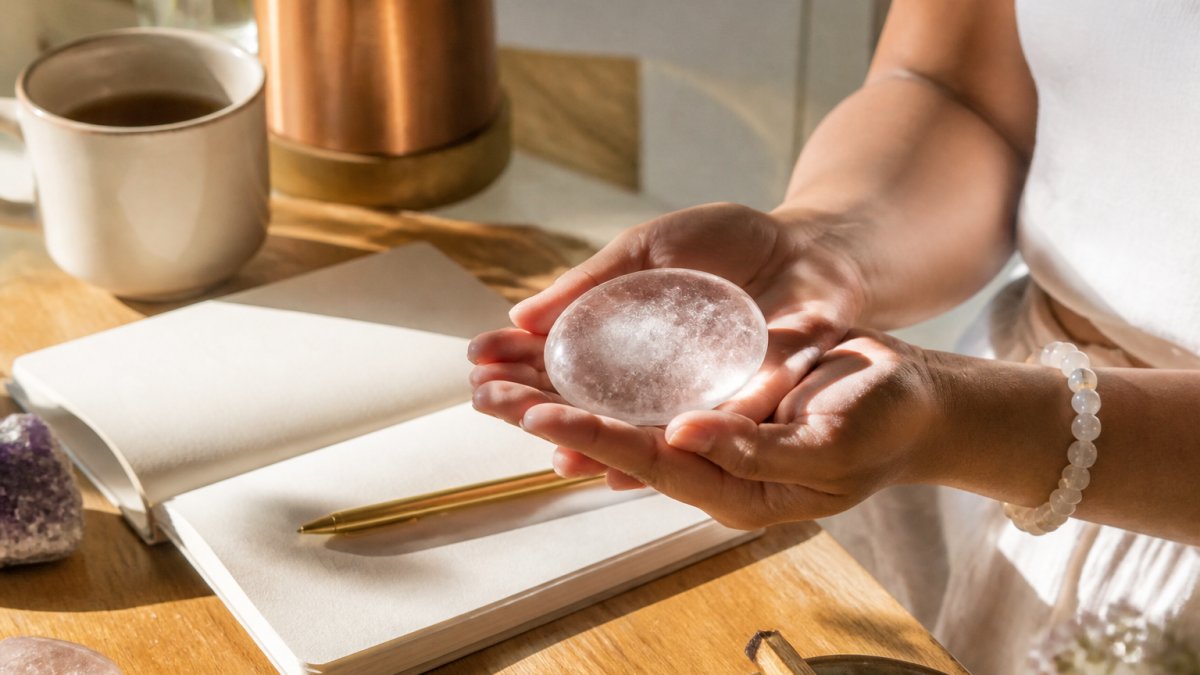
Morning Grounding Practice
Start your day by grounding yourself with your crystal. This sets a calm, intentional tone before the day's demands take over.
A basic morning ritual:
- Sit quietly for two to three minutes. Hold your crystal in both hands, palms up.
- Take five slow breaths. Notice the stone's temperature, texture, and weight. Feel your feet on the ground.
- State your intention silently or aloud. Examples: "I am present," "I choose calm," "I move through today with awareness."
- Carry the stone with you. Return to it whenever you feel scattered during the day.
This practice takes less than five minutes and offers an opportunity to begin your day with greater awareness and intention.
Meditation Session with Crystals
A formal meditation session with your stone provides dedicated time to practice focused attention and stillness.
Your meditation session might look like this:
- Sit in a comfortable position. Support your spine so you're not straining.
- Hold your crystal in one hand or rest it on your lap. Let its presence anchor your attention.
- Close your eyes and breathe naturally. Don't force or control your breath, just notice it.
- When your mind wanders, gently return focus to the stone. Feel its weight and texture. This is the practice.
- Sit for 5 to 20 minutes, depending on your schedule and experience level.
Start with five minutes if you're new to meditation. Your mind will wander, that's normal. Each time you notice your mind wandering and gently return your attention, you're practicing mindfulness.
Popular Crystals for Meditation and Mindfulness
Certain stones have long associations with specific qualities. These aren't magical guarantees, they're tools that help your mind focus on what matters to you.
Clear Quartz for Clarity and Amplification
Clear quartz is one of the most versatile crystals used in mindfulness practices. Its transparency and natural internal features make it a compelling object for visual contemplation. Within metaphysical traditions, clear quartz is associated with clarity, amplification, and spiritual awareness, making it a popular choice for intention-setting and meditation.
Clear quartz works well if you're:
- Starting a mindfulness practice and aren't sure what you need
- Seeking mental clarity or sharper focus
- Exploring the traditional association between clear quartz and the amplification of intention.
The Clear Quartz Palm Stone from Mystic Parcel is hand-selected for exceptional clarity.
Hold clear quartz during meditation to support mental clarity, or place it on your altar as a purifying presence in your space.
Amethyst for Calm and Spiritual Awareness
Amethyst carries associations with calm, intuition, and spiritual awareness.
Amethyst is your stone if you're:
- Working with intuition and inner knowing
- Wanting to quiet mental chatter
Many people keep amethyst on their bedside table or hold it during evening meditation to support restful sleep. Within metaphysical traditions, amethyst is valued for its associations with calm, intuition, and spiritual awareness, making it a popular choice for evening reflection and contemplative practices.
Other Stones for Grounding and Balance
Beyond clear quartz and amethyst, several stones support grounding and emotional balance during mindfulness practice.
Peach Moonstone is traditionally associated with nurturing energy, intuition, and emotional balance. Its warm coloration and gentle visual character make it an appealing choice for mindfulness practices centered on self-compassion and personal transitions. The Peach Moonstone Palm Stone from Madagascar offers a smooth, comfortable form for handheld meditation.

Selenite and Satin Spar — Clarity and Energetic Cleansing
Selenite and satin spar are forms of gypsum (CaSO₄·2H₂O). Selenite commonly refers to transparent crystalline gypsum, while satin spar describes the fibrous variety known for its silky appearance.
Satin spar is frequently marketed as selenite in the crystal trade, although the two forms have distinct physical characteristics.
Within metaphysical practices, both are associated with clarity, purification, and energetic cleansing.
The Selenite (Satin Spar) Tumbled Stone from Morocco can be placed in a dry meditation area as a symbolic reminder to begin with a clear intention.

Rainbow Fluorite — Focus and Mental Organization
Fluorite is a calcium fluoride mineral (CaF₂) that occurs in an impressive variety of colors, sometimes displaying distinct bands of purple, green, blue, and other tones.
Metaphysically, fluorite is commonly associated with clarity, concentration, and mental organization.
For those who prefer structured meditation, the Rainbow Fluorite Mala from Mystic Parcel incorporates 108 polished beads that can be used to count mantras, affirmations, or intentional breaths.
The repeated movement of the beads provides a physical rhythm for the practice.
Each stone offers a different combination of mineralogical character, sensory qualities, and traditional symbolism. Choose the one that best complements the experience you wish to create.
How to Cleanse Crystals Before and After Use
Crystal cleansing is a common part of many spiritual and intention-setting traditions. However, it is important to distinguish between physical cleaning and energetic cleansing, as they serve different purposes.
Physical cleaning removes dust, fingerprints, oils, and other contaminants that may accumulate through handling or display.
Energetic cleansing refers to a spiritual practice intended to symbolically refresh a stone or mark a transition between intentions. The concept of accumulated energy requiring removal is part of metaphysical belief rather than an established mineralogical process.
Both approaches can have a place in personal crystal care, provided the methods used are appropriate for the mineral.
When to Cleanse
When receiving a new crystal: Examine your stone for dust or residue and clean it physically if necessary. Some practitioners also choose to perform an energetic cleansing ritual before introducing a new stone into their collection.
During routine maintenance: Displayed crystals may collect dust, while frequently handled palm stones can accumulate skin oils. Clean them as needed according to their mineral properties.
After a meaningful experience: If you associate a crystal with an emotionally significant period, an intention-setting or cleansing ritual can provide a symbolic opportunity for reflection and renewal.
When establishing a new intention: You may choose to refresh your meditation space or repeat a cleansing ritual whenever your focus changes.
There is no scientifically established requirement to energetically cleanse crystals on a particular schedule. The timing can reflect your personal practice.
Safe Cleansing Methods by Stone Type
Not all minerals respond to moisture, heat, sunlight, or handling in the same way.
Understanding basic mineral properties helps preserve the natural beauty and structural integrity of your crystals.
Quartz Family: Clear Quartz, Amethyst, and Smoky Quartz
Quartz has a Mohs hardness of 7 and is generally more resistant to scratching and routine handling than many softer minerals.
For simple, intact, polished quartz pieces, gentle cleaning with a soft cloth is often sufficient. Water may be appropriate for some quartz specimens, but avoid assuming that every quartz-bearing piece is safe to rinse.
Crystals with delicate formations, fractures, coatings, treatments, or associated minerals may require specialized care.
Avoid prolonged direct sunlight, particularly with amethyst, as some specimens can fade with extended exposure.
Fluorite
Fluorite has a Mohs hardness of 4 and four directions of perfect cleavage, making it more vulnerable to scratches and breakage than quartz.
For routine care, use a soft, dry cloth or a very gentle brush appropriate to the specimen.
Avoid unnecessary water exposure, harsh cleaners, ultrasonic cleaning, and impacts. Natural fluorite clusters and specimens with fractures or delicate crystal formations require additional caution.
Selenite and Satin Spar (Gypsum)
Gypsum has a Mohs hardness of 2, making it exceptionally soft compared with quartz and fluorite. It is also moderately soluble in water.
Keep selenite and satin spar dry, and avoid soaking or rinsing them.
A gentle, dry cleaning method is generally preferable. Because satin spar has a fibrous structure, avoid vigorous brushing or handling that could damage its surface.
Calcite
Calcite is a relatively soft mineral, with a Mohs hardness of 3. It is particularly sensitive to acids, which can etch or dissolve its surface.
Although calcite is not as readily soluble in neutral water as minerals such as halite, prolonged moisture exposure and inappropriate cleaning products can still present risks.
For routine care, gentle dry cleaning is a conservative choice, especially for natural specimens with associated minerals.
Lepidolite and Other Delicate or Layered Minerals
Lepidolite belongs to the mica group and commonly exhibits pronounced cleavage, meaning it can separate into thin sheets.
Avoid soaking, vigorous rubbing, or scrubbing that might loosen or damage its layered structure.
Use gentle dry cleaning and minimal handling, particularly with fragile natural specimens.
Energetic Cleansing Without Water
For those who incorporate energetic cleansing into their spiritual practices, several methods do not require immersing a mineral in water:
- Sound: Use a bell, singing bowl, or other gentle sound as a symbolic way to begin or conclude a ritual. Keep vibrating instruments from directly contacting fragile specimens.
- Moonlight: Place your stone in a dry, secure indoor location near a window as part of a moonlight ritual. Protect it from condensation, falls, and direct sunlight the following morning.
- Visualization: Hold or observe the crystal while imagining a release of distracting thoughts or a renewal of your personal intention.
- Smoke: Some traditions use incense or herbal smoke. If you choose this method, use adequate ventilation and avoid exposing delicate mineral surfaces to heat, soot, or residue.
These are spiritual and symbolic practices, not scientifically demonstrated methods for removing energy from minerals.
What to Avoid
Regardless of the purpose of your cleansing ritual, several practices can place crystals at risk.
Prolonged direct sunlight: Some minerals may fade or experience damage under extended exposure to strong sunlight.
Salt and saltwater: Salt can leave residue or contribute to surface damage, particularly with soft, porous, or chemically sensitive minerals.
Ultrasonic cleaners: Vibrations can damage fragile crystals, worsen existing fractures, or loosen components of composite specimens.
Unnecessary immersion: Do not assume a specimen is water-safe based solely on its primary mineral. Associated minerals, fractures, adhesives, treatments, and coatings can affect appropriate care.
Burying crystals in soil: Soil can introduce moisture, abrasion, and contaminants, while also creating a risk of losing or breaking delicate specimens.
When uncertain, use the least invasive cleaning method and seek mineral-specific care guidance.
A Simple Monthly Routine
A monthly crystal-care ritual can combine practical maintenance with intentional reflection.
- Examine your crystal for dust, surface changes, or signs of damage.
- Clean gently using a method appropriate for its mineral composition.
- Place the stone in a clean, dry, protected location.
- If desired, incorporate sound, visualization, or a moonlight ritual.
- Take a moment to reflect on your intention before returning the crystal to its usual space.
Caring for a crystal can itself become an exercise in mindfulness.
The deliberate act of examining its surface, appreciating its natural characteristics, and handling it with care encourages attention to the present moment.
Setting Intentions with Your Crystals
Intention-setting is the practice of consciously identifying a quality, value, or direction you wish to cultivate.
Unlike a specific goal, which often focuses on achieving a measurable result, an intention describes how you wish to approach your experiences.
For example, a goal might be to complete a difficult project. An intention might be to approach that project with patience, clarity, and confidence.
A crystal can become a meaningful physical symbol of that intention.
To create your own practice:
- Hold your crystal. Notice its shape, weight, and surface against your skin.
- Identify your intention. Consider the quality you wish to bring into your life or a particular situation.
- Express it clearly. Use a short, positive statement that feels authentic to you.
- Connect the intention to the stone. Allow the crystal to become a personal reminder of your chosen focus.
- Return to your intention regularly. Each time you encounter the stone, take a moment to consider how you are putting that intention into practice.
Examples include:
- "I approach challenges with patience and clarity."
- "I give myself permission to grow and change."
- "I remain grounded in what matters to me."
- "I choose to act with compassion and awareness."
Your intention can evolve as your circumstances change.
The crystal provides continuity, while the meaning and action come from you.
At Mystic Parcel, intention is not simply a label assigned to a mineral. It is the personal relationship you develop between a stone, its traditional associations, and the qualities you choose to cultivate.
Realistic Expectations and Mindfulness Outcomes
Crystals can be meaningful additions to personal mindfulness practices, but it is important to maintain realistic expectations about what they can and cannot do.
Research on meditation and mindfulness suggests that these practices may support aspects of psychological well-being, including stress management and emotional awareness, although outcomes vary and the quality of available evidence differs across studies.
The National Center for Complementary and Integrative Health provides an overview of research examining mindfulness and meditation.
There is not comparable scientific evidence establishing that particular crystals independently produce specific therapeutic or psychological outcomes.
What incorporating crystals into mindfulness can offer:
- A sensory anchor: Holding or observing a crystal gives attention a tangible focal point.
- A reminder of intention: A personally meaningful object can prompt reflection on qualities you wish to cultivate.
- A familiar ritual: Repeatedly using the same stone can help create a recognizable moment for mindfulness.
- An opportunity for observation: The mineral's structure, texture, and natural characteristics invite deliberate attention and curiosity.
- A personal spiritual connection: Traditional crystal associations may add meaning for those who incorporate metaphysical beliefs into their practice.
What crystals cannot guarantee:
- Relief from anxiety, depression, or other medical conditions.
- Specific emotional, spiritual, or physical outcomes.
- Changes in behavior without personal effort.
- A substitute for appropriate professional healthcare or mental health support.
The real work is yours. Your crystal is a companion and a reminder, not a substitute for the actual practice of returning your mind to the present moment.
A meaningful crystal practice does not require choosing between scientific understanding and personal spirituality. You can appreciate a stone's geological formation while also finding symbolic significance in its traditional associations.
Frequently Asked Questions
How can you use crystals for daily mindfulness?
Hold a crystal during meditation, carry a small polished stone as a reminder to pause, or place one somewhere visible in your daily environment. Focus on its weight, temperature, texture, or appearance while bringing attention to your breathing and surroundings. The stone serves as a tangible cue to return to the present moment.
Which crystals are commonly used for mindfulness?
Clear quartz is traditionally associated with clarity and amplification, amethyst with calm and spiritual awareness, peach moonstone with nurturing and emotional balance, and fluorite with focus and mental organization. Satin spar is often selected for symbolic cleansing rituals. The best choice depends on your personal preferences, intentions, and how you plan to use the stone.
Why should you cleanse your crystals?
Physical cleaning removes dust, oils, and other surface contaminants. Energetic cleansing is a separate spiritual practice that some individuals use to symbolically refresh their relationship with a crystal or establish a new intention. The latter is based on personal beliefs rather than a scientifically demonstrated need to remove accumulated energy. Always choose methods appropriate for the mineral's physical properties.
Can crystals help with mental clarity?
Crystals can serve as focal objects within a mindfulness practice. Observing or holding a stone while practicing deliberate attention may help you create a moment to pause, recognize distractions, and redirect your focus. Clear quartz and fluorite are traditionally associated with clarity, but there is no established evidence that these minerals independently improve cognitive performance.
Do you need to believe in crystal energy to practice mindfulness with crystals?
No. A crystal can be appreciated for its beauty, geological formation, and sensory qualities without adopting metaphysical beliefs. Some people incorporate traditional energetic associations, while others use stones simply as meaningful objects for meditation and reflection. Both approaches can coexist within an intentional mindfulness practice.
Conclusion
At Mystic Parcel, I believe the beauty of working with crystals begins with appreciating what nature has created.
Every mineral has its own character. Some reveal their history through distinct crystal faces and growth patterns; others through subtle inclusions, color variations, or the way they interact with light. Those details are part of what makes selecting and spending time with a stone so meaningful.
But the intention we bring to a crystal is uniquely our own.
Whether you are drawn to clear quartz for clarity, amethyst for contemplation, or smoky quartz for grounding, the most meaningful part of your practice is not what you expect the stone to do for you. It is what the stone reminds you to do for yourself.
To pause. To pay attention. To recognize what matters. To approach each day with greater awareness.
Mindfulness doesn't require perfection, and intentional living doesn't need to be complicated. Sometimes it begins with a few quiet minutes and a small reminder of the qualities you wish to cultivate.
At Mystic Parcel, we honor both the natural beauty of the mineral and the personal meaning it holds. Because the crystal is a creation of nature, but the intention is yours.


