
Native Copper (51g) — Sculptural Branching | Hubei, China
Chinese Native Copper specimen from Hubei Province with flattened branching growth, irregular sculptural projections, and bright copper-red metallic luster; approx. 51g / 2 × 2.1 × 0.4 in.
 Country of Origin | China
Couldn't load pickup availability
Estimated Delivery: …
What's included in your order?
 30-Days Returns
 Ethically Curated
 Authentic Minerals



Native Copper (51g) — Sculptural Branching | Hubei, China
Native Copper (51g) — Sculptural Branching | Hubei, China
Copper connects. Intention directs. Action transforms.
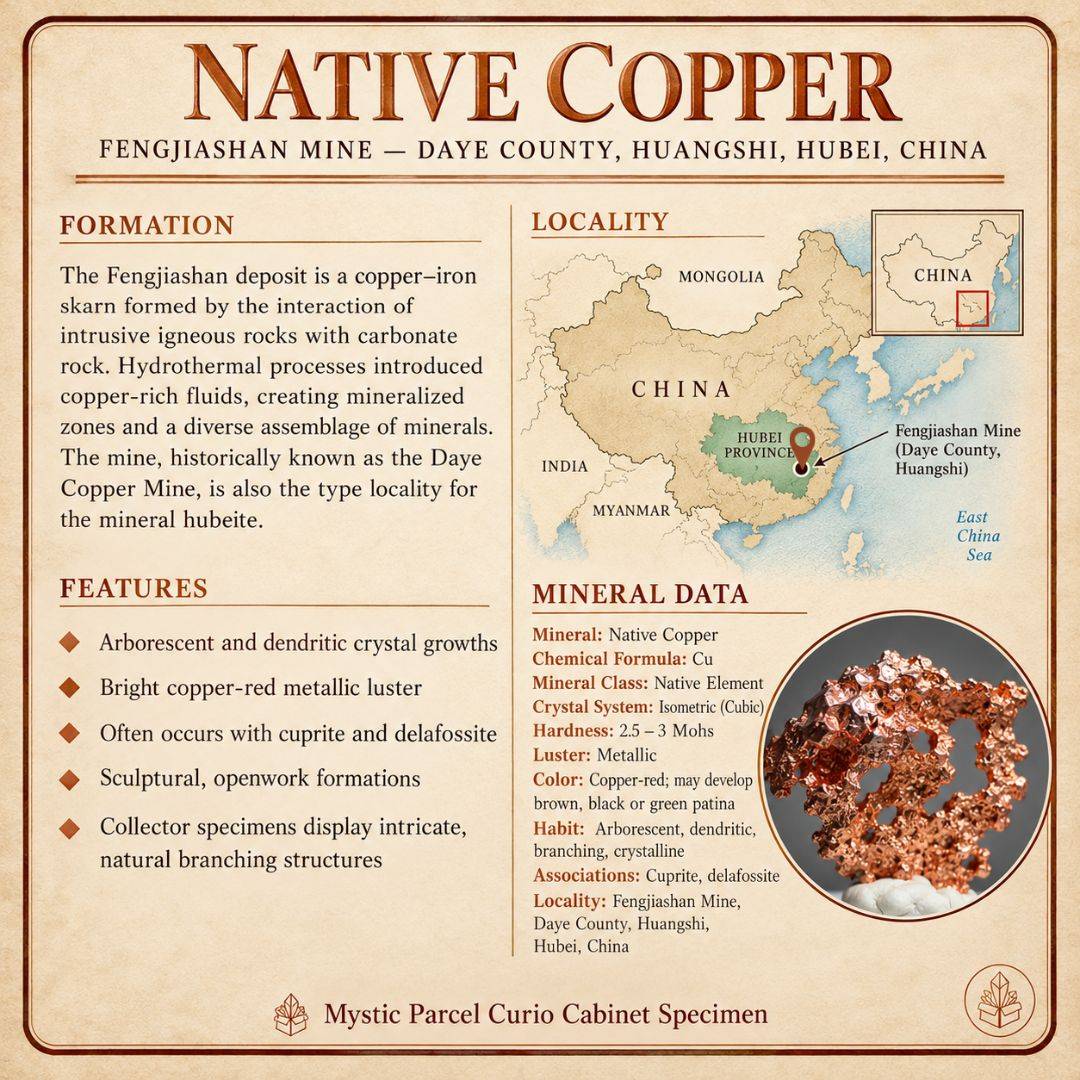
This Native Copper specimen from Fengjiashan Mine in Hubei Province, China, features an intricate, naturally sculptural formation with branching metallic growth and warm copper-red coloration. Weighing 51g and measuring approximately 2 × 2.1 × 0.4 inches, this compact specimen combines broad, textured copper growths with smaller projections that extend outward in several directions. Its irregular silhouette gives the piece a distinctive three-dimensional character despite its relatively narrow profile.
The specimen displays bright reflective surfaces, granular crystalline textures, and deeper reddish-brown areas that become more apparent when viewed from different angles. Several raised, branching projections emerge from a wider interconnected copper formation, creating an asymmetrical arrangement with a sense of movement. The reverse reveals darker metallic areas and additional surface detail, offering a different perspective on the same natural growth.
Native Copper occurs naturally as elemental copper (Cu), rather than copper chemically combined with other elements in a mineral compound. Its distinctive metallic luster, reddish coloration, and capacity for complex branching formations make it a recognizable member of the native element mineral class. This specimen is presented in a large protective perky box, allowing its intricate growth to be viewed while helping protect the delicate projections.
Specimen Details
- Material: Native Copper (Cu)
- Locality: Fengjiashan Mine, Daye County, Huangshi, Hubei Province, China
- Formation: Arborescent and branching native copper growth with irregular crystalline projections
- Features: Sculptural silhouette, flattened interconnected growth, raised branching structures, textured metallic surfaces
- Color: Copper-red, rose-copper, and reddish brown with darker metallic areas
- Finish: Naturally textured metallic surface
- Size: Approx. 2 × 2.1 × 0.4 in.
- Specimen Size: Small Cabinet
- Specimen Weight: 51g / approx. 1.80 oz
- With Perky: Approx. 3 × 3 × 3 in. / 104g total
- Display: Large perky specimen box with clear protective cover
- Selection: One-of-a-kind; exact specimen shown
Geological Notes
The Fengjiashan Mine in Hubei Province, China, is part of a historically significant copper-iron mining region associated with the Daye Copper Mine. The deposit is classified as a copper-iron skarn, formed through interactions between intrusive igneous rocks and carbonate-rich host rocks. Hydrothermal processes introduced copper-rich fluids into the surrounding geological environment, contributing to a diverse assemblage of minerals.
Fengjiashan is particularly notable among mineral collectors as the type locality for hubeite, a calcium-manganese-iron silicate mineral. The mine also contains several copper-bearing species, including native copper, cuprite, and delafossite. These mineral associations reflect the complexity of the deposit, although additional minerals have not been identified on this particular specimen.
Native Copper belongs to the native element mineral class and crystallizes in the isometric (cubic) crystal system. Although copper can develop recognizable geometric crystals, it frequently occurs in arborescent, dendritic, and irregularly branching formations. This specimen illustrates that sculptural growth through its interconnected copper masses, angular projections, and contrasting metallic textures.
Mystic Parcel Notes
One of my favorite qualities of Native Copper is how naturally it engages the imagination. Much like watching clouds and discovering recognizable figures in their shifting outlines, the eye begins to interpret copper's branching structures as familiar shapes. In this particular specimen, I see a pair of dancers, their forms seemingly caught in motion within the copper's irregular silhouette. Someone else may see something entirely different, and that personal interpretation is part of what makes these natural specimens so interesting.
Copper holds a distinctive place in Mystic Parcel's philosophy of intentional living because I do not associate it with only one intention. Copper is an exceptional physical conductor of electricity and heat, and I see a meaningful symbolic connection between those properties and the conscious direction of our intentions. To me, copper serves as a conduit for all intentions, representing the connection between what we hope to cultivate and the choices and actions through which we express that purpose.
For intention buyers, this specimen offers a visual reminder of creativity, connection, and the movement from intention into action. For collectors, its Fengjiashan locality, sculptural branching growth, and contrasting copper surfaces provide both mineralogical interest and display character. Its compact presentation also makes it well suited to a personal collection where the details of individual specimens can be appreciated up close.
What you'll receive
- One (1) Native Copper specimen from Fengjiashan Mine, Hubei, China — exact specimen shown
- One (1) large perky specimen box with clear protective cover, approx. 3 × 3 × 3 inches
- Mystic Parcel specimen identification card
How to use
- Display in its protective perky box as part of a Curio Cabinet, mineral collection, office, or personal space.
- Position where indirect light can reveal the copper's reflective surfaces and intricate crystalline textures.
- Observe the specimen from different angles to discover familiar forms suggested by its branching structures.
- Use as a visual focal point for creative reflection, meditation, or setting personal intentions.
- Pair with other native element specimens or copper-bearing minerals for comparative study and display.
Care
- Keep the specimen secured inside its protective perky box when possible to prevent damage to its branching formations.
- Avoid direct contact with water, prolonged humidity, and damp storage conditions.
- If necessary, dust very gently with a soft, dry brush without applying pressure to delicate projections.
- Do not use polishing compounds, salt, acids, or abrasive cleaning materials.
- Native Copper may naturally darken or develop surface patina over time through environmental exposure.
Notes: This is a natural, one-of-a-kind mineral specimen with irregular branching growth, varied metallic textures, and possible natural contact points. The specimen is shown secured within its perky box using visible mounting material. Photos show the exact specimen you will receive. Crystal and intention practices are symbolic and personal and are not substitutes for professional advice.
To explore copper's symbolic role as a conduit for intention, discover how this remarkable native element connects to the philosophy of Mystic Parcel in our article, Copper and Intentional Living: The Conduit That Connects Our Intentions.
| Specification | Details |
|---|---|
| Material | Native Copper (Cu) |
| Locality | Fengjiashan Mine, Daye County, Huangshi, Hubei Province, China |
| Weight | 51g / approx. 1.80 oz |
| Size | Approx. 2 × 2.1 × 0.4 inches |
| Display Box Size | Approx. 3 × 3 × 3 inches |
| Total Weight with Box | Approx. 104g |
| Specimen Type | Small Cabinet Specimen |
| Finish | Naturally textured metallic surface |
| Color | Copper-red, rose-copper, reddish brown with darker metallic areas |
| Material | Description |
|---|---|
| Native Copper (Cu) | This specimen represents the elemental form of copper, celebrated for its unique metallic sheen and inviting warm tones. It displays elaborate branching structures and sculptural forms that enhance its visual appeal. |
The Fengjiashan Mine in Hubei Province, China, is part of a historically significant copper-iron mining region associated with the Daye Copper Mine. The deposit is classified as a copper-iron skarn, formed through interactions between intrusive igneous rocks and carbonate-rich host rocks. Hydrothermal processes introduced copper-rich fluids into the surrounding geological environment, contributing to a diverse assemblage of minerals.
Fengjiashan is particularly notable among mineral collectors as the type locality for hubeite, a calcium-manganese-iron silicate mineral. The mine also contains several copper-bearing species, including native copper, cuprite, and delafossite. These mineral associations reflect the complexity of the deposit, although additional minerals have not been identified on this particular specimen.
Native Copper belongs to the native element mineral class and crystallizes in the isometric (cubic) crystal system. Although copper can develop recognizable geometric crystals, it frequently occurs in arborescent, dendritic, and irregularly branching formations. This specimen illustrates that sculptural growth through its interconnected copper masses, angular projections, and contrasting metallic textures.
One of my favorite qualities of Native Copper is how naturally it engages the imagination. Much like watching clouds and discovering recognizable figures in their shifting outlines, the eye begins to interpret copper's branching structures as familiar shapes. In this particular specimen, I see a pair of dancers, their forms seemingly caught in motion within the copper's irregular silhouette. Someone else may see something entirely different, and that personal interpretation is part of what makes these natural specimens so interesting.
Copper holds a distinctive place in Mystic Parcel's philosophy of intentional living because I do not associate it with only one intention. Copper is an exceptional physical conductor of electricity and heat, and I see a meaningful symbolic connection between those properties and the conscious direction of our intentions. To me, copper serves as a conduit for all intentions, representing the connection between what we hope to cultivate and the choices and actions through which we express that purpose.
For intention buyers, this specimen offers a visual reminder of creativity, connection, and the movement from intention into action. For collectors, its Fengjiashan locality, sculptural branching growth, and contrasting copper surfaces provide both mineralogical interest and display character. Its compact presentation also makes it well suited to a personal collection where the details of individual specimens can be appreciated up close.


