
Native Copper (126g) — Dendritic Openwork | Hubei, China
Chinese Native Copper specimen from Hubei Province with branching, openwork growth, textured metallic surfaces, and bright copper-red color; approx. 126g / 3.5 × 3.5 × 1.5 in.
 Country of Origin | China
Couldn't load pickup availability
Estimated Delivery: …
What's included in your order?
 30-Days Returns
 Ethically Curated
 Authentic Minerals



Native Copper (126g) — Dendritic Openwork | Hubei, China
Native Copper (126g) — Dendritic Openwork | Hubei, China
Copper connects. Intention directs. Action transforms.
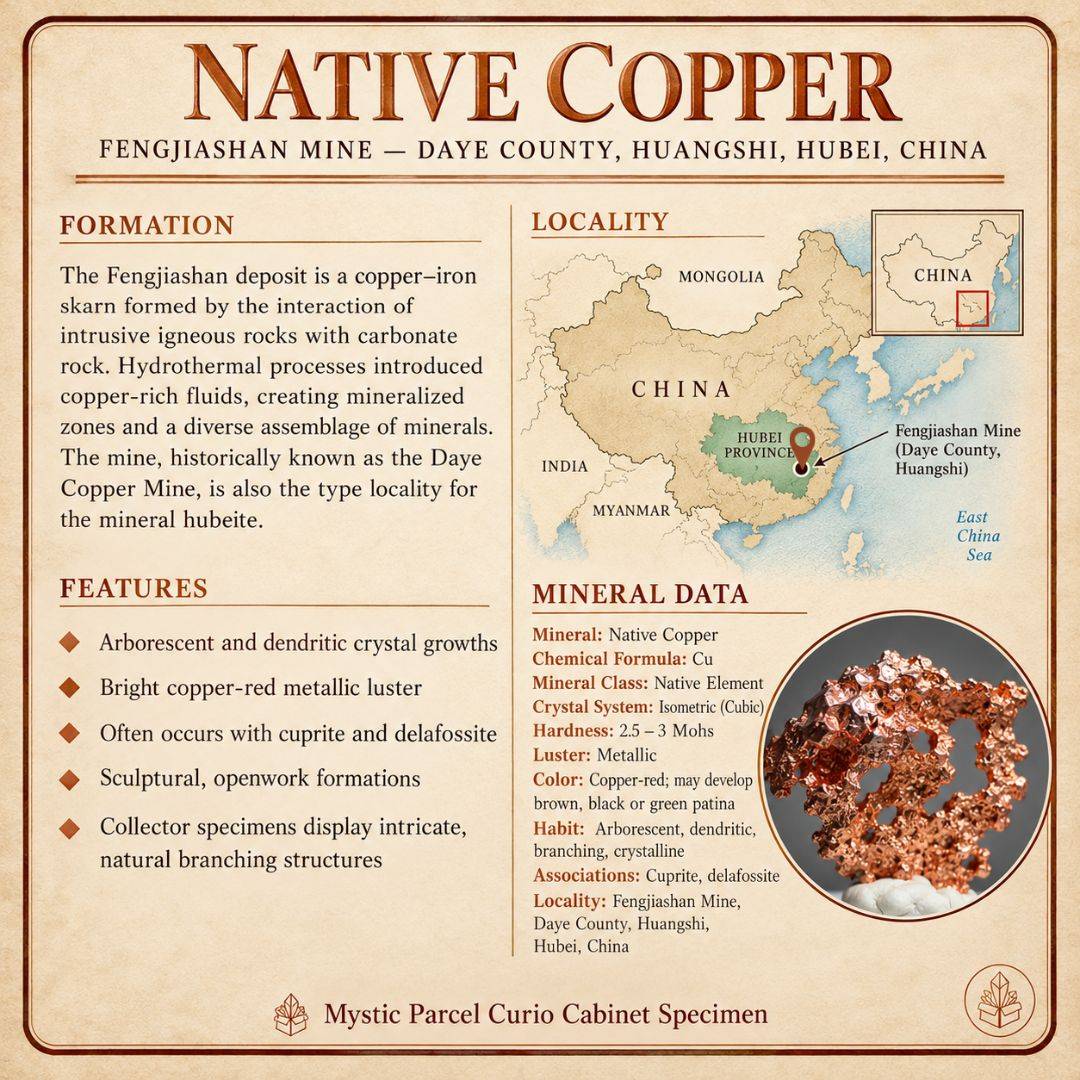
This Native Copper specimen from the Fengjiashan Mine in Hubei Province, China, features a naturally sculptural, openwork formation with branching metallic growth and a bright copper-red surface. Weighing 126g and measuring approximately 3.5 × 3.5 × 1.5 inches, this small cabinet specimen presents an intricate network of interconnected copper with openings that allow light to pass through the formation.
The specimen displays broad, irregular copper growths connected by narrower branching structures, creating an almost lace-like arrangement. Its granular, reflective surfaces catch the light at different angles, revealing a range of warm copper tones, subtle darker recesses, and natural surface textures. Both sides offer distinct views of the formation, while its narrow profile adds dimension to its sculptural character.
Native Copper is a naturally occurring form of elemental copper (Cu), recognized for its metallic luster, distinctive reddish color, and ability to form complex crystalline growths. This specimen comes from the historic Fengjiashan mining locality, known for its diverse copper-bearing mineral assemblages and unusual collector specimens.
Specimen Details
- Material: Native Copper (Cu)
- Locality: Fengjiashan Mine, Daye County, Huangshi, Hubei Province, China
- Formation: Arborescent and dendritic native copper growth with interconnected openwork structures
- Features: Branching metallic formations, irregular openings, textured crystalline surfaces, sculptural silhouette
- Color: Bright copper-red to reddish brown with darker recessed areas
- Finish: Naturally textured metallic surface
- Size: Approx. 3.5 × 3.5 × 1.5 in.
- Specimen Size: Small Cabinet
- Specimen Weight: 126g / approx. 4.44 oz
- With Base: Approx. 4.5 × 3.5 × 1.5 in. / 219g total
- Display: Clear acrylic display base included
- Selection: One-of-a-kind; exact specimen shown
Geological Notes
The Fengjiashan Mine, historically associated with the Daye Copper Mine, is located in Hubei Province in central China. The deposit is classified as a copper-iron skarn, formed through interactions between intrusive igneous rocks and carbonate-rich host rock. Hydrothermal fluids contributed to mineralization, producing a diverse assemblage of minerals within the deposit.
The mine is particularly significant to mineral collectors as the type locality for hubeite, a calcium-manganese-iron silicate mineral. Native Copper is among the minerals documented from Fengjiashan, along with copper-bearing species such as cuprite and delafossite. These associations reflect the geological diversity of the locality, although the presence of those additional minerals has not been established on this particular specimen.
Native Copper belongs to the native element mineral class and crystallizes in the isometric system. Its growth may produce branching, arborescent, and dendritic structures rather than readily recognizable geometric crystals. This specimen demonstrates that character through its interconnected metallic formations, irregular openings, and three-dimensional openwork appearance.
Mystic Parcel Notes
One of the things I find most fascinating about Native Copper is the way its natural formations spark the imagination. Much like finding recognizable figures in passing clouds, the eye begins to interpret the branching structures and open spaces as familiar shapes. Every person may see something different, and that is part of what makes these specimens so engaging. In this particular piece, I see a lion emerging from this copper formation.
Copper also holds a special place in Mystic Parcel's approach to intentional living. As a material, copper is an excellent conductor of electricity and heat, and I find that physical characteristic particularly meaningful in its symbolic role. Rather than associating copper with only one specific intention, I think of it as a conduit for all intentions—a connection between the purpose we consciously choose and the attention we bring to it.
For intention buyers, this specimen can serve as a visual reminder of creativity, connection, and the conscious direction of personal intentions. For collectors, its Fengjiashan locality, branching copper growth, metallic luster, and openwork structure make it an engaging small cabinet display specimen. Whether the viewer sees a lion, an abstract sculpture, or something entirely different, its natural formation invites a closer look.
What you'll receive
- One (1) Native Copper specimen from Fengjiashan Mine, Hubei, China — exact specimen shown
- One (1) clear acrylic display base, as pictured
- Mystic Parcel specimen identification card
How to use
- Display as a small cabinet mineral specimen in a Curio Cabinet, collector shelf, office, or personal space.
- Position where natural or indirect lighting can reveal its metallic texture and openwork structure.
- View from different angles to explore the recognizable figures suggested by its branching formations.
- Use as a symbolic focal point for setting intentions, creative reflection, or meditation.
- Pair with other native element specimens for a comparative mineral collection.
Care
- Handle carefully by the display base whenever possible. Branching copper formations may have delicate projections.
- Keep in a dry environment, away from prolonged humidity and direct contact with water.
- Dust gently with a soft, dry brush or microfiber cloth without applying pressure to the finer branches.
- Avoid salt, acids, abrasive cleaners, and polishing compounds.
- Native Copper may naturally darken or develop a patina over time as its surface reacts with the environment.
Notes: This is a natural, one-of-a-kind mineral specimen with irregular growth patterns, openings, surface textures, and possible natural contact points. The specimen is shown secured to its acrylic base with visible mounting material. Photos show the exact specimen you will receive. Crystal and intention practices are personal and symbolic and are not substitutes for professional advice.
To explore copper’s symbolic role as a conduit for intention, discover how this remarkable native element connects to the philosophy of Mystic Parcel in our article, Copper and Intentional Living.
| Specification | Details |
|---|---|
| Material | Native Copper (Cu) |
| Locality | Fengjiashan Mine, Daye County, Huangshi, Hubei Province, China |
| Weight | 126g (approx. 4.44 oz) |
| Size | Approx. 3.5 × 3.5 × 1.5 inches |
| Display Base Size | Approx. 4.5 × 3.5 × 1.5 inches |
| Total Weight with Base | 219g |
| Specimen Type | Small Cabinet Specimen |
| Finish | Naturally textured metallic surface |
| Features | Branching metallic formations with irregular openings and textured surfaces |
| Material | Description |
|---|---|
| Native Copper (Cu) | This specimen is made of native copper, known for its metallic luster and distinctive reddish hue. The intricate, branching formations of the copper showcase interconnected openwork structures that are characteristic of its natural growth. |
The Fengjiashan Mine, historically associated with the Daye Copper Mine, is located in Hubei Province in central China. The deposit is classified as a copper-iron skarn, formed through interactions between intrusive igneous rocks and carbonate-rich host rock. Hydrothermal fluids contributed to mineralization, producing a diverse assemblage of minerals within the deposit.
The mine is particularly significant to mineral collectors as the type locality for hubeite, a calcium-manganese-iron silicate mineral. Native Copper is among the minerals documented from Fengjiashan, along with copper-bearing species such as cuprite and delafossite. These associations reflect the geological diversity of the locality, although the presence of those additional minerals has not been established on this particular specimen.
Native Copper belongs to the native element mineral class and crystallizes in the isometric system. Its growth may produce branching, arborescent, and dendritic structures rather than readily recognizable geometric crystals. This specimen demonstrates that character through its interconnected metallic formations, irregular openings, and three-dimensional openwork appearance.
One of the things I find most fascinating about Native Copper is the way its natural formations spark the imagination. Much like finding recognizable figures in passing clouds, the eye begins to interpret the branching structures and open spaces as familiar shapes. Every person may see something different, and that is part of what makes these specimens so engaging. In this particular piece, I see a lion emerging from this copper formation.
Copper also holds a special place in Mystic Parcel's approach to intentional living. As a material, copper is an excellent conductor of electricity and heat, and I find that physical characteristic particularly meaningful in its symbolic role. Rather than associating copper with only one specific intention, I think of it as a conduit for all intentions—a connection between the purpose we consciously choose and the attention we bring to it.
For intention buyers, this specimen can serve as a visual reminder of creativity, connection, and the conscious direction of personal intentions. For collectors, its Fengjiashan locality, branching copper growth, metallic luster, and openwork structure make it an engaging small cabinet display specimen. Whether the viewer sees a lion, an abstract sculpture, or something entirely different, its natural formation invites a closer look.


