
Native Copper (26g) — Sculptural Branching | Hubei, China
Chinese Native Copper specimen from Hubei with compact branching growth, irregular crystalline projections, and bright copper-red metallic luster; approx. 26g / 1.5 × 1 × 1 in.
 Country of Origin | China
Couldn't load pickup availability
Estimated Delivery: …
What's included in your order?
 30-Days Returns
 Ethically Curated
 Authentic Minerals



Native Copper (26g) — Sculptural Branching | Hubei, China
Native Copper (26g) — Sculptural Branching, China
Copper connects. Intention directs. Action transforms.
This Native Copper specimen from Hubei Province, China, features a compact, naturally sculptural formation with branching metallic growth and bright copper-red coloration. Weighing 26g and measuring approximately 1.5 × 1 × 1 inches, this toenail specimen combines irregular crystalline masses with several prominent projections extending outward from its central structure. Its asymmetrical silhouette creates an interesting three-dimensional form that changes considerably when viewed from opposite sides.
The specimen displays textured copper surfaces with reflective metallic highlights, irregular crystalline edges, and variations in growth density. Its broader central formation extends into angular branches, while smaller projections and recessed areas provide additional surface detail. Bright copper-red coloration contrasts with darker reddish-brown areas and small gray-green patches visible near the lower portion of the specimen.
Native Copper is naturally occurring elemental copper (Cu), recognized for its characteristic reddish color, metallic luster, and ability to develop complex crystalline formations. This specimen comes from the historic Fengjiashan mining locality, known for its diverse copper-bearing mineral assemblages. It is presented in a medium protective perky box, allowing its compact branching structure to be displayed and examined from different angles.
Specimen Details
- Material: Native Copper (Cu)
- Locality: Fengjiashan Mine, Daye County, Huangshi, Hubei Province, China
- Formation: Irregular arborescent copper growth with interconnected crystalline masses and angular branching projections
- Features: Compact sculptural formation, outward-extending branches, textured metallic surfaces, contrasting growth structures
- Color: Bright copper-red to reddish brown with darker areas and minor gray-green surface patches
- Finish: Naturally textured metallic surface
- Size: Approx. 1.5 × 1 × 1 in.
- Specimen Size: Miniature
- Specimen Weight: 26g / approx. 0.92 oz
- With Perky: Approx. 2 × 2 × 2 in. / 58g total
- Display: Medium perky specimen box with clear protective cover
- Selection: One-of-a-kind; exact specimen shown
Geological Notes
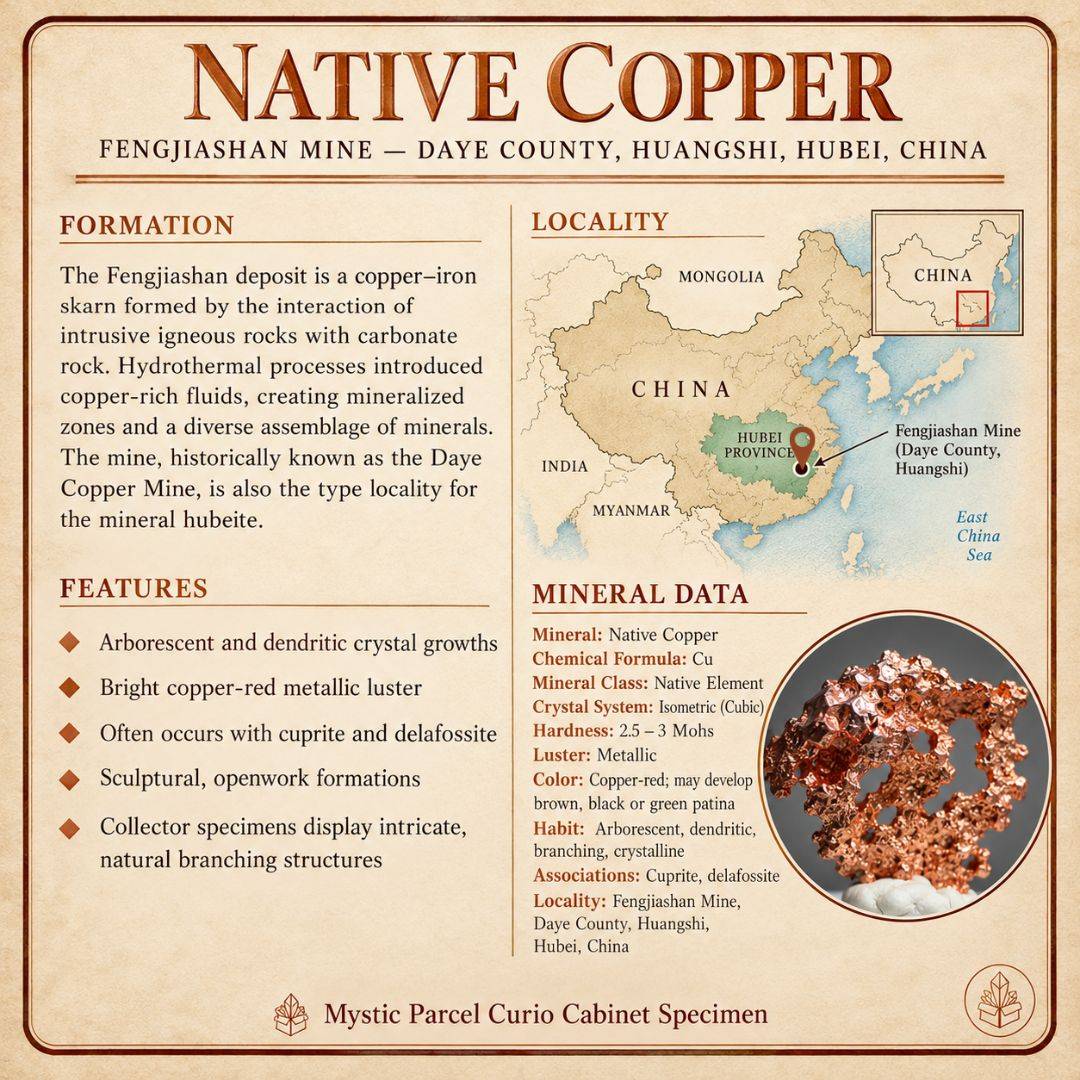
The Fengjiashan Mine in Hubei Province, China, is part of the historic Daye copper mining region. The deposit is classified as a copper-iron skarn, formed through interactions between intrusive igneous rocks and carbonate-rich host rocks. Hydrothermal processes introduced mineral-bearing fluids into the surrounding geological environment, contributing to copper-rich mineralized zones and a diverse assemblage of minerals.
Fengjiashan is particularly significant among mineral collectors as the type locality for hubeite, a calcium-manganese-iron silicate mineral first described from this deposit. The mine is also known for copper-bearing minerals including native copper, cuprite, and delafossite. These associations illustrate the geological diversity of the locality, although the identity of the darker mineral areas on this particular specimen has not been established.
Native Copper belongs to the native element mineral class and crystallizes in the isometric (cubic) crystal system, with a hardness of approximately 2.5–3 on the Mohs scale. Although copper can develop recognizable geometric crystals, it frequently occurs in branching, arborescent, and dendritic formations. This specimen demonstrates that natural variation through its irregular metallic masses, clustered crystalline growths, and outward-extending projections.
Mystic Parcel Notes
One of the things I find most fascinating about Native Copper is how its natural formations spark the imagination. Much like looking at clouds and discovering recognizable figures in their shapes, our eyes begin to interpret the copper's branching structures as something familiar. In this particular specimen, I see a fox, with its pointed ears, elongated snout, and irregular body taking shape in the copper's natural growth. The silhouette becomes especially interesting when viewed from different angles, as each side reveals an entirely different arrangement of forms.
Copper holds a special place in Mystic Parcel's philosophy of intentional living because I do not associate it with any single intention. As an exceptional physical conductor of electricity and heat, copper offers a meaningful symbolic connection to the idea of carrying and directing intention. I think of copper as a conduit for all intentions, representing the connection between our conscious purpose and the attention and actions we bring to it. Its role is not to define an intention but to symbolize the movement and connection through which we work toward it.
For intention buyers, this specimen can serve as a visual reminder of creativity, connection, and the conscious direction of personal intentions. Its fox-like silhouette also invites reflection on curiosity, observation, and the different perspectives through which we interpret the natural world. For collectors, its Fengjiashan locality, contrasting metallic textures, and compact branching formation make it an interesting toenail specimen for close examination and display.
What you'll receive
- One (1) Native Copper specimen from Fengjiashan Mine, Hubei, China — exact specimen shown
- One (1) medium perky specimen box with clear protective cover, approx. 2 × 2 × 2 inches
- Mystic Parcel specimen identification card
How to use
- Display in its protective perky box as part of a Curio Cabinet, mineral collection, bookshelf, or personal workspace.
- Position where indirect light can reveal the copper's reflective metallic surfaces and irregular crystalline textures.
- Observe from different angles to discover recognizable forms suggested by its natural branching structure.
- Use as a symbolic focal point for creative reflection, meditation, or setting personal intentions.
- Pair with other native element specimens or copper-bearing minerals for comparative collection and display.
Care
- Keep the specimen secured inside its protective perky box when possible to protect its irregular crystalline projections.
- Avoid prolonged humidity, water exposure, and damp storage conditions.
- Dust very gently with a soft, dry brush if necessary, avoiding pressure on delicate branching edges.
- Do not use salt, acids, abrasive cleaners, or polishing compounds.
- Native Copper may naturally darken or develop surface patina over time as it reacts with its environment.
Notes: This is a natural, one-of-a-kind mineral specimen with irregular crystalline growth, varied metallic textures, darker surface areas, and possible natural contact points. The specimen is shown secured within its perky box using visible mounting material. Photos show the exact specimen you will receive. Crystal and intention practices are symbolic and personal and are not substitutes for professional advice.
To explore copper's symbolic role as a conduit for intention, discover how this remarkable native element connects to the philosophy of Mystic Parcel in our article, Copper and Intentional Living.
| Specification | Details |
|---|---|
| Material | Native Copper (Cu) |
| Locality | Fengjiashan Mine, Daye County, Huangshi, Hubei Province, China |
| Formation | Arborescent native copper growth |
| Size | Approximately 1.5 × 1 × 1 inches |
| Weight | 26g / approximately 0.92 oz |
| Display Size | Approximately 2 × 2 × 2 inches (including Perky Box) |
| Total Weight (with Perky Box) | Approximately 58g |
| Specimen Type | Miniature |
| Material | Description |
|---|---|
| Native Copper | Unique reddish metallic element exhibiting intricate arborescent growth formations |
| Display Box | Sturdy medium perky box featuring a transparent cover, perfect for showcasing and protecting the specimen |
The Fengjiashan Mine in Hubei Province, China, is part of the historic Daye copper mining region. The deposit is classified as a copper-iron skarn, formed through interactions between intrusive igneous rocks and carbonate-rich host rocks. Hydrothermal processes introduced mineral-bearing fluids into the surrounding geological environment, contributing to the development of copper-rich mineralized zones.
Fengjiashan is particularly significant among mineral collectors as the type locality for hubeite, a calcium-manganese-iron silicate mineral first described from this deposit. The mine is also known for copper-bearing minerals including native copper, cuprite, and delafossite. These mineral associations illustrate the geological diversity of the locality, although additional minerals have not been identified on this particular specimen.
Native Copper belongs to the native element mineral class and crystallizes in the isometric (cubic) crystal system, with a hardness of approximately 2.5–3 on the Mohs scale. Its crystalline growth may produce recognizable geometric forms, but it can also develop branching, arborescent, and dendritic structures. This specimen displays that natural variation through its upright growth, interconnected copper masses, and irregular outward-projecting branches.
One of the things I find most fascinating about Native Copper is how its natural formations spark the imagination. Much like looking at clouds and discovering recognizable figures in their shapes, our eyes begin to interpret the copper's branching structures as something familiar. In this particular specimen, I see a fox, with its pointed ears, elongated snout, and irregular body taking shape in the copper's natural growth. The silhouette becomes especially interesting when viewed from different angles, as each side reveals an entirely different arrangement of forms.
Copper holds a special place in Mystic Parcel's philosophy of intentional living because I do not associate it with any single intention. As an exceptional physical conductor of electricity and heat, copper offers a meaningful symbolic connection to the idea of carrying and directing intention. I think of copper as a conduit for all intentions, representing the connection between our conscious purpose and the attention and actions we bring to it. Its role is not to define an intention but to symbolize the movement and connection through which we work toward it.
For intention buyers, this specimen can serve as a visual reminder of creativity, connection, and the conscious direction of personal intentions. Its fox-like silhouette also invites reflection on curiosity, observation, and the different perspectives through which we interpret the natural world. For collectors, its Fengjiashan locality, contrasting metallic textures, and compact branching formation make it an interesting toenail specimen for close examination and display.


