

Choosing Crystal Gifts for Beginners
Table of Contents
- Choosing Crystal Gifts for Beginners: Where to Start
- Best Crystals for Beginners: Stones That Rarely Miss
- Understanding Crystal Meanings for Beginners
- How to Choose a Crystal Gift When You Do Not Know Their Intentions
- Crystal Jewelry Gift Ideas and Other Forms Worth Giving
- Presentation, Packaging, and What to Include With a Crystal Gift
- Frequently Asked Questions
Last Updated: October 9, 2026
Choosing Crystal Gifts for Beginners: Where to Start
Choosing crystal gifts for beginners works best when you lead with the person, not the stone. A gift lands when the recipient can hold it, understand it, and find one simple way to use it.
Start with three simple questions:
- What is the occasion?
- How will the recipient use the crystal—carry it, wear it, or display it?
- Do you want to gift by intention, by form, or by visual appeal?
The best beginner crystal gifts are easy to understand, easy to live with, and easy to connect to. When the form fits the person, the gift feels thoughtful immediately.
Best Crystals for Beginners: Stones That Rarely Miss
The most beginner-friendly stones are quartz family minerals and iron-rich varieties: widely available, easy to identify, and forgiving of handling. Each has a clear traditional association and a distinct physical character.
Clear Quartz, Amethyst, and Rose Quartz
Clear Quartz is one of the easiest crystals to gift because it is recognizable, versatile, and beautiful in both natural and polished forms. Our Clear Quartz Point is a straightforward example; a polished palm stone suits someone who prefers a smooth surface.

Amethyst is quartz colored by iron and irradiation, typically forming in points, geodes, and clusters. Its traditional associations are calm, intuition, and rest, which is why it appears on so many nightstands.
Carnelian, Red Jasper, and Fluorite
Carnelian is a warm, energizing quartz variety that is easy to love as a first crystal. Tumbled Carnelian from Madagascar shows banding and translucence that vary piece to piece. Traditionally associated with courage and creative confidence, its smooth, tumbled form makes it practical to carry throughout the day.
Red Jasper is a chalcedony rich in iron, opaque and earthy, traditionally linked to grounding and steady effort. Fluorite stands apart from quartz varieties with its distinctive color zoning and is often chosen for focus and mental organization.
Stone |
Composition |
Traditional Association |
Beginner-Friendly Form |
|---|---|---|---|
Clear Quartz |
Silicon dioxide (SiO2) |
Clarity, amplification |
Point, palm stone |
Amethyst |
Quartz with iron coloration |
Calm, intuition, rest |
Geode cluster piece |
Rose Quartz |
Quartz with trace titanium or iron |
Compassion, self-acceptance |
Sphere, tumbled |
Carnelian |
Chalcedony with iron oxide |
Courage, creativity |
Tumbled stone |
Red Jasper |
Chalcedony rich in iron |
Grounding, steady strength |
Raw piece |
Fluorite |
Calcium fluoride |
Focus, mental organization |
Raw piece |
Understanding Crystal Meanings for Beginners
The meaning of a crystal is rooted in a combination of cultural history, traditional associations, and the mineral's natural physical properties. Its color, composition, crystal structure, and geological formation all contribute to its unique character and the ways people connect with it.
When selecting a crystal as a gift, consider both the stone's natural characteristics and the intentions traditionally associated with it. Amethyst, for example, is often associated with calm, intuition, and spiritual connection, making it a thoughtful gift for someone seeking greater peace or insight. Sharing the meaning behind your selection adds a personal dimension to the gift while allowing the recipient to develop their own relationship with the crystal.
How to Choose a Crystal Gift When You Do Not Know Their Intentions
When you do not know someone's intentions, choose by form and color rather than a specific outcome. Clear Quartz is the standard recommendation because it carries no single narrow association and pairs with whatever the recipient already owns.
A short decision path helps:
- Do they already own crystals? If yes, add a form they lack, such as a sphere or a raw specimen.
- Do they prefer objects they can use? Choose a palm stone or tumbled stone over a display piece.
- Is the gift for a milestone? A curated set supports a moment better than a single stone.
- Are they skeptical of metaphysical language? Lead with the mineral: origin, formation, color, and how it was cut or polished.
- Do you want to avoid a wrong guess entirely? A set that covers several stones gives them room to choose.
If you have an intention in mind but aren't sure which crystals to select, our Essential Crystal Mystery Box offers a thoughtful solution. You select an intention such as Clarity, Balance, or Insight, and the set arrives as five stones curated to work together, with an intention card and a personalized letter.

Crystal Jewelry Gift Ideas and Other Forms Worth Giving
Crystal jewelry is the most wearable option and solves the "where do I put this" problem: a beaded bracelet or pendant stays with the person rather than sitting on a shelf. Jewelry can be a beautiful option, but only when it suits the recipient’s personal style. If you are unsure, a display piece or palm stone is often the easier gift.
Specimen or Jewelry: Matching Form to Recipient
Specimens suit collectors and anyone who enjoys geology. Jewelry suits daily wearers. Tumbled stones suit pockets and pouches, palm stones suit meditation, and spheres suit a shelf or desk.
Form |
Best For |
Consideration |
|---|---|---|
Raw specimen |
Collectors, desk display |
Edges and matrix vary; not for pockets |
Tumbled stone |
Pockets, pouches, carrying |
Small and easy to start with |
Palm stone |
Meditation, hand-held use |
Smooth, substantial in the hand |
Point |
Altars, workspaces |
Terminated tip is more fragile |
Sphere |
Shelves, nightstands |
Heavier, rolls, needs a stand |
Jewelry |
Daily wear |
Requires knowing their style |
How to Recognize a Gift-Ready Piece
Quality in a crystal is several separate judgments, and they do not always move together.
Specimen grade vs. decorative grade. A specimen-grade piece is selected for what it shows about the mineral: sharp faces, defined terminations, visible growth patterns, often a labeled locality.
What to actually look at:
- Terminations. On a point, the tip should be intact and the faces should meet cleanly. A bruised or sheared tip is common in shipping and worth checking before you wrap it.
- Clarity and inclusions. For quartz-family stones, internal veils, phantoms, or rutile needles are normal and often desirable. A perfectly clear stone is not automatically better, just different.
- Color saturation and evenness. In Amethyst, deep even purple with visible crystal faces reads as higher grade than pale, washed-out color. In Fluorite, distinct color zoning is a feature, not a flaw.
- Treatments and dyes. Some stones are heat-treated, dyed, or coated to deepen color. This is common and not inherently dishonest, but it should be disclosed.
A practical rule for beginners: buy the best example of a modest stone rather than a poor example of a rare one.
Matching Form to a Milestone
For a milestone such as a graduation or career change, a themed set does more work than a single piece. Our Grounding Gift Set pairs a Shungite beaded bracelet with a Jasper sphere and wood stand, a UV reactive Petrified Wood piece from Hubbard Basin in Elko County, Nevada, a Tiger's Eye merkaba, and a Satin Spar Selenite barrel tumble, wearable, tactile, and display options in one box.
Presentation, Packaging, and What to Include With a Crystal Gift
Presentation is where a crystal gift reads as thoughtful or as an afterthought.
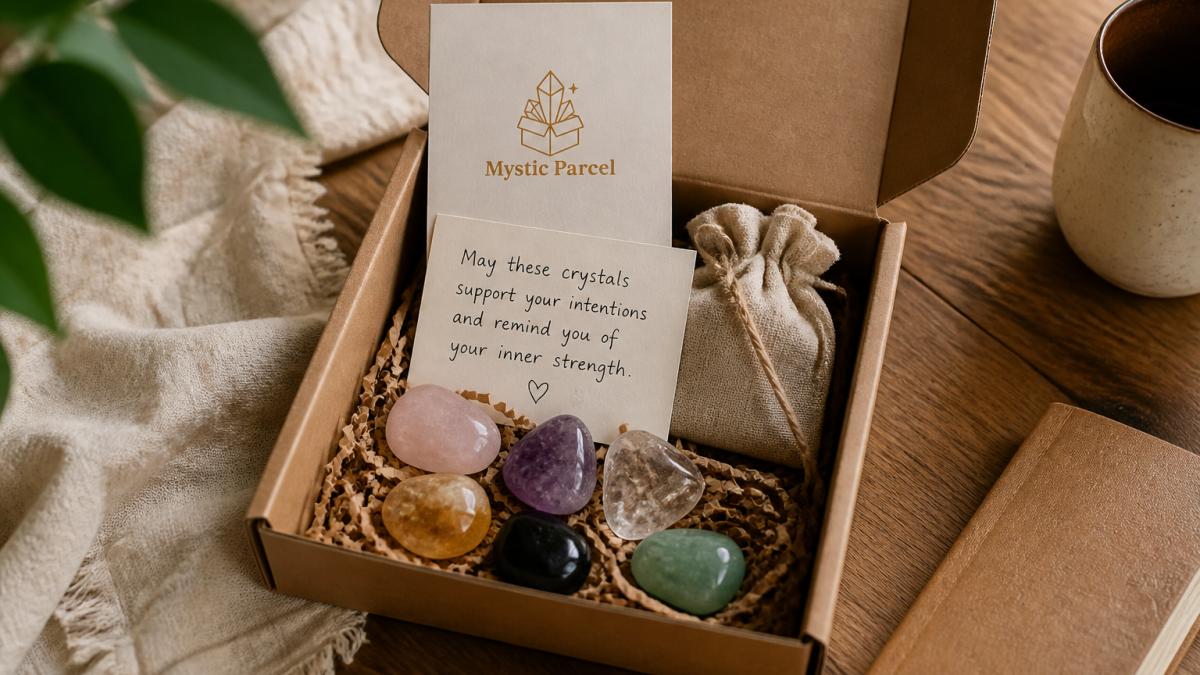
What to include:
- The stone's name and origin. "Carnelian, Madagascar" tells the recipient this was selected, not grabbed.
- One line on its traditional association. Keep it to a sentence.
- One suggested use. "Keep it on your desk" or "Hold it when you journal."
- Care instructions. Dry cloth, no harsh chemicals, keep out of prolonged sun.
Packaging should protect the stone first. Tumbled stones travel well in a small pouch; spheres and clusters need padding and, for a sphere, a stand so it does not roll.
For a set built around this idea, the Atlas Tumble Set: World arrives in a clear 3.5 by 2.5-inch acrylic collector case with a vintage atlas-inspired identification card listing five stones and their origins: Shungite from Russia, Shiva Lingam from India, Rutilated Quartz from Brazil, Malachite from DR Congo, and Kambaba Jasper from Madagascar.

Choosing a crystal gift for a beginner does not require expert knowledge. What matters most is thoughtfulness: selecting a stone or set that feels approachable, meaningful, and easy to live with. When you match the gift to the recipient’s style, intention, or season of life, even a simple piece can become something they return to often.
At Mystic Parcel, we approach crystal gifting through both beauty and intention—offering pieces that are geologically interesting, visually compelling, and thoughtfully selected for real use in daily life.
Frequently Asked Questions
How do you choose a crystal gift for someone new to crystals?
Start with the recipient's situation rather than the stone. A friend navigating a demanding season may appreciate grounding forms like Red Jasper or a Grounding Gift Set, while someone exploring self-reflection may respond to Amethyst or Rose Quartz. Choose a manageable form, such as a palm stone or small tumble, and include a note explaining why you selected it. Beginners benefit most from one clear piece with context rather than a large assortment they cannot interpret.
Which crystals are good gifts for beginners?
Clear Quartz, Amethyst, Rose Quartz, Carnelian, Red Jasper, and Fluorite are reliable starting points because they are widely recognized and easy to work with. Clear Quartz is the most adaptable since it pairs with any intention. Amethyst suits quiet reflection, Rose Quartz is often associated with compassion, and Carnelian with confidence. A curated set, such as the Essential Crystal Mystery Box, removes the guesswork by grouping stones around a single theme.
Should you choose a crystal based on its meaning or appearance?
Both matter, and they rarely conflict. Traditional associations give the gift a purpose, while color, form, and finish determine whether the recipient actually keeps it on a desk or nightstand. If you are unsure of someone's intentions, let appearance lead and choose a stone with broad traditional associations, such as Clear Quartz. If you know what they are working through, let meaning guide the selection and confirm the piece looks appealing in hand.
Is jewelry or a mineral specimen a better crystal gift for a beginner?
Jewelry suits someone who wants the stone with them throughout the day, while a specimen suits someone who prefers a piece for a desk, altar, or bedside table. A palm stone or tumbled stone bridges both: it is tactile, portable, and easy to hold during meditation or journaling. If the recipient wears little jewelry, a display piece is the safer choice. If they already wear bracelets or pendants daily, wearable grounding is a natural fit.


