

7 Grounding Stones for Busy Professionals at Work
Table of Contents
- Why Grounding Stones Fit a Working Day
-
Seven Grounding Stones for the Workday
- 1. Smoky Quartz: Grounding and Releasing Mental Clutter
- 2. Black Tourmaline: Protection and Personal Boundaries
- 3. Red Jasper: Endurance and Steady Progress
- 4. Hematite: Stability and Present-Moment Awareness
- 5. Petrified Wood: Patience and Long-Term Perspective
- 6. Garnet: Motivation and Renewed Purpose
- 7. Obsidian: Clarity and Self-Reflection
- Best Crystals for Office Desk Placement
- Choosing Grounding Stones for Your Workday
- Bringing Grounding Stones Into Your Workday
- Caring for Your Grounding Stones
- Grounding Begins With Intention
- Frequently Asked Questions
Last Updated: October 17, 2026
Why Grounding Stones Fit a Working Day
Between meetings, deadlines, emails, and competing responsibilities, the modern workday can leave little opportunity to reconnect with ourselves.
Grounding stones offer a simple way to bring intention into our daily routines. Whether displayed on a desk, carried in a pocket, or worn as jewelry, a thoughtfully chosen stone can become a personal reminder to pause, refocus, and approach the moment with greater awareness.
At Mystic Parcel, we believe intentional living doesn't require elaborate rituals. It begins with the conscious choices we make throughout our day.
For some, that might mean holding a smoky quartz palm stone before an important meeting. For others, it could be wearing a black tourmaline bracelet as a reminder to maintain personal boundaries or keeping a piece of petrified wood nearby as a symbol of patience and perspective.
The connection between a person and a stone is personal. What matters is the intention we associate with it and how we choose to incorporate that intention into our lives.
Understanding the Connection Between Minerals and Intention
Every natural mineral has a distinct geological identity, defined by its chemical composition, crystal structure, and formation history.
Smoky quartz develops its characteristic coloration through irradiation-related processes within its crystal structure. Hematite is an iron oxide recognized for its density and distinctive luster. Petrified wood preserves evidence of ancient trees through mineralization processes that can occur over millions of years.
These are measurable physical characteristics.
The spiritual meanings associated with minerals belong to a different tradition. Throughout various cultural and contemporary spiritual practices, stones have been associated with qualities such as protection, grounding, clarity, and renewal.
While scientific research has not established that crystals directly improve concentration, reduce stress, or influence emotional states through their mineral properties, their symbolic meanings can provide a personal framework for reflection and intentional practice.
Understanding this distinction allows us to appreciate minerals for both their natural characteristics and the personal significance we choose to give them.
Seven Grounding Stones for the Workday
Each of the following stones offers a different combination of geological characteristics and traditional spiritual associations.
There is no universally correct choice. Consider which qualities resonate with your intentions and how you would like to incorporate a stone into your professional environment.
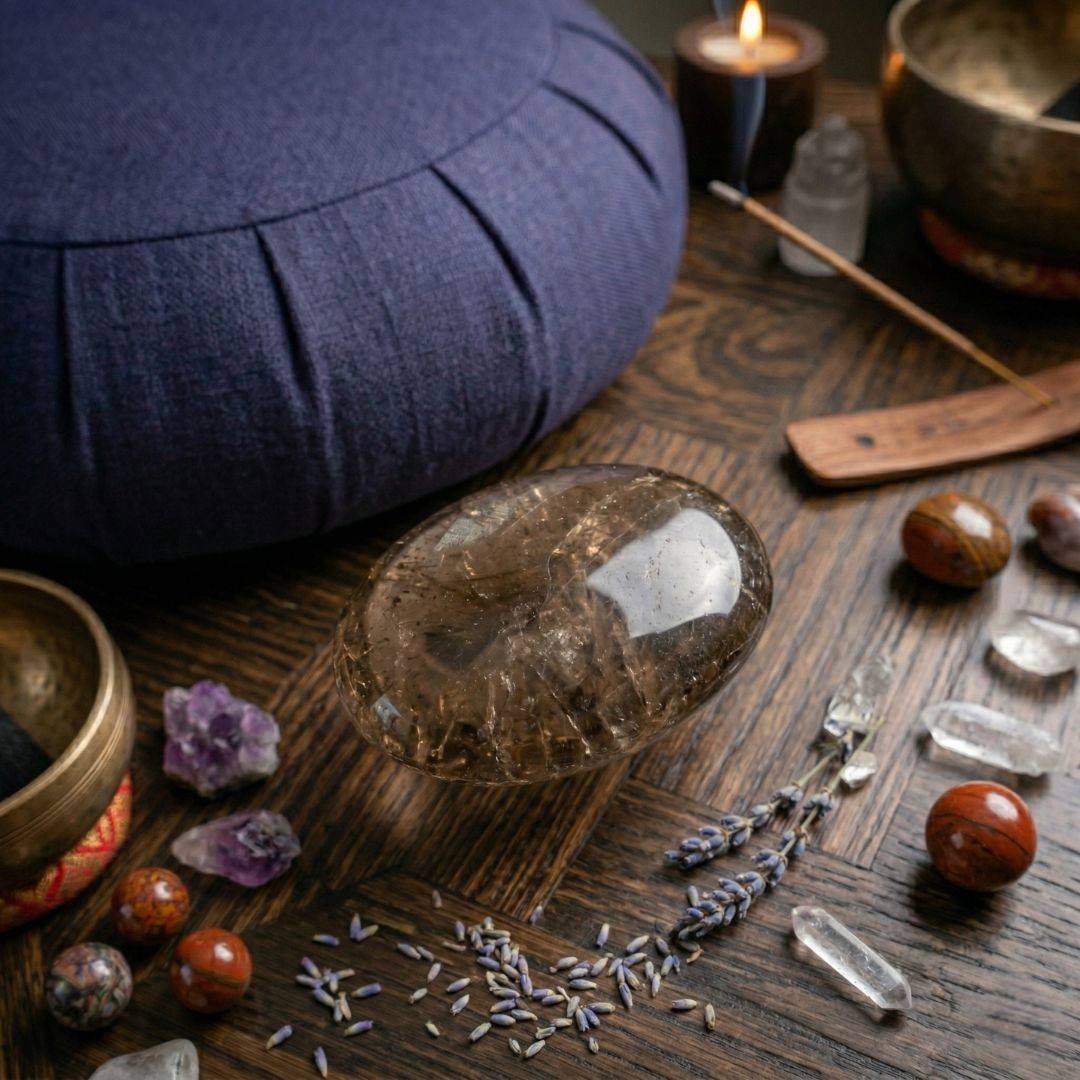
1. Smoky Quartz: Grounding and Releasing Mental Clutter
Smoky quartz is a variety of quartz distinguished by its translucent brown, gray, or nearly black coloration.
Its smoky appearance results from radiation-induced color centers associated with impurities, commonly aluminum, within the quartz crystal structure.
In contemporary crystal traditions, smoky quartz is associated with grounding, protection, and the release of negative energy.
These associations make it a popular choice for people seeking to bring greater awareness and balance into demanding routines.
During a busy workday, smoky quartz can symbolize the conscious decision to release distractions and return attention to what matters.
A polished Smoky Quartz Palm Stone can be kept near your workspace as a tactile reminder to pause before moving between responsibilities.
For those who prefer wearable crystals, a Smoky Quartz Bracelet offers a convenient way to carry that intention throughout the day.
Traditional associations: Grounding, protection, emotional balance, and release.
Workday intention: I release unnecessary distractions and remain grounded in the present moment.
2. Black Tourmaline: Protection and Personal Boundaries
Black tourmaline, commonly known as schorl, belongs to the tourmaline mineral group.
It is a complex boron-bearing silicate recognized for its dark coloration, distinctive longitudinal crystal striations, and vitreous to resinous luster.
In modern metaphysical traditions, black tourmaline is strongly associated with protection, grounding, and energetic boundaries.
For professionals navigating shared workspaces, demanding interactions, or environments that require constant engagement, these associations can serve as meaningful reminders of personal boundaries.
A Raw Black Tourmaline Specimen can become a distinctive addition to a desk or personal workspace.
Alternatively, a Black Tourmaline Palm Stone offers a smooth, portable option for those who prefer to carry their stones.
Rather than viewing the mineral as a physical barrier against external influences, consider its protective symbolism an invitation to approach interactions with intention and maintain healthy personal boundaries.
Traditional associations: Protection, grounding, stability, and energetic boundaries.
Workday intention: I remain centered in my own energy while respecting the boundaries of others.

3. Red Jasper: Endurance and Steady Progress
Red jasper is an opaque, microcrystalline variety of silica, generally classified as a form of chalcedony.
Its characteristic red coloration is typically associated with iron oxide minerals, particularly hematite.
Long valued as an ornamental stone, red jasper is traditionally associated with endurance, strength, stability, and determination.
These qualities make it a meaningful symbolic companion for long-term projects, demanding schedules, and professional goals that require persistence.
Unlike moments of immediate inspiration, sustained progress often depends on consistent effort over time.
Red jasper can represent that commitment to steady, intentional action.
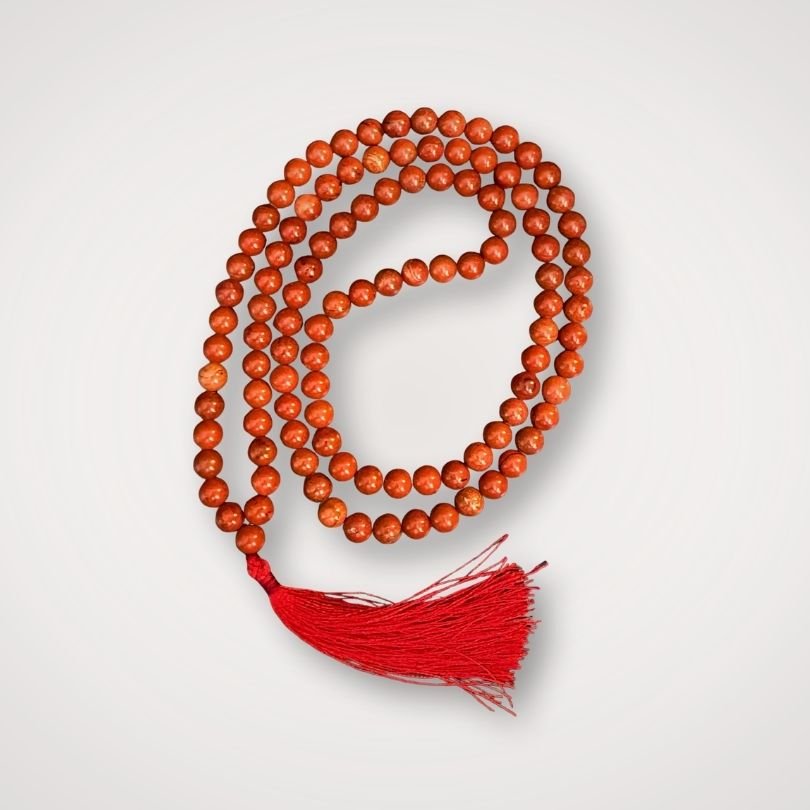
A raw Red Jasper piece offers a connection to the stone's natural appearance, while a Red Jasper Mala can be incorporated into meditation or other personal reflection practices.
Traditional associations: Endurance, strength, stability, courage, and determination.
Workday intention: I approach my responsibilities with patience, strength, and steady determination.
4. Hematite: Stability and Present-Moment Awareness
Hematite is an iron oxide mineral with the chemical formula Fe₂O₃.
Although commonly recognized for its metallic gray appearance, hematite can also occur in earthy red forms. Its characteristic red streak is one of its most useful identifying properties.
Hematite is traditionally associated with grounding, stability, protection, and balance.
Its relatively high density gives natural hematite a noticeable weight, making it particularly distinctive among commonly collected minerals.
In an intentional practice, hematite can symbolize stability during moments that demand careful consideration or clear decision-making.
For professionals who prefer an unobtrusive way to incorporate stones into their routine, wearable jewelry offers an alternative to desk specimens.
A 12 mm Hematite Beaded Bracelet can serve as a visible reminder to remain present and approach responsibilities deliberately.
Traditional associations: Grounding, stability, protection, and balance.
Workday intention: I remain steady, present, and confident in my decisions.Petrified Wood: Deep Time on a Desk
5. Petrified Wood: Patience and Long-Term Perspective
Petrified wood offers a particularly interesting connection between the natural world and the passage of time.
It forms when buried wood undergoes mineralization, often involving silica-rich groundwater. Minerals can fill pore spaces, replace original organic material, or both, preserving structures such as wood grain, growth rings, and cellular details.
Some specimens preserve remarkable evidence of trees that lived millions of years ago.
Unlike the other stones on this list, petrified wood is a fossil rather than a mineral species.
Its connection to ancient forests and geological time makes it a compelling symbol of patience, endurance, and transformation.
For professionals managing long-term projects, strategic planning, or periods of transition, petrified wood can offer a reminder that meaningful development often takes time.
A specimen displaying preserved wood grain or distinct patterns can become a thoughtful addition to a desk, bookshelf, or personal workspace.
Beyond its symbolic significance, petrified wood provides a tangible connection to Earth's natural history.
Traditional associations: Patience, stability, transformation, and ancestral wisdom.
Workday intention: I trust the process of growth and recognize the value of steady progress.
6. Garnet: Motivation and Renewed Purpose
Garnet refers to a group of closely related silicate minerals rather than a single mineral species.
Although garnets occur in many colors, including green, orange, purple, and yellow, deep red varieties such as almandine are among the most familiar.
Garnet has a long history of use in jewelry and decorative objects.
In contemporary spiritual traditions, red garnet is commonly associated with vitality, passion, motivation, and personal strength.
These associations make it a meaningful choice for professionals seeking to reconnect with their enthusiasm or maintain a sense of purpose in their work.
A small polished garnet or natural specimen can be kept in a pocket, displayed in a personal space, or incorporated into jewelry.
Its significance need not depend on size or rarity. A modest specimen can hold substantial personal meaning when chosen with intention.
Traditional associations: Vitality, motivation, passion, courage, and strength.
Workday intention: I approach my work with purpose, confidence, and renewed enthusiasm.
7. Obsidian: Clarity and Self-Reflection
Obsidian is a naturally occurring volcanic glass formed when silica-rich lava cools rapidly enough to prevent substantial crystal growth.
Because obsidian lacks the ordered crystalline structure of a mineral, it is classified as a mineraloid.
Its smooth, glassy appearance and characteristic conchoidal fracture distinguish it from crystalline stones.
In contemporary metaphysical traditions, black obsidian is associated with protection, truth, self-reflection, and clarity.
These symbolic associations can make obsidian particularly meaningful during periods of professional change or when facing important decisions.
Rather than representing certainty about an outcome, obsidian can serve as a reminder to examine circumstances thoughtfully and remain aware of personal motivations.
Polished obsidian is especially suitable for handling or display. Raw specimens may have sharp edges because of the material's glass-like fracture.
Traditional associations: Protection, clarity, truth, grounding, and self-reflection.
Workday intention: I approach decisions with clarity, honesty, and self-awareness.
Best Crystals for Office Desk Placement
Choosing crystals for an office desk involves more than deciding which mineral resonates with your intentions.
The size, shape, durability, and appearance of a specimen can all influence how comfortably it fits into your workspace.
Some people prefer a single statement specimen that becomes part of their office environment. Others enjoy a small arrangement of meaningful stones or a polished piece kept within easy reach.
Your choice should reflect both your personal preferences and your working conditions.
Raw Mineral Specimens
Raw specimens preserve more of a mineral's natural appearance, including original crystal faces, growth patterns, and associated minerals.
For collectors and mineral enthusiasts, these geological characteristics may be just as meaningful as a stone's traditional associations.
Black tourmaline, smoky quartz, and red jasper are examples of stones that can be displayed in natural forms.
Consider using a specimen stand, small tray, or protective base when appropriate, particularly for pieces with delicate crystal formations.
Polished Palm Stones
Palm stones are shaped and polished to create smooth surfaces that are comfortable to hold.
They are popular choices for intentional practices because their rounded forms are easy to handle.
A smoky quartz or black tourmaline palm stone can be kept in a desk drawer, beside a notebook, or in a small pouch for travel.
Because palm stones vary in shape, choose a stable location for display rather than assuming every piece will rest flat.
Crystal Jewelry
Crystal jewelry offers a practical alternative for professionals who prefer not to keep specimens in their workspace.
Bracelets can accompany you between meetings, during travel, or throughout a changing work schedule.
Smoky quartz, hematite, and red jasper are all available in wearable forms, allowing you to select a stone based on the intention you wish to cultivate.
There is no requirement to choose between displaying minerals and wearing them. Many people enjoy both.
Thoughtful Placement and Care
When displaying stones in a professional environment, consider the mineral's physical characteristics.
Some specimens have delicate crystal formations, while others may contain loose matrix material or surfaces that can be scratched.
Avoid placing fragile specimens where they might be knocked over. Keep minerals away from excessive heat, harsh cleaning products, and prolonged sunlight when their color or stability may be affected.
A dedicated display surface can help protect both the specimen and your furniture.
For shared workspaces, portable pieces may offer greater convenience, but personal preference should guide your arrangement.
Choosing Grounding Stones for Your Workday
The best grounding stone for your professional environment is the one that resonates with your personal intentions.
Traditional crystal associations can provide a starting point, but they are not fixed rules.
The following comparison illustrates how the seven stones can be incorporated into different aspects of professional life.
Grounding Stone |
Traditional Associations |
Suggested Workday Intention |
Display or Use |
|---|---|---|---|
Smoky Quartz |
Grounding, protection, release |
Releasing distractions and remaining present |
Palm stone, bracelet, or specimen |
Black Tourmaline |
Protection, stability, boundaries |
Maintaining personal boundaries |
Raw specimen or palm stone |
Red Jasper |
Endurance, strength, determination |
Sustaining long-term effort |
Rough stone, polished piece, or mala |
Hematite |
Stability, grounding, balance |
Remaining centered during decisions |
Bracelet or polished stone |
Petrified Wood |
Patience, transformation, perspective |
Remembering the value of long-term growth |
Display specimen |
Garnet |
Vitality, motivation, passion |
Reconnecting with purpose |
Small specimen, polished stone, or jewelry |
Obsidian |
Protection, clarity, self-reflection |
Approaching decisions thoughtfully |
Polished specimen or palm stone |
These suggestions are not prescriptions. You may find that the symbolism of one stone speaks to an intention different from its most commonly cited associations.
That personal connection is an important part of intentional living.
Bringing Grounding Stones Into Your Workday
Working with crystals does not require a prescribed ritual or a particular level of spiritual practice.
Some people enjoy meditation, energetic cleansing, and carefully arranged crystal displays. Others prefer incorporating a single meaningful stone into an existing daily routine.
Both approaches can be expressions of intentional living.
The important consideration is choosing a practice that reflects your beliefs, preferences, and circumstances.

Begin the Day With an Intention
Before opening your laptop or reviewing your schedule, take a moment to consider how you want to approach the day.
You might choose patience, confidence, focus, or balance.
Holding a stone associated with that quality can provide a physical reminder of your intention.
For example, red jasper might represent determination before beginning a demanding project, while smoky quartz could symbolize the intention to remain grounded throughout a busy schedule.
Create a Moment of Awareness Before Meetings
Important conversations often benefit from a deliberate approach.
Before entering a meeting, consider the qualities you want to bring into the interaction.
A piece of hematite might symbolize stability, while black tourmaline could represent maintaining healthy personal boundaries.
The stone does not determine the outcome of the conversation. Its significance comes from the intention you associate with it.
Mark the Transition Between Work and Personal Time
For professionals with demanding schedules, the transition away from work can be an important opportunity to reconnect with personal priorities.
A stone kept near your workspace or carried during the commute can become part of a simple transition practice.
You might pause to acknowledge what you accomplished, recognize what can wait until tomorrow, and consciously redirect your attention toward your personal life.
This practice can be as simple or elaborate as you choose.
Create a Personal Space for Reflection
For those who enjoy working with several stones, a small crystal arrangement can reflect multiple intentions.
You might combine smoky quartz for grounding, garnet for motivation, and petrified wood for patience.
Others may prefer a single mineral specimen selected for its beauty, geological significance, or personal symbolism.
There is no prescribed arrangement.
At Mystic Parcel, we believe the value of an intentional practice comes from the awareness and meaning you bring to it.
For a deeper exploration of this philosophy, read Beyond the Wish: Awakening the Power of Intention.
Caring for Your Grounding Stones
Proper mineral care begins with understanding that different stones have different physical properties.
Although many common grounding stones are relatively durable, their composition and surface characteristics should guide cleaning and handling.
Quartz and jasper: These silica-based materials are generally durable, but natural fractures, inclusions, and associated minerals can affect individual specimens.
Black tourmaline: Schorl has good hardness, but its crystals can fracture or chip, particularly around thin terminations or damaged surfaces.
Hematite: Natural hematite should be kept dry during routine care, as moisture may contribute to surface alteration under some conditions.
Petrified wood: Durability varies depending on mineral composition, preservation, and the presence of fractures or porous areas.
Obsidian: Because it is natural glass, obsidian can chip and develop sharp edges. Handle raw or damaged specimens carefully.
For most specimens, gentle dusting with a soft brush or cloth is a sensible starting point.
Avoid prolonged soaking or harsh chemical cleaners unless you understand the mineral's specific care requirements.
What About Energetic Cleansing?
Energetic cleansing is a personal spiritual practice distinct from physical mineral cleaning.
Some traditions incorporate smoke, sound, moonlight, visualization, or intention as part of a cleansing ritual.
These practices reflect spiritual beliefs rather than scientifically established changes to a mineral's properties.
If energetic cleansing is part of your practice, choose methods that are compatible with your specimen's physical characteristics.
Water and prolonged sunlight are not appropriate for every mineral.
Grounding Begins With Intention
The demands of professional life can make it easy to move from one responsibility to another without taking time to reconnect with ourselves.
Grounding stones offer a tangible connection to the natural world and an opportunity to bring greater awareness into our daily routines.
Whether you are drawn to the protective symbolism of black tourmaline, the steadying associations of smoky quartz, or the ancient history preserved in petrified wood, choosing a stone is a personal experience.
Its geological identity tells us something about the natural processes that created it. Its traditional associations offer a framework for exploring meaning.
The intention we bring to it is uniquely our own.
At Mystic Parcel, we believe the most meaningful crystal is not necessarily the rarest, largest, or most elaborate. It is the one that resonates with your intention and reminds you to carry that intention into everyday life.
Frequently Asked Questions
What crystal is best for focus and productivity at work?
Smoky quartz, red jasper, and hematite are traditionally associated with qualities that can support an intentional approach to professional life. Smoky quartz represents grounding and the release of distractions, red jasper symbolizes endurance and sustained determination, and hematite is associated with stability and present-moment awareness. While scientific research has not established that crystals directly improve concentration or productivity, a personally meaningful stone can serve as a tangible reminder to approach responsibilities with focus and intention.
Which grounding stones should I keep on my office desk?
Smoky quartz, black tourmaline, red jasper, and petrified wood are all suitable options, depending on the size and condition of the specimen. Polished stones are convenient for handling, while raw mineral specimens can provide additional geological and visual interest. Choose a piece that reflects your intentions and fits comfortably within your workspace.
How can I use a grounding stone during a difficult meeting?
Before a meeting, take a moment to identify the quality you want to bring into the conversation. You might choose patience, confidence, clarity, or understanding. Holding a polished stone or wearing a meaningful bracelet can provide a physical reminder of that intention. The practice is personal and does not depend on a particular mineral producing a measurable psychological effect.
What is the difference between smoky quartz and black tourmaline?
Smoky quartz is a variety of quartz composed of silicon dioxide, SiO₂. Its characteristic smoky coloration results from radiation-related changes involving defects and impurities within the crystal structure. Black tourmaline, or schorl, is a complex boron-bearing silicate mineral recognized for its dark color and longitudinal crystal striations. In contemporary metaphysical traditions, smoky quartz is commonly associated with grounding and release, while black tourmaline is associated with protection and personal boundaries.
Can grounding stones protect against electromagnetic radiation from computers?
There is no reliable scientific evidence that simply placing grounding stones near computers protects users from electromagnetic radiation. Black tourmaline and shungite are sometimes promoted for this purpose, but claims about protection should not be confused with their actual physical properties. A stone may hold personal symbolic meaning in a technology-focused workspace, but it should not be considered a substitute for evidence-based safety measures.
Do I need to cleanse my grounding stones regularly?
There is no mineralogical requirement for energetic cleansing. Physical cleaning should be based on the mineral's composition, condition, and environment. Energetic cleansing, however, is a personal spiritual practice. Some people incorporate it regularly, while others do not. If you choose to cleanse your stones, select a method that respects both your personal beliefs and the material's physical properties.
Can I use more than one grounding stone at work?
Yes. Some people enjoy combining stones associated with complementary intentions, such as smoky quartz for grounding, garnet for motivation, and black tourmaline for protection. Others prefer working with one stone at a time. There is no universally prescribed number or combination. The choice should reflect your personal intentions, preferences, and relationship with the minerals.


