
Grape Agate Cluster from Indonesia — 374g
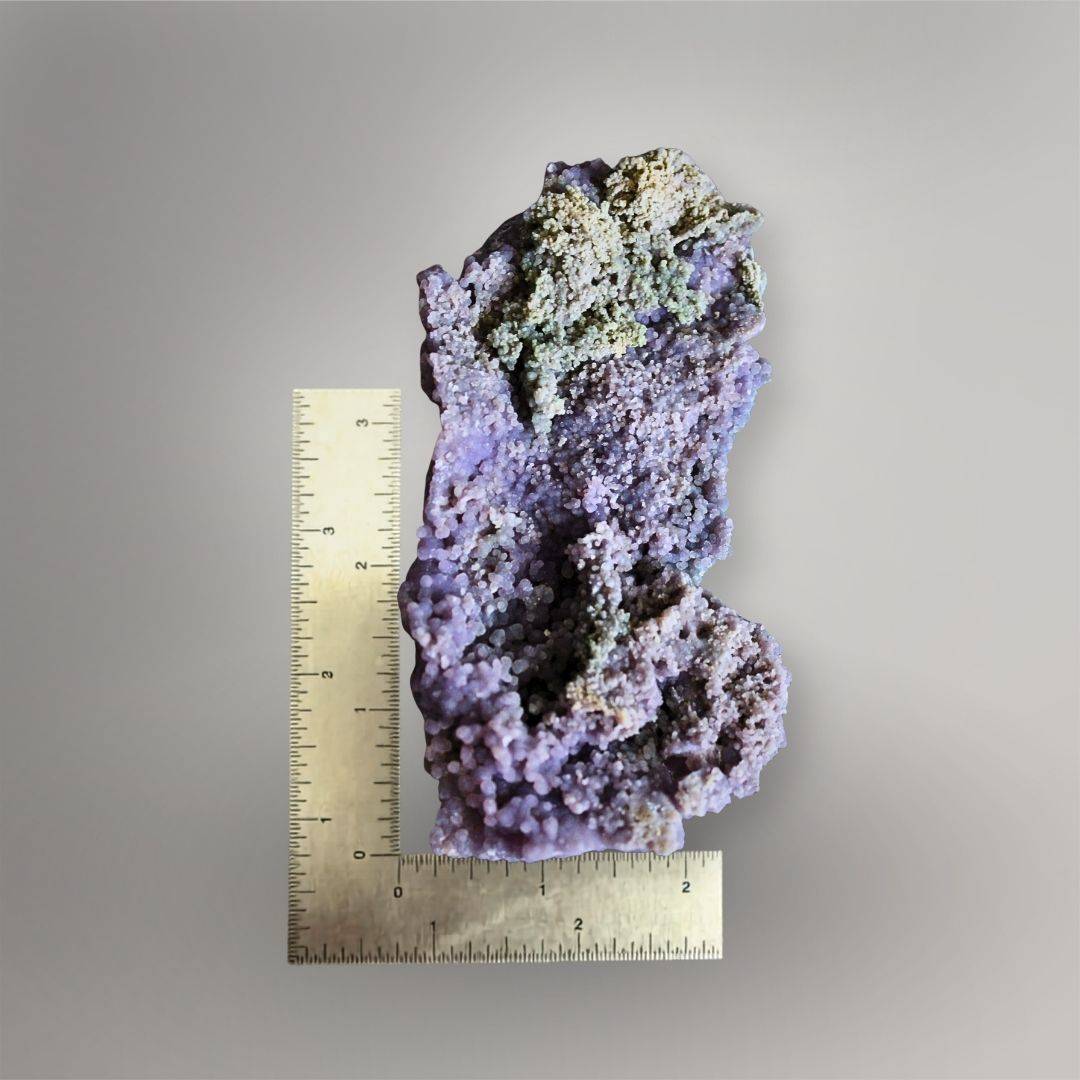
A wide cabinet specimen with dense lavender grape-like growth, scalloped ridges, open pockets, and pale green contrast — 374g | 5.8 × 3.1 × 1.3 in.
 Chakra | Crown and Third Eye
 Primary Intention | Awakening
 Country of Origin | Indonesia


Couldn't load pickup availability
Estimated Delivery: …
What's included in your order?
 30-Days Returns
 Ethically Curated
 Authentic Minerals



Grape Agate Cluster from Indonesia — 374g
Grape Agate Cluster from Indonesia — 374g
Growth, Awakening, Integration
One-of-a-kind Grape Agate specimen from Mamuju Regency, West Sulawesi, Indonesia, featuring a wide field of pink-lavender amethystine quartz. Dense rounded spherulites cover the primary display face, rising into sculptural ridges and curling around natural pockets within the formation.
The specimen’s color moves between soft lilac, pale violet, gray-purple, and blush-toned lavender. Small cream and muted blue-green areas provide contrast, while subtle crystalline overgrowth catches direct light across portions of the rounded surface.
At approximately 5.8 inches long, this is the widest specimen in the group. Its relatively shallow depth gives it the presence of a cabinet-size mineral plate, but the clustered ridges, folds, and recessed spaces create substantial three-dimensional structure across the face.
Specimen Details
- Material: Botryoidal quartz with amethystine coloration — trade name Grape Agate
- Locality: Mamuju Regency, West Sulawesi, Indonesia — historically traded as Manakarra quartz
- Formation: Connected quartz spherulites formed within clay-filled spaces associated with weathered volcanic pillow lava
- Features: Wide horizontal profile, dense rounded growth, scalloped ridges, open pockets, drusy texture, and pale green mineral areas
- Color: Lavender, pink-lilac, pale violet, gray-purple, cream, and muted blue-green tones
- Finish: Natural and unpolished
- Size: Approx. 5.8 × 3.1 × 1.3 in. / 147 × 78 × 32 mm
- Specimen Size: Cabinet
- Weight: 374g / 13.2 oz.
- Display: Display block shown in photographs is not included
- Selection: Exact specimen shown
Geological Notes
Grape Agate is the trade name for the grape-like aggregates of quartz found in West Sulawesi. Although it is widely marketed as an agate, it lacks the internal chalcedony banding required for a mineralogical classification as true agate.
The rounded formations are quartz spherulites. Each developed through radial crystal growth around a central point. When large numbers formed close together, their surfaces met and joined into the connected botryoidal clusters seen across this specimen.
The purple color is amethystine and is associated with iron-related color centers in quartz. The same fundamental coloration system is responsible for amethyst, although here it occurs in rounded aggregates rather than large prismatic crystals.
The material occurs in clay-filled spaces associated with weathered Miocene pillow lavas in Mamuju Regency. These volcanic rocks cooled beneath water, creating rounded pillow-like masses separated by irregular openings and channels.
Hydrothermal alteration of silica-rich volcanic glass is believed to have produced magnesium- and calcium-rich clay while supplying silica to circulating fluids. Quartz later precipitated as radial spherulites within these clay-filled spaces. Pale green and blue-green areas are associated with clay-mineral inclusions or coatings within the formation.
The specimen’s wide, comparatively thin structure resembles a mineralized section of the original pocket wall. Dense growth covers the broad front, while the narrow sides reveal folded layers, internal openings, and places where the quartz developed around the irregular boundaries of the pocket.
Mystic Parcel Notes
This specimen was selected for Mystic Parcel because of its unusually broad presentation and dense coverage. From the principal viewing angle, lavender spheres form a nearly continuous landscape across the piece, gathering into high rounded ridges and falling away into shadowed pockets.
The rounded formations vary noticeably in scale. Fine spheres create a textured foundation, while larger pink-lilac clusters project outward along the ridges and edges. The effect feels organic and fluid despite the specimen’s shallow, plate-like structure.
The side views reveal more of the formation story. Thin mineral layers curve around deep pockets, and pale cream to blue-green material remains visible where the purple quartz growth was less complete.
Energetically, Grape Agate is often connected with growth, awakening, and integration. The wide field of joined spheres suggests expansion through connection: many separate centers developing together until they become part of one larger form.
For collectors, this is a strong cabinet specimen with an impressive horizontal span, extensive botryoidal coverage, and visible volcanic-pocket architecture. For intention buyers, its broad silhouette creates a calm but substantial anchor for a shelf, workspace, or reflective setting.
What you’ll receive
- One (1) 374g Grape Agate quartz specimen from Mamuju Regency, West Sulawesi, Indonesia — exact specimen shown
- Mystic Parcel specimen identification card
The display block used in the photographs is a styling prop and is not included.
How to use
- Display horizontally on a stable specimen stand, museum putty, padded shelf, or secure cabinet support.
- Use the broad clustered face as the primary viewing side to emphasize the dense lavender growth and sculptural ridges.
- Position with angled light to reveal the fine crystalline sparkle and shadows within the recessed pockets.
- Rotate periodically to examine the narrow layered sides and pale clay-associated mineral areas.
- Use as a visual anchor for growth, awakening, connection, or integration work.
Care
- Quartz is relatively durable, but the thin pocket walls, projecting spheres, and scalloped edges may be delicate.
- Support the specimen across its broader underside when lifting it and avoid pressure on the narrow ends.
- Remove dust with a clean air bulb or very soft dry brush.
- If rinsing is required, use cool low-pressure water briefly and allow the specimen to dry fully.
- Avoid prolonged soaking, ultrasonic cleaning, harsh chemicals, salt, abrasive scrubbing, and sudden temperature changes.
- Do not scrub pale green or cream areas, which may be softer or more friable than the quartz.
Notes: This is a natural mineral specimen and may show clay-associated mineral areas, cavities, thin pocket walls, uneven edges, inclusions, color variation, crystalline texture, and delicate formation points. The display block shown in the photographs is not included. Photos show the exact specimen you will receive. Crystal use is complementary to and not a substitute for professional advice.
Natural mineral layers, cavities, clay-associated areas, inclusions, color variation, crystalline texture, and formation lines are part of this specimen’s origin and character.
Grape Agate Cluster from Indonesia — 335g
Clarity, Growth, Balance
One-of-a-kind Grape Agate specimen from Mamuju Regency, West Sulawesi, Indonesia, featuring dense lavender amethystine quartz across a broad and highly dimensional formation. Rounded spherulites gather across the primary display face, producing the clustered appearance for which this unusual Indonesian quartz is known.
The lavender surface is interrupted by a cool blue-green zone near the upper center, with additional cream, gray, and pale lilac detail appearing around the edges and reverse. Closely grouped spheres alternate with smoother mineral surfaces, layered ledges, and recessed cavities, giving the specimen significant textural variation.
Measuring approximately 4.7 inches across and 2.3 inches deep, this is a substantial small cabinet specimen with visual interest on every side. The broad face emphasizes the rounded quartz growth, while the reverse exposes more of the layered pocket architecture and natural spaces within the formation.
Specimen Details
- Material: Amethystine botryoidal quartz — trade name Grape Agate
- Locality: Mamuju Regency, West Sulawesi, Indonesia — historically traded as Manakarra quartz
- Formation: Radial quartz spherulites formed within clay-filled spaces associated with weathered volcanic pillow lava
- Features: Broad clustered face, dense rounded growth, pale blue-green center, layered pocket walls, recessed cavities, and fine crystalline texture
- Color: Lavender, lilac, pale violet, icy blue-green, cream, and gray tones
- Finish: Natural and unpolished
- Size: Approx. 4.7 × 3.9 × 2.3 in. / 119 × 98 × 58 mm
- Specimen Size: Small cabinet
- Weight: 335g / 11.8 oz.
- Display: Display block shown in photographs is not included
- Selection: Exact specimen shown
Geological Notes
Grape Agate is the commercial name for aggregates of spheroidal quartz found in West Sulawesi. Despite the familiar trade name, the material is not a true agate because it lacks the internal chalcedony banding that defines mineralogical agate.
Each rounded structure is a quartz spherulite composed of fine crystals arranged radially around a growth center. Where many spherulites formed close together, they contacted and joined one another, creating the botryoidal, grape-like clusters visible across the specimen.
The purple portions are amethystine quartz. Their coloration is associated with iron-related color centers in quartz, comparable to the mechanism responsible for amethyst coloration. Here, that color is expressed through rounded spherulitic growth rather than conventional prismatic crystal points.
The deposits occur in clay-filled spaces associated with weathered Miocene pillow lavas in Mamuju Regency. These intermediate volcanic rocks formed beneath water, where rapidly cooled lava developed rounded pillow-like masses with irregular spaces between them.
The current formation model proposes that alteration of silica-rich volcanic glass produced clay within these spaces while releasing silica into circulating fluids. Quartz later precipitated as radial spherulites within and along the clay-filled pockets. The pale blue-green portions of the material are associated with magnesium- and calcium-rich clay-mineral inclusions rather than simply representing a continuation of the purple color zoning.
This specimen preserves several parts of that formation environment. Dense lavender spheres dominate the principal face, while the reverse reveals pale crystalline surfaces, overlapping pocket walls, and recessed spaces around the original growth structure.
Mystic Parcel Notes
This specimen was selected for Mystic Parcel because it combines strong grape-like quartz coverage with an unusually visible pocket structure. The primary display face presents a broad field of lavender spheres, while the central blue-green area creates a cool contrast within the otherwise amethystine palette.
The reverse has a more geological character. Pale layers fold around cavities and narrow openings, showing where quartz developed over and around the irregular surfaces within the mineralized pocket. These structures make the piece especially rewarding to examine from above and from both sides.
Its form feels broad and grounded rather than upright or delicate. The specimen has enough depth to hold visual weight in a Curio Cabinet while remaining compact enough for a desk, shelf, or meditation space.
Energetically, Grape Agate is often associated with clarity, growth, and balance. The joined spheres suggest that development does not occur in isolation: many individual points of change can gather into one stable and connected whole.
For collectors, this is a dimensional small cabinet specimen with strong botryoidal coverage, contrasting clay-associated color, and visible pocket architecture. For intention buyers, its broad form and quiet lavender palette make it a steady visual anchor for reflection and gradual growth.
What you’ll receive
- One (1) 335g Grape Agate quartz specimen from Mamuju Regency, West Sulawesi, Indonesia — exact specimen shown
- Mystic Parcel specimen identification card
The display block used in the photographs is a styling prop and is not included.
How to use
- Display on a stable shelf, specimen stand, museum putty, or padded support appropriate to its irregular natural base.
- Position the broad lavender face forward to emphasize the dense rounded growth and blue-green central accent.
- Rotate periodically to view the layered reverse, recessed cavities, and changing mineral textures.
- Use as a visual anchor for clarity, balance, gradual growth, or reflective intention work.
- Pair with amethyst, quartz, botryoidal minerals, or volcanic-pocket specimens for a formation-focused display.
Care
- Quartz is relatively durable, but individual spheres, layered edges, and natural attachment points may be delicate.
- Support the broader body of the specimen when lifting it rather than grasping projecting formations.
- Remove loose dust with a clean air bulb or very soft dry brush.
- If rinsing is necessary, use a brief low-pressure rinse with cool water and allow the specimen to dry completely.
- Avoid prolonged soaking, ultrasonic cleaning, harsh chemicals, salt, abrasive scrubbing, and sudden temperature changes.
- Pale clay-associated areas may be more friable than the quartz and should not be scrubbed.
Notes: This is a natural mineral specimen and may show clay-associated mineral areas, cavities, inclusions, uneven surfaces, color variation, crystalline texture, and delicate formation points. The display block shown in the photographs is not included. Photos show the exact specimen you will receive. Crystal use is complementary to and not a substitute for professional advice.
Natural mineral layers, cavities, clay-associated areas, inclusions, color variation, crystalline texture, and formation lines are part of this specimen’s origin and character.
| Specification | Detail |
|---|---|
| Material | Botryoidal Amethystine Quartz (Grape Agate) |
| Origin | Mamuju Regency, West Sulawesi, Indonesia |
| Size | Approximately 5.8 × 3.1 × 1.3 in. / 147 × 78 × 32 mm |
| Weight | 374g / 13.2 oz. |
| Finish | Natural and unpolished |
| Features | Distinctive sculptural ridges, vibrant layered spherulites, exquisite drusy texture, and unique clay-mineral inclusions |
| Material | Description |
|---|---|
| Amethystine Quartz | Commonly referred to as Grape Agate, this unique material displays a mesmerizing array of interwoven spheroidal quartz aggregates, renowned for their delicate crystalline textures. |
| Color Palette | Exhibits a stunning combination of lavender, lilac, soft violet, gray, cream, and subtle tan shades intricately woven within the matrix. |
Grape Agate from Mamuju Regency occurs in mineralized clay-filled spaces within a weathered Miocene submarine pillow-lava sequence. The pillow lavas formed when volcanic material cooled rapidly beneath water, leaving irregular voids and channels between neighboring masses.
Silica released during hydrothermal alteration later precipitated as radial quartz spherulites within these clay-filled spaces. Where the spheres grew close together, they joined into broad clusters; where the pocket remained open, cavities and recessed mineral-lined surfaces were preserved.
The specimen’s wide, relatively thin form resembles a section removed from one of these mineralized pocket walls. Dense botryoidal growth covers the front, while side views reveal layered ridges, interior openings, and pale clay-associated mineral material.
This specimen was selected for its exceptional width and nearly continuous coverage of lavender quartz spheres. The front reads like a panoramic mineral landscape, with high clustered ridges separated by recessed pockets and winding channels.
The pale pink-lilac areas soften the deeper violet background, while small green and cream zones preserve evidence of the clay-associated material within the original volcanic pocket.
Energetically, Grape Agate is often connected with growth, awakening, and integration. The specimen’s broad field of interconnected spheres gives it a strong sense of many individual developments becoming part of one larger structure.
Grape Agate Cluster from Indonesia — 374g
Growth, Awakening, Integration
One-of-a-kind Grape Agate specimen from Mamuju Regency, West Sulawesi, Indonesia, featuring a wide field of pink-lavender amethystine quartz. Dense rounded spherulites cover the primary display face, rising into sculptural ridges and curling around natural pockets within the formation.
The specimen’s color moves between soft lilac, pale violet, gray-purple, and blush-toned lavender. Small cream and muted blue-green areas provide contrast, while subtle crystalline overgrowth catches direct light across portions of the rounded surface.
At approximately 5.8 inches long, this is the widest specimen in the group. Its relatively shallow depth gives it the presence of a cabinet-size mineral plate, but the clustered ridges, folds, and recessed spaces create substantial three-dimensional structure across the face.
Specimen Details
- Material: Botryoidal quartz with amethystine coloration — trade name Grape Agate
- Locality: Mamuju Regency, West Sulawesi, Indonesia — historically traded as Manakarra quartz
- Formation: Connected quartz spherulites formed within clay-filled spaces associated with weathered volcanic pillow lava
- Features: Wide horizontal profile, dense rounded growth, scalloped ridges, open pockets, drusy texture, and pale green mineral areas
- Color: Lavender, pink-lilac, pale violet, gray-purple, cream, and muted blue-green tones
- Finish: Natural and unpolished
- Size: Approx. 5.8 × 3.1 × 1.3 in. / 147 × 78 × 32 mm
- Specimen Size: Cabinet
- Weight: 374g / 13.2 oz.
- Display: Display block shown in photographs is not included
- Selection: Exact specimen shown
Geological Notes
Grape Agate is the trade name for the grape-like aggregates of quartz found in West Sulawesi. Although it is widely marketed as an agate, it lacks the internal chalcedony banding required for a mineralogical classification as true agate.
The rounded formations are quartz spherulites. Each developed through radial crystal growth around a central point. When large numbers formed close together, their surfaces met and joined into the connected botryoidal clusters seen across this specimen.
The purple color is amethystine and is associated with iron-related color centers in quartz. The same fundamental coloration system is responsible for amethyst, although here it occurs in rounded aggregates rather than large prismatic crystals.
The material occurs in clay-filled spaces associated with weathered Miocene pillow lavas in Mamuju Regency. These volcanic rocks cooled beneath water, creating rounded pillow-like masses separated by irregular openings and channels.
Hydrothermal alteration of silica-rich volcanic glass is believed to have produced magnesium- and calcium-rich clay while supplying silica to circulating fluids. Quartz later precipitated as radial spherulites within these clay-filled spaces. Pale green and blue-green areas are associated with clay-mineral inclusions or coatings within the formation.
The specimen’s wide, comparatively thin structure resembles a mineralized section of the original pocket wall. Dense growth covers the broad front, while the narrow sides reveal folded layers, internal openings, and places where the quartz developed around the irregular boundaries of the pocket.
Mystic Parcel Notes
This specimen was selected for Mystic Parcel because of its unusually broad presentation and dense coverage. From the principal viewing angle, lavender spheres form a nearly continuous landscape across the piece, gathering into high rounded ridges and falling away into shadowed pockets.
The rounded formations vary noticeably in scale. Fine spheres create a textured foundation, while larger pink-lilac clusters project outward along the ridges and edges. The effect feels organic and fluid despite the specimen’s shallow, plate-like structure.
The side views reveal more of the formation story. Thin mineral layers curve around deep pockets, and pale cream to blue-green material remains visible where the purple quartz growth was less complete.
Energetically, Grape Agate is often connected with growth, awakening, and integration. The wide field of joined spheres suggests expansion through connection: many separate centers developing together until they become part of one larger form.
For collectors, this is a strong cabinet specimen with an impressive horizontal span, extensive botryoidal coverage, and visible volcanic-pocket architecture. For intention buyers, its broad silhouette creates a calm but substantial anchor for a shelf, workspace, or reflective setting.
What you’ll receive
- One (1) 374g Grape Agate quartz specimen from Mamuju Regency, West Sulawesi, Indonesia — exact specimen shown
- Mystic Parcel specimen identification card
The display block used in the photographs is a styling prop and is not included.
How to use
- Display horizontally on a stable specimen stand, museum putty, padded shelf, or secure cabinet support.
- Use the broad clustered face as the primary viewing side to emphasize the dense lavender growth and sculptural ridges.
- Position with angled light to reveal the fine crystalline sparkle and shadows within the recessed pockets.
- Rotate periodically to examine the narrow layered sides and pale clay-associated mineral areas.
- Use as a visual anchor for growth, awakening, connection, or integration work.
Care
- Quartz is relatively durable, but the thin pocket walls, projecting spheres, and scalloped edges may be delicate.
- Support the specimen across its broader underside when lifting it and avoid pressure on the narrow ends.
- Remove dust with a clean air bulb or very soft dry brush.
- If rinsing is required, use cool low-pressure water briefly and allow the specimen to dry fully.
- Avoid prolonged soaking, ultrasonic cleaning, harsh chemicals, salt, abrasive scrubbing, and sudden temperature changes.
- Do not scrub pale green or cream areas, which may be softer or more friable than the quartz.
Notes: This is a natural mineral specimen and may show clay-associated mineral areas, cavities, thin pocket walls, uneven edges, inclusions, color variation, crystalline texture, and delicate formation points. The display block shown in the photographs is not included. Photos show the exact specimen you will receive. Crystal use is complementary to and not a substitute for professional advice.
Natural mineral layers, cavities, clay-associated areas, inclusions, color variation, crystalline texture, and formation lines are part of this specimen’s origin and character.
Grape Agate Cluster from Indonesia — 335g
Clarity, Growth, Balance
One-of-a-kind Grape Agate specimen from Mamuju Regency, West Sulawesi, Indonesia, featuring dense lavender amethystine quartz across a broad and highly dimensional formation. Rounded spherulites gather across the primary display face, producing the clustered appearance for which this unusual Indonesian quartz is known.
The lavender surface is interrupted by a cool blue-green zone near the upper center, with additional cream, gray, and pale lilac detail appearing around the edges and reverse. Closely grouped spheres alternate with smoother mineral surfaces, layered ledges, and recessed cavities, giving the specimen significant textural variation.
Measuring approximately 4.7 inches across and 2.3 inches deep, this is a substantial small cabinet specimen with visual interest on every side. The broad face emphasizes the rounded quartz growth, while the reverse exposes more of the layered pocket architecture and natural spaces within the formation.
Specimen Details
- Material: Amethystine botryoidal quartz — trade name Grape Agate
- Locality: Mamuju Regency, West Sulawesi, Indonesia — historically traded as Manakarra quartz
- Formation: Radial quartz spherulites formed within clay-filled spaces associated with weathered volcanic pillow lava
- Features: Broad clustered face, dense rounded growth, pale blue-green center, layered pocket walls, recessed cavities, and fine crystalline texture
- Color: Lavender, lilac, pale violet, icy blue-green, cream, and gray tones
- Finish: Natural and unpolished
- Size: Approx. 4.7 × 3.9 × 2.3 in. / 119 × 98 × 58 mm
- Specimen Size: Small cabinet
- Weight: 335g / 11.8 oz.
- Display: Display block shown in photographs is not included
- Selection: Exact specimen shown
Geological Notes
Grape Agate is the commercial name for aggregates of spheroidal quartz found in West Sulawesi. Despite the familiar trade name, the material is not a true agate because it lacks the internal chalcedony banding that defines mineralogical agate.
Each rounded structure is a quartz spherulite composed of fine crystals arranged radially around a growth center. Where many spherulites formed close together, they contacted and joined one another, creating the botryoidal, grape-like clusters visible across the specimen.
The purple portions are amethystine quartz. Their coloration is associated with iron-related color centers in quartz, comparable to the mechanism responsible for amethyst coloration. Here, that color is expressed through rounded spherulitic growth rather than conventional prismatic crystal points.
The deposits occur in clay-filled spaces associated with weathered Miocene pillow lavas in Mamuju Regency. These intermediate volcanic rocks formed beneath water, where rapidly cooled lava developed rounded pillow-like masses with irregular spaces between them.
The current formation model proposes that alteration of silica-rich volcanic glass produced clay within these spaces while releasing silica into circulating fluids. Quartz later precipitated as radial spherulites within and along the clay-filled pockets. The pale blue-green portions of the material are associated with magnesium- and calcium-rich clay-mineral inclusions rather than simply representing a continuation of the purple color zoning.
This specimen preserves several parts of that formation environment. Dense lavender spheres dominate the principal face, while the reverse reveals pale crystalline surfaces, overlapping pocket walls, and recessed spaces around the original growth structure.
Mystic Parcel Notes
This specimen was selected for Mystic Parcel because it combines strong grape-like quartz coverage with an unusually visible pocket structure. The primary display face presents a broad field of lavender spheres, while the central blue-green area creates a cool contrast within the otherwise amethystine palette.
The reverse has a more geological character. Pale layers fold around cavities and narrow openings, showing where quartz developed over and around the irregular surfaces within the mineralized pocket. These structures make the piece especially rewarding to examine from above and from both sides.
Its form feels broad and grounded rather than upright or delicate. The specimen has enough depth to hold visual weight in a Curio Cabinet while remaining compact enough for a desk, shelf, or meditation space.
Energetically, Grape Agate is often associated with clarity, growth, and balance. The joined spheres suggest that development does not occur in isolation: many individual points of change can gather into one stable and connected whole.
For collectors, this is a dimensional small cabinet specimen with strong botryoidal coverage, contrasting clay-associated color, and visible pocket architecture. For intention buyers, its broad form and quiet lavender palette make it a steady visual anchor for reflection and gradual growth.
What you’ll receive
- One (1) 335g Grape Agate quartz specimen from Mamuju Regency, West Sulawesi, Indonesia — exact specimen shown
- Mystic Parcel specimen identification card
The display block used in the photographs is a styling prop and is not included.
How to use
- Display on a stable shelf, specimen stand, museum putty, or padded support appropriate to its irregular natural base.
- Position the broad lavender face forward to emphasize the dense rounded growth and blue-green central accent.
- Rotate periodically to view the layered reverse, recessed cavities, and changing mineral textures.
- Use as a visual anchor for clarity, balance, gradual growth, or reflective intention work.
- Pair with amethyst, quartz, botryoidal minerals, or volcanic-pocket specimens for a formation-focused display.
Care
- Quartz is relatively durable, but individual spheres, layered edges, and natural attachment points may be delicate.
- Support the broader body of the specimen when lifting it rather than grasping projecting formations.
- Remove loose dust with a clean air bulb or very soft dry brush.
- If rinsing is necessary, use a brief low-pressure rinse with cool water and allow the specimen to dry completely.
- Avoid prolonged soaking, ultrasonic cleaning, harsh chemicals, salt, abrasive scrubbing, and sudden temperature changes.
- Pale clay-associated areas may be more friable than the quartz and should not be scrubbed.
Notes: This is a natural mineral specimen and may show clay-associated mineral areas, cavities, inclusions, uneven surfaces, color variation, crystalline texture, and delicate formation points. The display block shown in the photographs is not included. Photos show the exact specimen you will receive. Crystal use is complementary to and not a substitute for professional advice.
Natural mineral layers, cavities, clay-associated areas, inclusions, color variation, crystalline texture, and formation lines are part of this specimen’s origin and character.
| Specification | Detail |
|---|---|
| Material | Botryoidal Amethystine Quartz (Grape Agate) |
| Origin | Mamuju Regency, West Sulawesi, Indonesia |
| Size | Approximately 5.8 × 3.1 × 1.3 in. / 147 × 78 × 32 mm |
| Weight | 374g / 13.2 oz. |
| Finish | Natural and unpolished |
| Features | Distinctive sculptural ridges, vibrant layered spherulites, exquisite drusy texture, and unique clay-mineral inclusions |
| Material | Description |
|---|---|
| Amethystine Quartz | Commonly referred to as Grape Agate, this unique material displays a mesmerizing array of interwoven spheroidal quartz aggregates, renowned for their delicate crystalline textures. |
| Color Palette | Exhibits a stunning combination of lavender, lilac, soft violet, gray, cream, and subtle tan shades intricately woven within the matrix. |
Grape Agate from Mamuju Regency occurs in mineralized clay-filled spaces within a weathered Miocene submarine pillow-lava sequence. The pillow lavas formed when volcanic material cooled rapidly beneath water, leaving irregular voids and channels between neighboring masses.
Silica released during hydrothermal alteration later precipitated as radial quartz spherulites within these clay-filled spaces. Where the spheres grew close together, they joined into broad clusters; where the pocket remained open, cavities and recessed mineral-lined surfaces were preserved.
The specimen’s wide, relatively thin form resembles a section removed from one of these mineralized pocket walls. Dense botryoidal growth covers the front, while side views reveal layered ridges, interior openings, and pale clay-associated mineral material.
This specimen was selected for its exceptional width and nearly continuous coverage of lavender quartz spheres. The front reads like a panoramic mineral landscape, with high clustered ridges separated by recessed pockets and winding channels.
The pale pink-lilac areas soften the deeper violet background, while small green and cream zones preserve evidence of the clay-associated material within the original volcanic pocket.
Energetically, Grape Agate is often connected with growth, awakening, and integration. The specimen’s broad field of interconnected spheres gives it a strong sense of many individual developments becoming part of one larger structure.
- 5 stars: 1 (100%)
- 4 stars: 0 (0%)
- 3 stars: 0 (0%)
- 2 stars: 0 (0%)
- 1 star: 0 (0%)
I couldn’t be happier with my experience with Mystic Parcel! I purchased a prasiolite crystal, and it’s absolutely beautiful. The color and clarity are even better than I expected, and it has such a calming, peaceful energy. I was also impressed by how quickly my order arrived. Everything was packaged with so much care and thoughtfulness, making the whole experience feel special from the moment I opened the box. If you’re looking for high-quality crystals and excellent customer service, I highly recommend Mystic Parcel. I’ll definitely be ordering from them again!


