
Malawi Agate Pair — Vibrant Multi-color Bands, Malawi
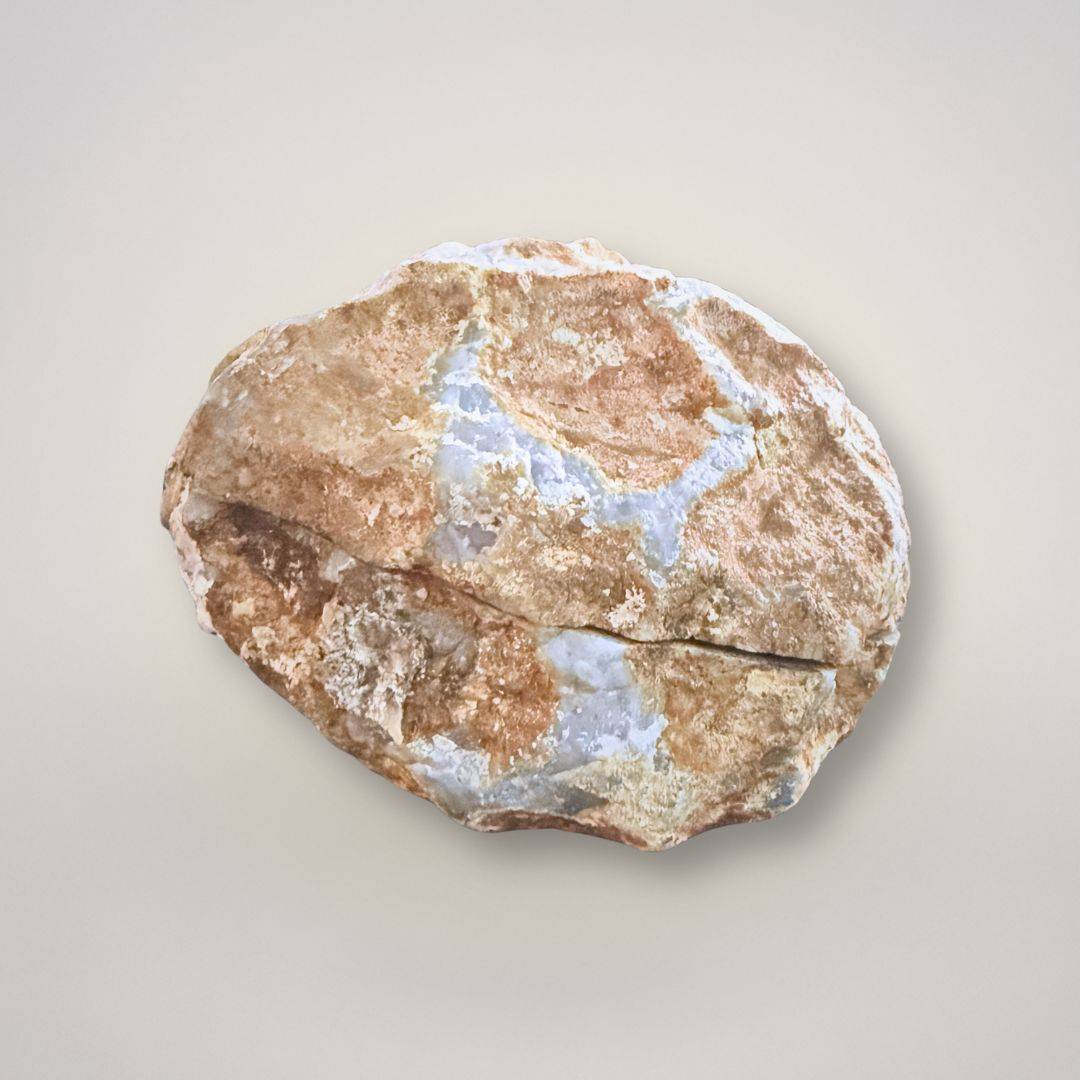
Cut and polished agate nodule sections from the Ngabu area of Malawi with mirrored fortification banding in vibrant multicolor layers, with a small internal druzy pocket; from a nodule measuring approx. 3.5 x 2.8 x 2.5 in. / 490g.
 Chakra | Root
 Primary Intention | Grounding
 Country of Origin | Malawi


Couldn't load pickup availability
Estimated Delivery: …
What's included in your order?
 30-Days Returns
 Ethically Curated
 Authentic Minerals



Malawi Agate Pair — Vibrant Multi-color Bands, Malawi
Malawi Agate Pair — Vibrant Multicolor Banded Nodule Sections
Curio Cabinet • Collector Agate • Natural Art • Display Pair
This Malawi Agate pair from the Ngabu area of Malawi presents two cut and polished sections of a single agate nodule, displayed as a matched pair. The polished faces reveal mirrored fortification banding in vibrant multicolor layers, shifting through blue-gray, cream, amber, red-orange, and warm earthy tones. Across the surface, the bands interlock in a way that reads almost like a woven textile, giving the piece an unusually rich visual rhythm.
The pair has strong collector presence because the relationship between the two halves is immediately visible. Each section shows the interior architecture of the original nodule, while the preserved natural rind frames the polished faces with rough exterior texture. Within the interior, a small amethyst-lined druzy pocket containing calcite formation adds an additional layer of mineral interest — an uncommon feature in Malawi agate, visible on close inspection. The result is a specimen that feels both geological and artistic — a record of natural formation presented as a display pair.
This particular pair was selected for The Curio Cabinet because of its vivid color contrast, mirrored structure, and unusually lively fortification banding. Rather than being defined by a single dominant color, the piece is strongest as a multicolor agate composition, with layered patterning that rewards close viewing.
Specimen Details
- Material: Malawi Agate
- Locality: Ngabu area, Malawi
- Formation: Cut and polished sections of one agate nodule, presented as a matched pair
- Features: Mirrored fortification banding, preserved natural rind, small amethyst druzy pocket with calcite
- Color: Blue-gray, cream, amber, red-orange, earthy tan, and violet tones
- Finish: Polished faces with natural exterior edges preserved
- Size: Approx. 3.54 × 2.76 × 2.52 in. / 90 × 70 × 64 mm — full nodule
- Specimen Size: Small cabinet / display pair
- Weight: 490g / 1 lb
- Source: Agate Bay / Josh Ritter
- Selection: Exact specimen shown
Geological Notes
Agate is a banded variety of chalcedony, a microcrystalline form of quartz. It forms when silica-rich fluids deposit successive layers of chalcedony within cavities, openings, or irregular spaces in host rock. Over time, repeated mineral deposition creates the banded structures visible when the stone is cut and polished.
This Malawi Agate pair shows fortification-style banding, a pattern named for its angular, layered structure that can resemble the outline of defensive walls or nested geometric forms. In this specimen, the banding is especially vivid, with multiple color zones moving across the polished faces rather than presenting as a simple two-tone agate.
The preserved outer rind shows the natural exterior of the original nodule, while the polished interior reveals the layered chalcedony, amethyst, and calcite structure inside. Because this piece has been cut into two related sections, the mirrored relationship between the halves remains part of its visual and geological appeal.
Mystic Parcel Notes
This pair was chosen for Mystic Parcel because it has the presence of natural art: a single agate nodule opened to reveal a vibrant, mirrored interior. The multicolor banding gives the piece more movement than a typical blue-gray or neutral agate, with warm and cool tones crossing through the polished faces in tightly layered bands.
The visual character of this specimen is unusually textile-like. The banding does not simply radiate outward; it builds in dense, interlocking layers that can read almost like a woven or knitted pattern when viewed up close. That quality makes the pair especially compelling as a Curio Cabinet display piece.
For collectors, this specimen stands out for its locality, matched presentation, preserved rind, and vibrant fortification banding. For display, the pair works beautifully on stands, in a cabinet, or as part of a curated mineral arrangement where both halves can be viewed together.
What you’ll receive
- One (1) Malawi Agate matched pair from the Ngabu area of Malawi — exact pair shown
- Mystic Parcel specimen identification card
How to use
- Display as a Curio Cabinet agate specimen pair.
- Place both sections together to show the mirrored relationship of the original nodule.
- Style on specimen stands, in a collector cabinet, or as a natural art object.
- Use as a focal piece in a mineral display where color, pattern, and locality are important.
- View from multiple angles to appreciate both the polished banding and preserved natural rind.
Care
- Agate is a durable quartz-family material, but polished faces can still scratch, chip, or lose luster if handled roughly.
- Handle both sections carefully and avoid dropping or striking the edges.
- Dust gently with a soft dry cloth or microfiber cloth.
- Avoid harsh chemical cleaners, acids, abrasives, and prolonged direct sunlight.
- Display securely on stable stands or a flat surface where the pieces will not shift or fall.
Notes: This is a natural agate specimen and may show natural rind texture, color zoning, small surface variations, polish differences, and formation-related features. Photos show the exact matched pair you will receive.
| Specification | Value |
|---|---|
| Dimensions | 3.54 x 2.76 x 2.52 in (90 x 70 x 64 mm) - full nodule |
| Weight | 1 lb (490 g) - full nodule |
| Origin | Ngabu area, Malawi |
| Specimen Size | Small cabinet / display pair |
| Color | Vibrant multicolor banding with blue-gray, cream, amber, red-orange, and earthy tonal zoning |
| Form | Cut and polished sections of one agate nodule, presented as a matched pair |
| Structure | Mirrored fortification banding with preserved natural rind |
| Finish | Polished faces with natural exterior edges |
| Source | Josh Ritter / Agate Bay |
| Chemical Composition | Agate / Chalcedony — SiO₂ |
| Material | Description |
|---|---|
| Malawi Agate | A beautiful banded variety of chalcedony, showcasing vivid multicolor layers formed through the deposition of silica-rich fluids. |
| Amethyst | An additional mineral layer, featured as a small druzy pocket, adding unique visual interest to the agate specimen. |
| Calcite | Present within the druzy pocket, contributing to the mineral complexity of the agate pair. |
Geological Notes
Agate is a banded variety of chalcedony, a microcrystalline form of quartz. It forms when silica-rich fluids deposit successive layers of chalcedony within cavities, openings, or irregular spaces in host rock. Over time, repeated mineral deposition creates the banded structures visible when the stone is cut and polished.
This Malawi Agate pair shows fortification-style banding, a pattern named for its angular, layered structure that can resemble the outline of defensive walls or nested geometric forms. In this specimen, the banding is especially vivid, with multiple color zones moving across the polished faces rather than presenting as a simple two-tone agate.
The preserved outer rind shows the natural exterior of the original nodule, while the polished interior reveals the layered chalcedony structure inside. Because this piece has been cut into two related sections, the mirrored relationship between the halves remains part of its visual and geological appeal.
Mystic Parcel Notes
This pair was chosen for Mystic Parcel because it has the presence of natural art: a single agate nodule opened to reveal a vibrant, mirrored interior. The multicolor banding gives the piece more movement than a typical blue-gray or neutral agate, with warm and cool tones crossing through the polished faces in tightly layered bands.
The visual character of this specimen is unusually textile-like. The banding does not simply radiate outward; it builds in dense, interlocking layers that can read almost like a woven or knitted pattern when viewed up close. That quality makes the pair especially compelling as a Curio Cabinet display piece.
For collectors, this specimen stands out for its locality, matched presentation, preserved rind, and vibrant fortification banding. For display, the pair works beautifully on stands, in a cabinet, or as part of a curated mineral arrangement where both halves can be viewed together.
Malawi Agate Pair — Vibrant Multicolor Banded Nodule Sections
Curio Cabinet • Collector Agate • Natural Art • Display Pair
This Malawi Agate pair from the Ngabu area of Malawi presents two cut and polished sections of a single agate nodule, displayed as a matched pair. The polished faces reveal mirrored fortification banding in vibrant multicolor layers, shifting through blue-gray, cream, amber, red-orange, and warm earthy tones. Across the surface, the bands interlock in a way that reads almost like a woven textile, giving the piece an unusually rich visual rhythm.
The pair has strong collector presence because the relationship between the two halves is immediately visible. Each section shows the interior architecture of the original nodule, while the preserved natural rind frames the polished faces with rough exterior texture. Within the interior, a small amethyst-lined druzy pocket containing calcite formation adds an additional layer of mineral interest — an uncommon feature in Malawi agate, visible on close inspection. The result is a specimen that feels both geological and artistic — a record of natural formation presented as a display pair.
This particular pair was selected for The Curio Cabinet because of its vivid color contrast, mirrored structure, and unusually lively fortification banding. Rather than being defined by a single dominant color, the piece is strongest as a multicolor agate composition, with layered patterning that rewards close viewing.
Specimen Details
- Material: Malawi Agate
- Locality: Ngabu area, Malawi
- Formation: Cut and polished sections of one agate nodule, presented as a matched pair
- Features: Mirrored fortification banding, preserved natural rind, small amethyst druzy pocket with calcite
- Color: Blue-gray, cream, amber, red-orange, earthy tan, and violet tones
- Finish: Polished faces with natural exterior edges preserved
- Size: Approx. 3.54 × 2.76 × 2.52 in. / 90 × 70 × 64 mm — full nodule
- Specimen Size: Small cabinet / display pair
- Weight: 490g / 1 lb
- Source: Agate Bay / Josh Ritter
- Selection: Exact specimen shown
Geological Notes
Agate is a banded variety of chalcedony, a microcrystalline form of quartz. It forms when silica-rich fluids deposit successive layers of chalcedony within cavities, openings, or irregular spaces in host rock. Over time, repeated mineral deposition creates the banded structures visible when the stone is cut and polished.
This Malawi Agate pair shows fortification-style banding, a pattern named for its angular, layered structure that can resemble the outline of defensive walls or nested geometric forms. In this specimen, the banding is especially vivid, with multiple color zones moving across the polished faces rather than presenting as a simple two-tone agate.
The preserved outer rind shows the natural exterior of the original nodule, while the polished interior reveals the layered chalcedony, amethyst, and calcite structure inside. Because this piece has been cut into two related sections, the mirrored relationship between the halves remains part of its visual and geological appeal.
Mystic Parcel Notes
This pair was chosen for Mystic Parcel because it has the presence of natural art: a single agate nodule opened to reveal a vibrant, mirrored interior. The multicolor banding gives the piece more movement than a typical blue-gray or neutral agate, with warm and cool tones crossing through the polished faces in tightly layered bands.
The visual character of this specimen is unusually textile-like. The banding does not simply radiate outward; it builds in dense, interlocking layers that can read almost like a woven or knitted pattern when viewed up close. That quality makes the pair especially compelling as a Curio Cabinet display piece.
For collectors, this specimen stands out for its locality, matched presentation, preserved rind, and vibrant fortification banding. For display, the pair works beautifully on stands, in a cabinet, or as part of a curated mineral arrangement where both halves can be viewed together.
What you’ll receive
- One (1) Malawi Agate matched pair from the Ngabu area of Malawi — exact pair shown
- Mystic Parcel specimen identification card
How to use
- Display as a Curio Cabinet agate specimen pair.
- Place both sections together to show the mirrored relationship of the original nodule.
- Style on specimen stands, in a collector cabinet, or as a natural art object.
- Use as a focal piece in a mineral display where color, pattern, and locality are important.
- View from multiple angles to appreciate both the polished banding and preserved natural rind.
Care
- Agate is a durable quartz-family material, but polished faces can still scratch, chip, or lose luster if handled roughly.
- Handle both sections carefully and avoid dropping or striking the edges.
- Dust gently with a soft dry cloth or microfiber cloth.
- Avoid harsh chemical cleaners, acids, abrasives, and prolonged direct sunlight.
- Display securely on stable stands or a flat surface where the pieces will not shift or fall.
Notes: This is a natural agate specimen and may show natural rind texture, color zoning, small surface variations, polish differences, and formation-related features. Photos show the exact matched pair you will receive.
| Specification | Value |
|---|---|
| Dimensions | 3.54 x 2.76 x 2.52 in (90 x 70 x 64 mm) - full nodule |
| Weight | 1 lb (490 g) - full nodule |
| Origin | Ngabu area, Malawi |
| Specimen Size | Small cabinet / display pair |
| Color | Vibrant multicolor banding with blue-gray, cream, amber, red-orange, and earthy tonal zoning |
| Form | Cut and polished sections of one agate nodule, presented as a matched pair |
| Structure | Mirrored fortification banding with preserved natural rind |
| Finish | Polished faces with natural exterior edges |
| Source | Josh Ritter / Agate Bay |
| Chemical Composition | Agate / Chalcedony — SiO₂ |
| Material | Description |
|---|---|
| Malawi Agate | A beautiful banded variety of chalcedony, showcasing vivid multicolor layers formed through the deposition of silica-rich fluids. |
| Amethyst | An additional mineral layer, featured as a small druzy pocket, adding unique visual interest to the agate specimen. |
| Calcite | Present within the druzy pocket, contributing to the mineral complexity of the agate pair. |
Geological Notes
Agate is a banded variety of chalcedony, a microcrystalline form of quartz. It forms when silica-rich fluids deposit successive layers of chalcedony within cavities, openings, or irregular spaces in host rock. Over time, repeated mineral deposition creates the banded structures visible when the stone is cut and polished.
This Malawi Agate pair shows fortification-style banding, a pattern named for its angular, layered structure that can resemble the outline of defensive walls or nested geometric forms. In this specimen, the banding is especially vivid, with multiple color zones moving across the polished faces rather than presenting as a simple two-tone agate.
The preserved outer rind shows the natural exterior of the original nodule, while the polished interior reveals the layered chalcedony structure inside. Because this piece has been cut into two related sections, the mirrored relationship between the halves remains part of its visual and geological appeal.
Mystic Parcel Notes
This pair was chosen for Mystic Parcel because it has the presence of natural art: a single agate nodule opened to reveal a vibrant, mirrored interior. The multicolor banding gives the piece more movement than a typical blue-gray or neutral agate, with warm and cool tones crossing through the polished faces in tightly layered bands.
The visual character of this specimen is unusually textile-like. The banding does not simply radiate outward; it builds in dense, interlocking layers that can read almost like a woven or knitted pattern when viewed up close. That quality makes the pair especially compelling as a Curio Cabinet display piece.
For collectors, this specimen stands out for its locality, matched presentation, preserved rind, and vibrant fortification banding. For display, the pair works beautifully on stands, in a cabinet, or as part of a curated mineral arrangement where both halves can be viewed together.
- 5 stars: 2 (100%)
- 4 stars: 0 (0%)
- 3 stars: 0 (0%)
- 2 stars: 0 (0%)
- 1 star: 0 (0%)
Absolutely exquisite piece!! Very happy with my purchase!! Thank you!!


