
Moldavite (3.97g) — Notched Plate, Czech Republic
Czech Republic Moldavite with a thin plate form, open notch, dense surface pitting, and olive-green translucence; approx. 3.97g / 0.91 × 0.83 × 0.28 in.
 Chakra | Crown and Heart
 Primary Intention | Transformation


Couldn't load pickup availability
Estimated Delivery: …
What's included in your order?
 30-Days Returns
 Ethically Curated
 Authentic Minerals



Moldavite (3.97g) — Notched Plate, Czech Republic
Moldavite (3.97g) — Notched Ellipsoid Plate, Czech Republic
Transformation • Awakening • Connection
This Moldavite specimen from the Czech Republic is a thin natural tektite with a broad plate form and a pronounced open notch along one side. It weighs 3.97g and measures approximately 23 × 21 × 7 mm, placing it within thumbnail specimen scale.
The surface is densely textured with shallow pits, small cavities, softened ridges, and irregular glass folds. In reflected light, the piece appears dark olive to nearly black, while transmitted light reveals a clearer olive-green body with lighter yellow-green areas. Its broad face and reduced thickness allow light to travel through much of the specimen.
Mystic Parcel selected this piece for the relationship between its thin flattened form, open negative space, and closely patterned surface sculpture. The protective acrylic case keeps the compact specimen supported while allowing the exact form and texture to remain visible. No polishing or surface alteration has been indicated.
Specimen Details
- Material: Moldavite, a natural tektite and impact-derived silicate glass
- Locality: Chlum Fields → South Bohemia → Czech Republic
- Formation: Natural impact glass formed when terrestrial material was melted and ejected during the Ries impact event, then cooled into glass
- Features: Thin ellipsoid plate form, pronounced open notch, dense pitting, shallow cavities, glass folds, and translucent body
- Color: Dark olive to nearly black in reflected light; olive green to yellow-green in transmitted light
- Finish: Natural, unpolished surface
- Size: Approx. 0.91 × 0.83 × 0.28 in. / 23 × 21 × 7 mm
- Specimen Size: Thumbnail specimen
- Weight: 3.97g
- Selection: Exact specimen shown; protective acrylic case included
Geological Notes
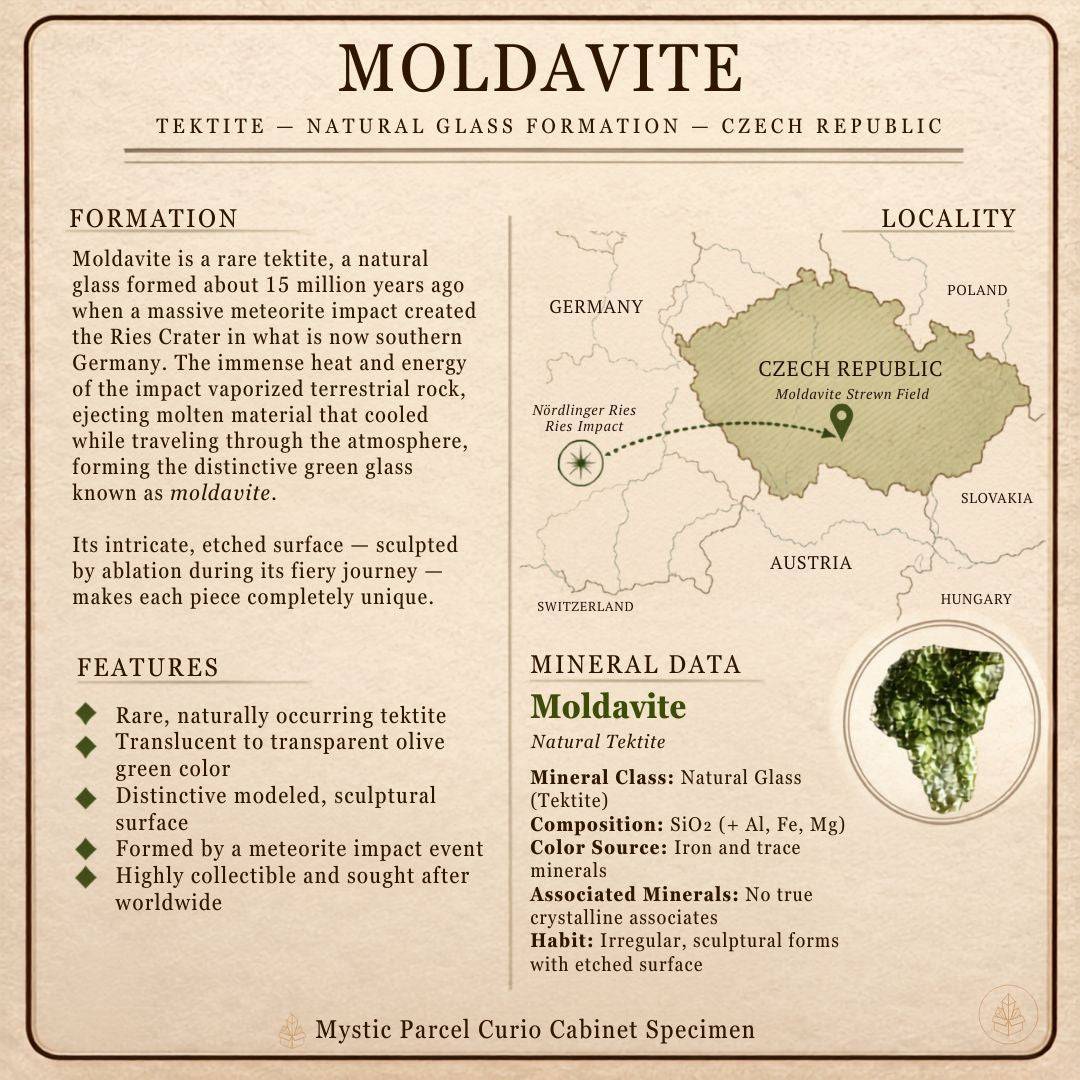
Moldavite is a green tektite, a natural silicate glass produced during a meteorite-impact event rather than through mineral crystallization. Its formation is connected to the Ries impact in present-day Germany approximately 14.8 million years ago. The impact rapidly heated and melted near-surface terrestrial material, ejecting droplets and irregular masses that cooled into glass.
The resulting glass was distributed across parts of Central Europe, including the Moldavite-bearing deposits of the Czech Republic. Many specimens were later transported and buried within sediments, exposing their surfaces to prolonged chemical weathering and natural abrasion. These processes contributed to the varied ridges, pits, grooves, and cavities found on recovered pieces.
This specimen’s broad flattened body records a thin glass form rather than a rounded droplet shape. Dense surface pitting covers both the thicker central area and the thinner margins, while the open notch creates a distinct break in the otherwise rounded outline. Backlighting reveals changes in thickness through variations from deeper olive green to brighter yellow-green.
Mystic Parcel Notes
This piece was selected for its open silhouette and the amount of visible surface structure held within a thumbnail-scale specimen. Its darker reflected appearance shifts noticeably under transmitted light, allowing the pitting, thickness changes, and interior color to be viewed from another perspective.
Moldavite is traditionally associated with transformation and awakening, while its crown- and heart-chakra correspondences are often used as symbols of expanded awareness and meaningful connection. These associations are interpretive rather than physical claims. The open notch may serve as a visual anchor for reflection on transition, release, and making space for change.
For collectors, this is a locality-identified Moldavite thumbnail with a thin plate form, dense natural surface sculpture, and included protective display case. For intention buyers, it may support reflective work centered on transformation, awakening, and connection without replacing the material and geological identity of the specimen.
What you’ll receive
- One (1) Moldavite thumbnail specimen from the Czech Republic — exact specimen shown
- One (1) protective acrylic specimen case with interior padding
- One (1) Mystic Parcel specimen identification card
How to use
- Display inside the included acrylic case on a collector shelf, desk, altar, or within a curio cabinet.
- View against transmitted or low-angle light to study the olive-green color, variable thickness, and dense surface pitting.
- Use as a study example of natural tektite glass, impact formation, and weathered surface sculpture.
- Use as an optional visual anchor for reflection associated with the crown and heart chakras.
Care
- Keep the specimen in its protective case when it is not being handled.
- Handle over a padded surface because natural glass can chip or fracture if dropped or struck.
- Lift the piece by its broader edges and avoid applying pressure around the open notch or thinner margins.
- Remove loose dust with a soft dry brush or gently wipe with a slightly damp, lint-free cloth.
- Avoid abrasives, harsh chemicals, ultrasonic cleaning, steam, and sudden temperature changes.
Notes: This natural impact-glass specimen shows irregular edges, pits, grooves, cavities, and color changes under different lighting conditions. The protective acrylic case is included, and photographs show the exact specimen you will receive. Chakra and intention associations are symbolic and are not substitutes for professional advice.
| Specification | Details |
|---|---|
| Material | Moldavite (Natural Tektite) |
| Weight | 3.97g |
| Size | Approx. 23 × 21 × 7 mm (0.91 × 0.83 × 0.28 in.) |
| Finish | Natural, unpolished surface |
| Color | Dark olive to nearly black in reflected light; olive green to yellow-green in transmitted light |
| Specimen Size | Thumbnail specimen |
| Locality | Chlum Fields, South Bohemia, Czech Republic |
| Notch Type | Pronounced open notch |
| Features | Dense pitting, shallow cavities, glass folds, translucent body |
| Material | Description |
|---|---|
| Moldavite | A natural impact-derived silicate glass produced during a meteorite impact, characterized by its thin, flattened form and distinctive textures. |
| Protective Case | Acrylic case designed to support the specimen while allowing visibility of its unique features. |
This piece was selected for its open silhouette and the amount of visible surface structure held within a thumbnail-scale specimen. Its darker reflected appearance shifts noticeably under transmitted light, allowing the pitting, thickness changes, and interior color to be viewed from another perspective.
For collectors, this is a locality-identified Moldavite thumbnail with a thin plate form, dense natural surface sculpture, and included protective display case. For intention buyers, it may support reflective work centered on transformation, awakening, and connection without replacing the material and geological identity of the specimen.
Moldavite (3.97g) — Notched Ellipsoid Plate, Czech Republic
Transformation • Awakening • Connection
This Moldavite specimen from the Czech Republic is a thin natural tektite with a broad plate form and a pronounced open notch along one side. It weighs 3.97g and measures approximately 23 × 21 × 7 mm, placing it within thumbnail specimen scale.
The surface is densely textured with shallow pits, small cavities, softened ridges, and irregular glass folds. In reflected light, the piece appears dark olive to nearly black, while transmitted light reveals a clearer olive-green body with lighter yellow-green areas. Its broad face and reduced thickness allow light to travel through much of the specimen.
Mystic Parcel selected this piece for the relationship between its thin flattened form, open negative space, and closely patterned surface sculpture. The protective acrylic case keeps the compact specimen supported while allowing the exact form and texture to remain visible. No polishing or surface alteration has been indicated.
Specimen Details
- Material: Moldavite, a natural tektite and impact-derived silicate glass
- Locality: Chlum Fields → South Bohemia → Czech Republic
- Formation: Natural impact glass formed when terrestrial material was melted and ejected during the Ries impact event, then cooled into glass
- Features: Thin ellipsoid plate form, pronounced open notch, dense pitting, shallow cavities, glass folds, and translucent body
- Color: Dark olive to nearly black in reflected light; olive green to yellow-green in transmitted light
- Finish: Natural, unpolished surface
- Size: Approx. 0.91 × 0.83 × 0.28 in. / 23 × 21 × 7 mm
- Specimen Size: Thumbnail specimen
- Weight: 3.97g
- Selection: Exact specimen shown; protective acrylic case included
Geological Notes
Moldavite is a green tektite, a natural silicate glass produced during a meteorite-impact event rather than through mineral crystallization. Its formation is connected to the Ries impact in present-day Germany approximately 14.8 million years ago. The impact rapidly heated and melted near-surface terrestrial material, ejecting droplets and irregular masses that cooled into glass.
The resulting glass was distributed across parts of Central Europe, including the Moldavite-bearing deposits of the Czech Republic. Many specimens were later transported and buried within sediments, exposing their surfaces to prolonged chemical weathering and natural abrasion. These processes contributed to the varied ridges, pits, grooves, and cavities found on recovered pieces.
This specimen’s broad flattened body records a thin glass form rather than a rounded droplet shape. Dense surface pitting covers both the thicker central area and the thinner margins, while the open notch creates a distinct break in the otherwise rounded outline. Backlighting reveals changes in thickness through variations from deeper olive green to brighter yellow-green.
Mystic Parcel Notes
This piece was selected for its open silhouette and the amount of visible surface structure held within a thumbnail-scale specimen. Its darker reflected appearance shifts noticeably under transmitted light, allowing the pitting, thickness changes, and interior color to be viewed from another perspective.
Moldavite is traditionally associated with transformation and awakening, while its crown- and heart-chakra correspondences are often used as symbols of expanded awareness and meaningful connection. These associations are interpretive rather than physical claims. The open notch may serve as a visual anchor for reflection on transition, release, and making space for change.
For collectors, this is a locality-identified Moldavite thumbnail with a thin plate form, dense natural surface sculpture, and included protective display case. For intention buyers, it may support reflective work centered on transformation, awakening, and connection without replacing the material and geological identity of the specimen.
What you’ll receive
- One (1) Moldavite thumbnail specimen from the Czech Republic — exact specimen shown
- One (1) protective acrylic specimen case with interior padding
- One (1) Mystic Parcel specimen identification card
How to use
- Display inside the included acrylic case on a collector shelf, desk, altar, or within a curio cabinet.
- View against transmitted or low-angle light to study the olive-green color, variable thickness, and dense surface pitting.
- Use as a study example of natural tektite glass, impact formation, and weathered surface sculpture.
- Use as an optional visual anchor for reflection associated with the crown and heart chakras.
Care
- Keep the specimen in its protective case when it is not being handled.
- Handle over a padded surface because natural glass can chip or fracture if dropped or struck.
- Lift the piece by its broader edges and avoid applying pressure around the open notch or thinner margins.
- Remove loose dust with a soft dry brush or gently wipe with a slightly damp, lint-free cloth.
- Avoid abrasives, harsh chemicals, ultrasonic cleaning, steam, and sudden temperature changes.
Notes: This natural impact-glass specimen shows irregular edges, pits, grooves, cavities, and color changes under different lighting conditions. The protective acrylic case is included, and photographs show the exact specimen you will receive. Chakra and intention associations are symbolic and are not substitutes for professional advice.
| Specification | Details |
|---|---|
| Material | Moldavite (Natural Tektite) |
| Weight | 3.97g |
| Size | Approx. 23 × 21 × 7 mm (0.91 × 0.83 × 0.28 in.) |
| Finish | Natural, unpolished surface |
| Color | Dark olive to nearly black in reflected light; olive green to yellow-green in transmitted light |
| Specimen Size | Thumbnail specimen |
| Locality | Chlum Fields, South Bohemia, Czech Republic |
| Notch Type | Pronounced open notch |
| Features | Dense pitting, shallow cavities, glass folds, translucent body |
| Material | Description |
|---|---|
| Moldavite | A natural impact-derived silicate glass produced during a meteorite impact, characterized by its thin, flattened form and distinctive textures. |
| Protective Case | Acrylic case designed to support the specimen while allowing visibility of its unique features. |
This piece was selected for its open silhouette and the amount of visible surface structure held within a thumbnail-scale specimen. Its darker reflected appearance shifts noticeably under transmitted light, allowing the pitting, thickness changes, and interior color to be viewed from another perspective.
For collectors, this is a locality-identified Moldavite thumbnail with a thin plate form, dense natural surface sculpture, and included protective display case. For intention buyers, it may support reflective work centered on transformation, awakening, and connection without replacing the material and geological identity of the specimen.
- 5 stars: 1 (100%)
- 4 stars: 0 (0%)
- 3 stars: 0 (0%)
- 2 stars: 0 (0%)
- 1 star: 0 (0%)
I couldn’t be happier with my experience with Mystic Parcel! I purchased a prasiolite crystal, and it’s absolutely beautiful. The color and clarity are even better than I expected, and it has such a calming, peaceful energy. I was also impressed by how quickly my order arrived. Everything was packaged with so much care and thoughtfulness, making the whole experience feel special from the moment I opened the box. If you’re looking for high-quality crystals and excellent customer service, I highly recommend Mystic Parcel. I’ll definitely be ordering from them again!


