
YGX Quartz with Scheelite & Fluorite ⎮ Paired Points, China
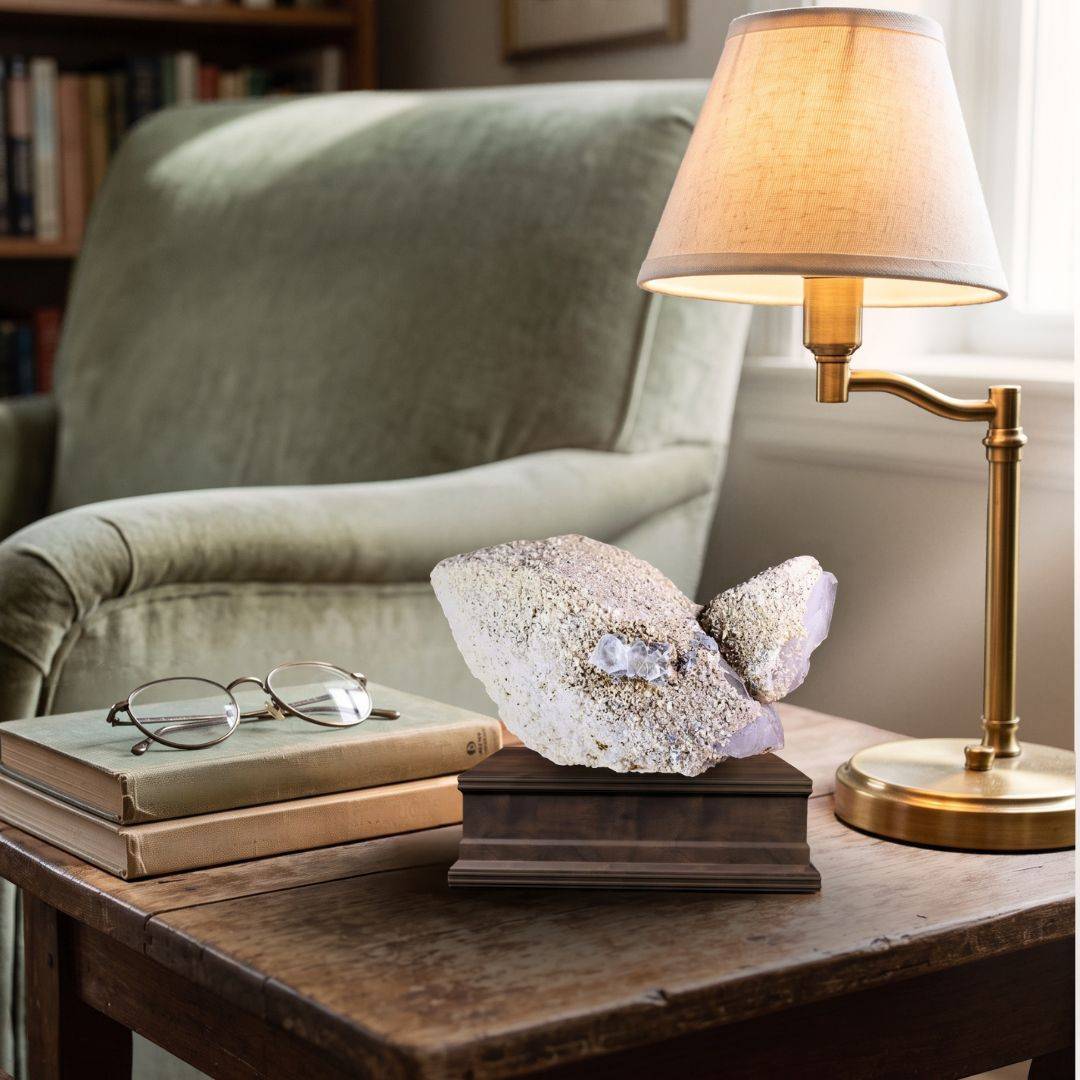
China quartz specimen with two connected terminated points, directional microcrystalline scheelite coating and later cubic fluorite growth; approx. 187 g / 3.5 × 2 × 2 in.
 Chakra | Crown
 Primary Intention | Amplifying
 Country of Origin | China


Couldn't load pickup availability
Estimated Delivery: …
What's included in your order?
 30-Days Returns
 Ethically Curated
 Authentic Minerals



YGX Quartz with Scheelite & Fluorite ⎮ Paired Points, China
YGX Quartz with Scheelite & Fluorite — Paired Terminated Crystals, China
Clarity • Amplifying • Awakening
This Yaogangxian Mine (YGX) specimen brings together quartz, scheelite, and fluorite in a compact record of multiple mineral-growth phases. Two connected terminated quartz crystals form the structure of the piece, while a fine microcrystalline coating spreads unevenly across their surfaces and later cubic fluorite crystals appear along the quartz face and near the junction where the two points meet.
The coating is notably directional rather than uniform. One side of the specimen carries a substantially thicker layer of microcrystalline material, while the smaller quartz point retains an exposed window where the underlying crystal surface remains visible. The contrast makes the sequence of deposition easier to read and gives the specimen distinctly different appearances depending on viewing angle.
Mystic Parcel selected this specimen specifically for that combination of minerals and the visible evidence of successive growth. Under ultraviolet light, the fluorite fluoresces under long-wave UV, while the scheelite responds under short-wave UV, adding a second way to examine the mineral relationships present across the quartz.
Specimen Details
- Material: Quartz with microcrystalline scheelite and fluorite
- Locality: Yaogangxian Mine (YGX) → Yaogangxian W-Sn ore field → Yizhang County → Chenzhou → Hunan Province → China
- Formation: Hydrothermal quartz-vein mineralization with successive mineral deposition
- Features: Connected pair of terminated quartz crystals; directional microcrystalline coating; exposed quartz window; later cubic fluorite growth
- Color: Colorless to pale smoky-gray quartz with cream to metallic-toned microcrystalline coating and colorless to pale fluorite
- UV Response: Fluorite under long wave & Scheelite under short wave
- Finish: Natural, unpolished mineral specimen
- Size: Approx. 3.5 × 2 × 2 in.
- Specimen Size: Small Cabinet
- Weight: 187 g
Geological Notes
The Yaogangxian Mine is part of the tungsten-tin mineralized system of southern Hunan, where hydrothermal fluids moved through fractures associated with the region’s granitic intrusive complex. Quartz veins within this system provided open spaces in which repeated generations of quartz and associated minerals could crystallize as fluid chemistry and conditions changed.
This specimen preserves that succession on a very small scale. The paired quartz points formed first and were followed by several episodes of fine microcrystalline deposition, including scheelite, rather than receiving a single uniform coating. Later fluorite crystallization produced recognizable cubic growth directly on the quartz face and around the area where the two quartz crystals connect.
The uneven coating is especially useful for reading that history. A thicker accumulation covers one side of the specimen, while a comparatively open area on the smaller quartz point creates a natural window into the earlier quartz growth beneath it. Under ultraviolet illumination, the mineral phases separate visually again: the fluorite responds to long-wave UV and the scheelite to short-wave UV.
The Yaogangxian Mine is currently listed by Mindat as an abandoned mine. Its long mining history and increasingly restricted and hazardous underground workings add important locality context to specimens already removed from this well-known tungsten-tin deposit.
Mystic Parcel Notes
Mystic Parcel selected this piece because it does more than place several minerals together—it preserves their relationship. The paired quartz, asymmetrical microcrystalline coating, open quartz window, and later fluorite cubes allow the specimen to be viewed as a sequence of mineral deposition rather than simply as a finished crystal cluster.
Quartz is traditionally associated with amplification and clarity, while the Crown Chakra is associated with awareness and expanded perspective. Here, those ideas are reflected physically in a specimen whose story becomes clearer the more closely it is examined: first in ordinary light, then across its coated and exposed surfaces, and again under two different ultraviolet wavelengths.
For a collector, the appeal lies in the mineral association, growth sequence, and fluorescent response. For an intention-focused collection, it offers a tangible reminder that clarity does not always mean simplicity; sometimes understanding comes from recognizing the separate layers that built the whole.
What you’ll receive
- The exact 187 g quartz with scheelite and fluorite specimen shown in the photographs
- One acrylic display base; the included base is not photographed
How to use
- Display from either principal side to emphasize the contrast between the heavier microcrystalline coating and the exposed quartz window
- Examine under magnification to study the successive mineral-growth phases and small cubic fluorite crystals
- View with long-wave and short-wave ultraviolet lights to compare the separate fluorescent responses of the fluorite and scheelite
- Use as a Crown Chakra or reflective specimen when working with intentions of clarity, amplification, and awakening
Care
- Handle by the strongest portion of the specimen rather than by the quartz terminations or projecting fluorite crystals
- Dust gently with a soft, dry brush or low-pressure air
- Avoid chemical cleaners, prolonged soaking, ultrasonic cleaning, and abrupt temperature changes
- Use appropriate eye protection and follow the manufacturer's safety guidance when viewing minerals under ultraviolet light
Notes: This listing is for the specific natural specimen photographed. Natural mineral specimens may contain contact points, growth interruptions, internal fractures, and other features associated with their formation and extraction. Fluorescence can vary in apparent intensity according to UV wavelength, lamp strength, ambient light, and viewing conditions.
| Key | Value |
|---|---|
| Material | Quartz with microcrystalline scheelite and fluorite |
| Locality | Yaogangxian Mine (YGX), Hunan Province, China |
| Formation | Hydrothermal quartz-vein mineralization with successive mineral deposition |
| Features | Connected pair of terminated quartz crystals; directional microcrystalline coating; exposed quartz window; later cubic fluorite growth |
| Color | Colorless to pale smoky-gray quartz with cream to metallic-toned microcrystalline coating and colorless to pale fluorite |
| UV Response | Fluorite under long wave UV & Scheelite under short wave UV |
| Finish | Natural, unpolished mineral specimen |
| Size | Approx. 3.5 × 2 × 2 in. |
| Specimen Size | Small Cabinet |
| Weight | 187 g |
| Material | Description |
|---|---|
| Quartz | A key component forming the primary structure, known for amplification and clarity. |
| Scheelite | A microcrystalline material present in the coating, exhibiting fluorescence under short-wave UV light. |
| Fluorite | Cubic crystals that appear later in the growth sequence, known for their fluorescence under long-wave UV light. |
The Yaogangxian Mine is part of the tungsten-tin mineralized system of southern Hunan, where hydrothermal fluids moved through fractures associated with the region’s granitic intrusive complex. Quartz veins within this system provided open spaces in which repeated generations of quartz and associated minerals could crystallize as fluid chemistry and conditions changed.
This specimen preserves that succession on a very small scale. The paired quartz points formed first and were followed by several episodes of fine microcrystalline deposition, including scheelite, rather than receiving a single uniform coating. Later fluorite crystallization produced recognizable cubic growth directly on the quartz face and around the area where the two quartz crystals connect.
The uneven coating is especially useful for reading that history. A thicker accumulation covers one side of the specimen, while a comparatively open area on the smaller quartz point creates a natural window into the earlier quartz growth beneath it. Under ultraviolet illumination, the mineral phases separate visually again: the fluorite responds to long-wave UV and the scheelite to short-wave UV.
The Yaogangxian Mine is currently listed by Mindat as an abandoned mine. Its long mining history and increasingly restricted and hazardous underground workings add important locality context to specimens already removed from this well-known tungsten-tin deposit.
Mystic Parcel selected this piece because it does more than place several minerals together—it preserves their relationship. The paired quartz, asymmetrical microcrystalline coating, open quartz window, and later fluorite cubes allow the specimen to be viewed as a sequence of mineral deposition rather than simply as a finished crystal cluster.
Quartz is traditionally associated with amplification and clarity, while the Crown Chakra is associated with awareness and expanded perspective. Here, those ideas are reflected physically in a specimen whose story becomes clearer the more closely it is examined: first in ordinary light, then across its coated and exposed surfaces, and again under two different ultraviolet wavelengths.
For a collector, the appeal lies in the mineral association, growth sequence, and fluorescent response. For an intention-focused collection, it offers a tangible reminder that clarity does not always mean simplicity; sometimes understanding comes from recognizing the separate layers that built the whole.
YGX Quartz with Scheelite & Fluorite — Paired Terminated Crystals, China
Clarity • Amplifying • Awakening
This Yaogangxian Mine (YGX) specimen brings together quartz, scheelite, and fluorite in a compact record of multiple mineral-growth phases. Two connected terminated quartz crystals form the structure of the piece, while a fine microcrystalline coating spreads unevenly across their surfaces and later cubic fluorite crystals appear along the quartz face and near the junction where the two points meet.
The coating is notably directional rather than uniform. One side of the specimen carries a substantially thicker layer of microcrystalline material, while the smaller quartz point retains an exposed window where the underlying crystal surface remains visible. The contrast makes the sequence of deposition easier to read and gives the specimen distinctly different appearances depending on viewing angle.
Mystic Parcel selected this specimen specifically for that combination of minerals and the visible evidence of successive growth. Under ultraviolet light, the fluorite fluoresces under long-wave UV, while the scheelite responds under short-wave UV, adding a second way to examine the mineral relationships present across the quartz.
Specimen Details
- Material: Quartz with microcrystalline scheelite and fluorite
- Locality: Yaogangxian Mine (YGX) → Yaogangxian W-Sn ore field → Yizhang County → Chenzhou → Hunan Province → China
- Formation: Hydrothermal quartz-vein mineralization with successive mineral deposition
- Features: Connected pair of terminated quartz crystals; directional microcrystalline coating; exposed quartz window; later cubic fluorite growth
- Color: Colorless to pale smoky-gray quartz with cream to metallic-toned microcrystalline coating and colorless to pale fluorite
- UV Response: Fluorite under long wave & Scheelite under short wave
- Finish: Natural, unpolished mineral specimen
- Size: Approx. 3.5 × 2 × 2 in.
- Specimen Size: Small Cabinet
- Weight: 187 g
Geological Notes
The Yaogangxian Mine is part of the tungsten-tin mineralized system of southern Hunan, where hydrothermal fluids moved through fractures associated with the region’s granitic intrusive complex. Quartz veins within this system provided open spaces in which repeated generations of quartz and associated minerals could crystallize as fluid chemistry and conditions changed.
This specimen preserves that succession on a very small scale. The paired quartz points formed first and were followed by several episodes of fine microcrystalline deposition, including scheelite, rather than receiving a single uniform coating. Later fluorite crystallization produced recognizable cubic growth directly on the quartz face and around the area where the two quartz crystals connect.
The uneven coating is especially useful for reading that history. A thicker accumulation covers one side of the specimen, while a comparatively open area on the smaller quartz point creates a natural window into the earlier quartz growth beneath it. Under ultraviolet illumination, the mineral phases separate visually again: the fluorite responds to long-wave UV and the scheelite to short-wave UV.
The Yaogangxian Mine is currently listed by Mindat as an abandoned mine. Its long mining history and increasingly restricted and hazardous underground workings add important locality context to specimens already removed from this well-known tungsten-tin deposit.
Mystic Parcel Notes
Mystic Parcel selected this piece because it does more than place several minerals together—it preserves their relationship. The paired quartz, asymmetrical microcrystalline coating, open quartz window, and later fluorite cubes allow the specimen to be viewed as a sequence of mineral deposition rather than simply as a finished crystal cluster.
Quartz is traditionally associated with amplification and clarity, while the Crown Chakra is associated with awareness and expanded perspective. Here, those ideas are reflected physically in a specimen whose story becomes clearer the more closely it is examined: first in ordinary light, then across its coated and exposed surfaces, and again under two different ultraviolet wavelengths.
For a collector, the appeal lies in the mineral association, growth sequence, and fluorescent response. For an intention-focused collection, it offers a tangible reminder that clarity does not always mean simplicity; sometimes understanding comes from recognizing the separate layers that built the whole.
What you’ll receive
- The exact 187 g quartz with scheelite and fluorite specimen shown in the photographs
- One acrylic display base; the included base is not photographed
How to use
- Display from either principal side to emphasize the contrast between the heavier microcrystalline coating and the exposed quartz window
- Examine under magnification to study the successive mineral-growth phases and small cubic fluorite crystals
- View with long-wave and short-wave ultraviolet lights to compare the separate fluorescent responses of the fluorite and scheelite
- Use as a Crown Chakra or reflective specimen when working with intentions of clarity, amplification, and awakening
Care
- Handle by the strongest portion of the specimen rather than by the quartz terminations or projecting fluorite crystals
- Dust gently with a soft, dry brush or low-pressure air
- Avoid chemical cleaners, prolonged soaking, ultrasonic cleaning, and abrupt temperature changes
- Use appropriate eye protection and follow the manufacturer's safety guidance when viewing minerals under ultraviolet light
Notes: This listing is for the specific natural specimen photographed. Natural mineral specimens may contain contact points, growth interruptions, internal fractures, and other features associated with their formation and extraction. Fluorescence can vary in apparent intensity according to UV wavelength, lamp strength, ambient light, and viewing conditions.
| Key | Value |
|---|---|
| Material | Quartz with microcrystalline scheelite and fluorite |
| Locality | Yaogangxian Mine (YGX), Hunan Province, China |
| Formation | Hydrothermal quartz-vein mineralization with successive mineral deposition |
| Features | Connected pair of terminated quartz crystals; directional microcrystalline coating; exposed quartz window; later cubic fluorite growth |
| Color | Colorless to pale smoky-gray quartz with cream to metallic-toned microcrystalline coating and colorless to pale fluorite |
| UV Response | Fluorite under long wave UV & Scheelite under short wave UV |
| Finish | Natural, unpolished mineral specimen |
| Size | Approx. 3.5 × 2 × 2 in. |
| Specimen Size | Small Cabinet |
| Weight | 187 g |
| Material | Description |
|---|---|
| Quartz | A key component forming the primary structure, known for amplification and clarity. |
| Scheelite | A microcrystalline material present in the coating, exhibiting fluorescence under short-wave UV light. |
| Fluorite | Cubic crystals that appear later in the growth sequence, known for their fluorescence under long-wave UV light. |
The Yaogangxian Mine is part of the tungsten-tin mineralized system of southern Hunan, where hydrothermal fluids moved through fractures associated with the region’s granitic intrusive complex. Quartz veins within this system provided open spaces in which repeated generations of quartz and associated minerals could crystallize as fluid chemistry and conditions changed.
This specimen preserves that succession on a very small scale. The paired quartz points formed first and were followed by several episodes of fine microcrystalline deposition, including scheelite, rather than receiving a single uniform coating. Later fluorite crystallization produced recognizable cubic growth directly on the quartz face and around the area where the two quartz crystals connect.
The uneven coating is especially useful for reading that history. A thicker accumulation covers one side of the specimen, while a comparatively open area on the smaller quartz point creates a natural window into the earlier quartz growth beneath it. Under ultraviolet illumination, the mineral phases separate visually again: the fluorite responds to long-wave UV and the scheelite to short-wave UV.
The Yaogangxian Mine is currently listed by Mindat as an abandoned mine. Its long mining history and increasingly restricted and hazardous underground workings add important locality context to specimens already removed from this well-known tungsten-tin deposit.
Mystic Parcel selected this piece because it does more than place several minerals together—it preserves their relationship. The paired quartz, asymmetrical microcrystalline coating, open quartz window, and later fluorite cubes allow the specimen to be viewed as a sequence of mineral deposition rather than simply as a finished crystal cluster.
Quartz is traditionally associated with amplification and clarity, while the Crown Chakra is associated with awareness and expanded perspective. Here, those ideas are reflected physically in a specimen whose story becomes clearer the more closely it is examined: first in ordinary light, then across its coated and exposed surfaces, and again under two different ultraviolet wavelengths.
For a collector, the appeal lies in the mineral association, growth sequence, and fluorescent response. For an intention-focused collection, it offers a tangible reminder that clarity does not always mean simplicity; sometimes understanding comes from recognizing the separate layers that built the whole.


