Apophyllite with Fluorescent Calcite — Maharashtra, India

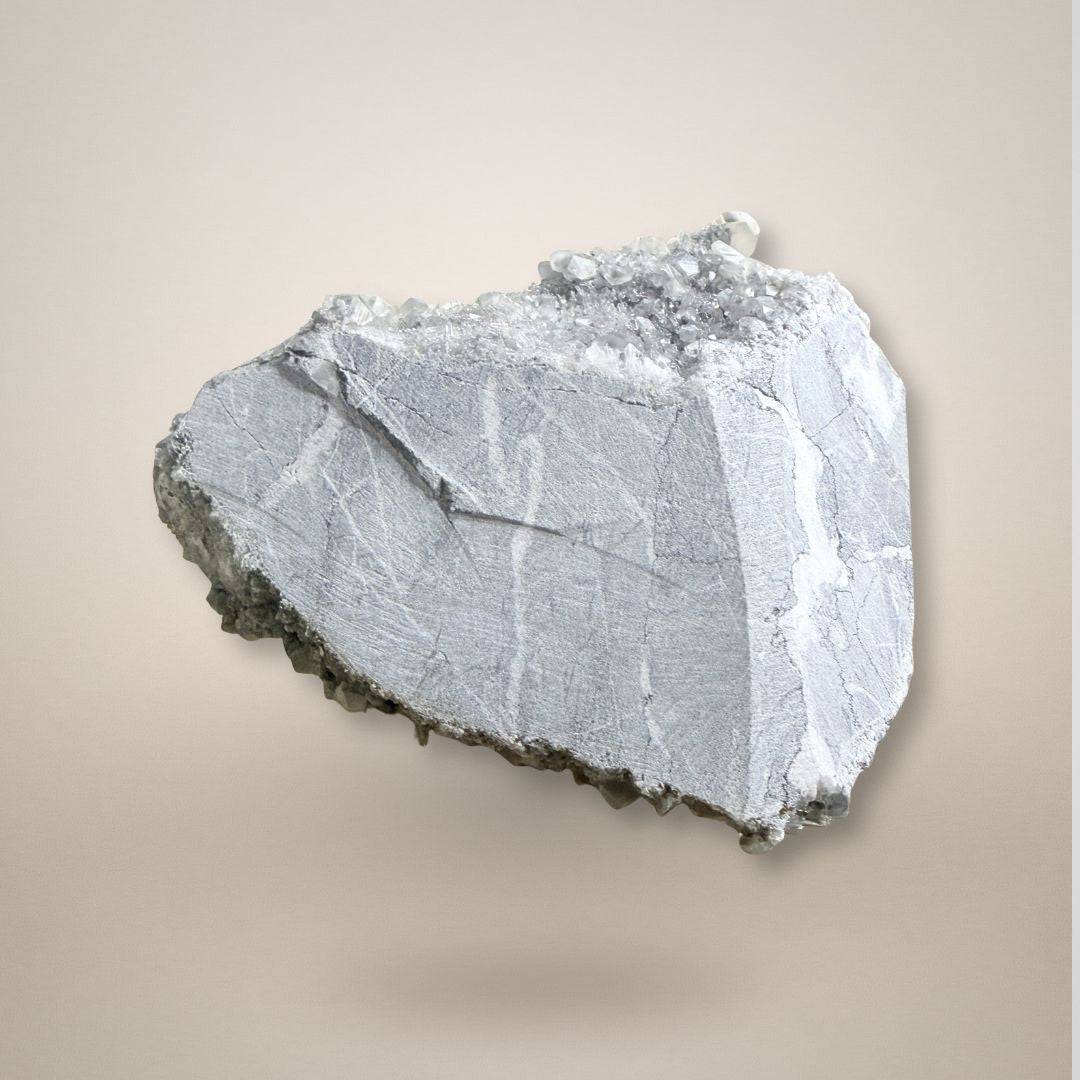
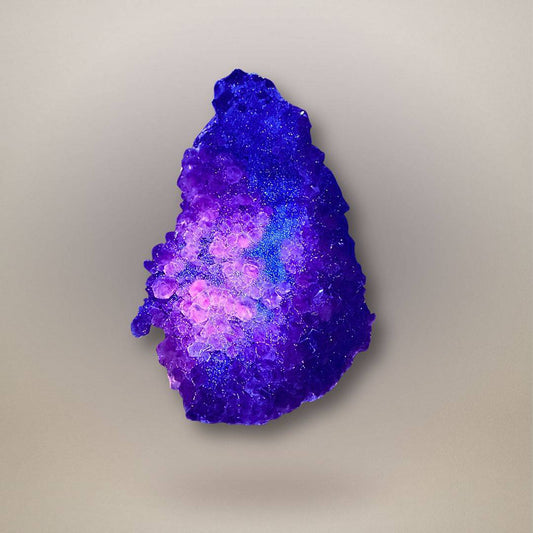
Maharashtra apophyllite specimen with intergrown calcite that reveals a vivid pink-orange response under UV, reflective clear-to-silvery crystal growth, and probable microscopic scolecite on the reverse; approx. 497 g / 5.4 × 4.1 × 1.9 in.


(2 reviews)
Regular price $168.00 USD
Regular price Sale price $168.00 USD
Sale
One of a kind
Taxes included. Shipping calculated at checkout.

Low stock

  • Chakra | Crown and Third Eye
  • Primary Intention | Insight
  • Country of Origin: India


Quantity
Share

Estimated Delivery:  …

What's included in your order?

  • 30-Days Returns
  • Ethically Curated
  • Authentic Minerals
View full details
Skip to product information
1 of 7
About this piece
Specifications
Materials
Mystic Parcel Notes

Apophyllite with Fluorescent Calcite — Maharashtra, India (497 g)

Clarity • Higher Awareness • Calm Expansion

This substantial collector specimen from Maharashtra, India brings together two very different expressions of crystal growth: clear-to-silvery apophyllite and intergrown calcite that reveals an unexpected fluorescent response under ultraviolet light. In normal light, the minerals merge into a cohesive field of transparent, translucent, and softly reflective crystal faces. Under UV, portions of the calcite separate visually from the surrounding apophyllite, glowing vivid pink to orange and revealing another layer of the specimen’s growth history.

The specimen came from an older collection identified as apophyllite from Maharashtra. Closer examination shows that the original identification describes the dominant crystal assemblage but not the entire specimen. Calcite occurs among and across portions of the apophyllite growth, while very fine acicular crystals visible on the reverse may represent associated scolecite. Scolecite is left as a probable identification rather than a confirmed species.

Maharashtra’s basalt cavities are well known for multi-stage secondary mineral growth, where apophyllite may occur alongside calcite, scolecite, stilbite, and other zeolite-associated minerals. This specimen preserves that complexity especially well: what initially appears to be a unified pale crystal cluster resolves into several distinct growth phases when examined more closely.

Apophyllite & Calcite Specimen Details

  • Weight: Approx. 497 g / 17.5 oz
  • Dimensions: Approx. 5.4 × 4.1 × 1.9 in (13.6 × 10.4 × 4.8 cm)
  • Origin: Maharashtra, India, per original collector identification
  • Primary Mineral: Apophyllite Group
  • Associated Mineral: Calcite
  • Additional Association: Probable microscopic scolecite on reverse
  • UV Response: Calcite displays a strong pink-to-orange fluorescent response
  • Chakra: Third Eye • Crown
  • Intention: Clarity • Insight • Energetic Alignment

Reading the Crystal Growth

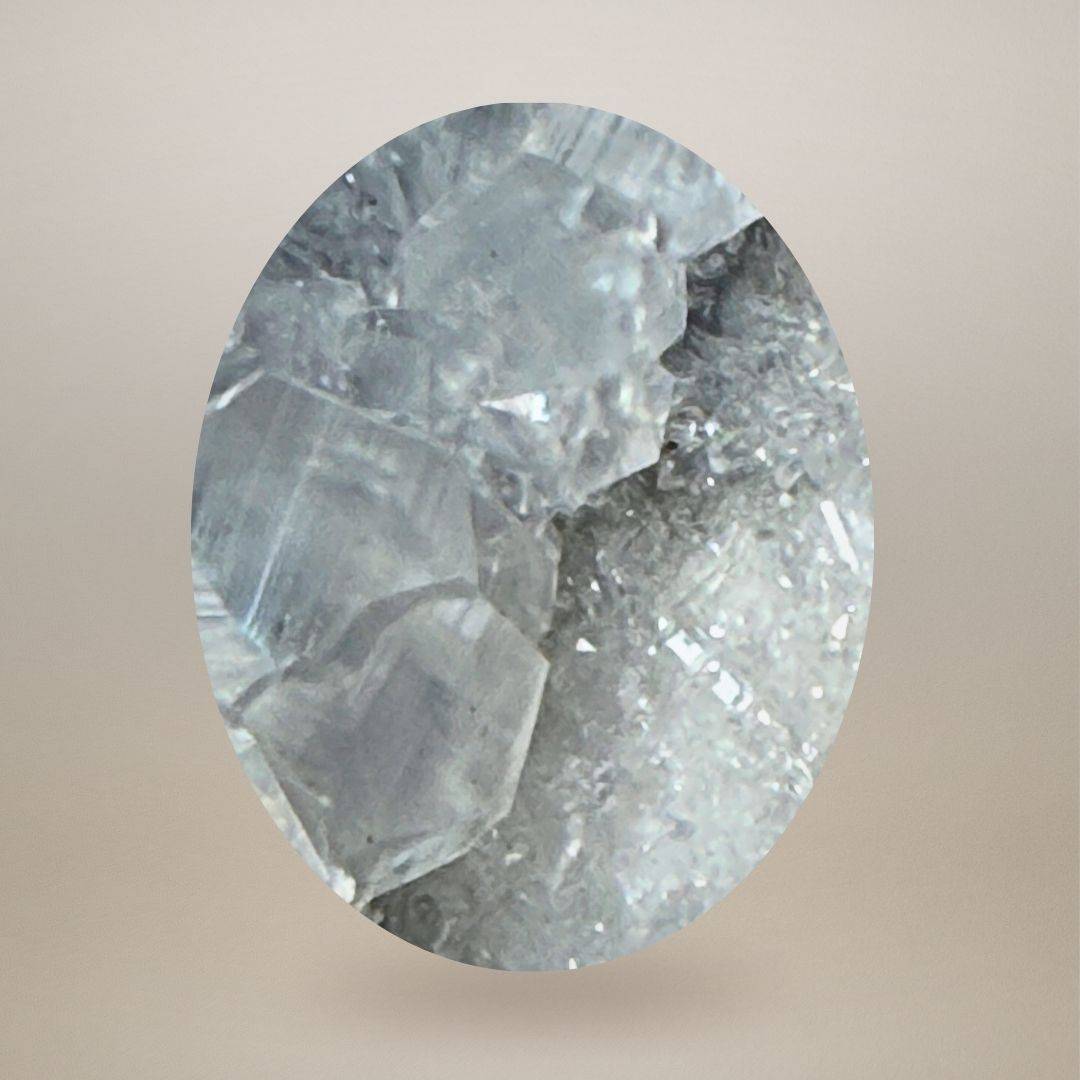
One of the most interesting features of this specimen is the transition between crystal species. Larger transparent to translucent crystals show the geometric character associated with apophyllite, while neighboring calcite growth creates a softer and more varied surface texture. In macro view, the boundary between these growth phases becomes easier to see.

Ultraviolet light makes the distinction even clearer. Areas that appear pale and nearly colorless in ordinary light fluoresce pink to orange, revealing the distribution of calcite within the broader apophyllite assemblage. The fluorescence is not uniform across the specimen, supporting the interpretation of multiple intergrown mineral phases rather than a single continuous coating.

On the reverse, extremely fine white acicular crystals occur between larger crystal faces. Their form and association are consistent with scolecite, a mineral known to occur with apophyllite in Maharashtra, although this minor phase has not been laboratory confirmed.

What You’ll Receive

  • One (1) Apophyllite with Fluorescent Calcite specimen — the exact specimen shown
  • Original collector locality information identifying the specimen as apophyllite from Maharashtra, India
  • Mystic Parcel specimen identification card

Energetic Notes

Apophyllite is traditionally associated with clarity, heightened perception, and subtle awareness. Its bright reflective surfaces lend themselves naturally to spaces intended for meditation, contemplation, or focused thought.

Calcite brings a somewhat different character to the specimen — softer, steadier, and more grounding in expression. Together, the two minerals create an interesting balance between clarity and integration: a useful pairing for intention work centered on seeing something clearly while remaining present enough to process what is revealed.

Placement Ideas

Display this specimen where its crystal faces can interact with natural or directional light. Its broad architecture allows it to be viewed from several orientations, while the reverse rewards closer inspection with additional fine crystal growth.

For collectors with a UV display or flashlight, the specimen offers a second presentation entirely. Portions of the calcite become distinctly visible under ultraviolet illumination, transforming an otherwise pale crystalline surface into areas of vivid fluorescence.

Mystic Parcel Notes

This specimen became more interesting after it had already entered the Mystic Parcel collection. Its original collector identification described it simply as apophyllite from Maharashtra, India. Examination under ultraviolet light revealed strong fluorescence in portions of the specimen, prompting a closer look at the crystal growth and the recognition of associated calcite.

A macro examination of the reverse also revealed extremely fine acicular crystals that may be scolecite. Rather than replacing the original identification, these observations add context to it: this is an apophyllite-dominant specimen preserving several stages of secondary mineral growth.

Natural crystals may include internal veils, contact points, growth lines, cleavage surfaces, and irregular textures created during formation. These are part of the specimen’s geological history rather than manufacturing defects. Apophyllite is relatively soft and has excellent cleavage, so the specimen should be handled carefully and lifted from its base rather than by individual crystals.

Specification Details
Weight Approximately 497 g / 17.5 oz
Dimensions Roughly 5.4 x 4.1 x 1.9 in (13.6 x 10.4 x 4.8 cm)
Origin Maharashtra, India
Chakra Third Eye, Crown
Intention Clarity, Insight, Energetic Alignment
Stone Family Apophyllite (Phyllosilicate mineral group)
Hardness 4.5–5 on the Mohs hardness scale
UV Response

Calcite displays a strong pink-to-orange fluorescent response

Component Description
Primary Mineral Apophyllite (from the Phyllosilicate mineral group)
Base Matrix Light-colored stone matrix that ensures structural integrity

This specimen became more interesting after it had already entered the Mystic Parcel collection. Its original collector identification described it simply as apophyllite from Maharashtra, India. Examination under ultraviolet light revealed strong fluorescence in portions of the specimen, prompting a closer look at the crystal growth and the recognition of associated calcite.

A macro examination of the reverse also revealed extremely fine acicular crystals that may be scolecite. Rather than replacing the original identification, these observations add context to it: this is an apophyllite-dominant specimen preserving several stages of secondary mineral growth.


About this piece

Apophyllite with Fluorescent Calcite — Maharashtra, India (497 g)

Clarity • Higher Awareness • Calm Expansion

This substantial collector specimen from Maharashtra, India brings together two very different expressions of crystal growth: clear-to-silvery apophyllite and intergrown calcite that reveals an unexpected fluorescent response under ultraviolet light. In normal light, the minerals merge into a cohesive field of transparent, translucent, and softly reflective crystal faces. Under UV, portions of the calcite separate visually from the surrounding apophyllite, glowing vivid pink to orange and revealing another layer of the specimen’s growth history.

The specimen came from an older collection identified as apophyllite from Maharashtra. Closer examination shows that the original identification describes the dominant crystal assemblage but not the entire specimen. Calcite occurs among and across portions of the apophyllite growth, while very fine acicular crystals visible on the reverse may represent associated scolecite. Scolecite is left as a probable identification rather than a confirmed species.

Maharashtra’s basalt cavities are well known for multi-stage secondary mineral growth, where apophyllite may occur alongside calcite, scolecite, stilbite, and other zeolite-associated minerals. This specimen preserves that complexity especially well: what initially appears to be a unified pale crystal cluster resolves into several distinct growth phases when examined more closely.

Apophyllite & Calcite Specimen Details

  • Weight: Approx. 497 g / 17.5 oz
  • Dimensions: Approx. 5.4 × 4.1 × 1.9 in (13.6 × 10.4 × 4.8 cm)
  • Origin: Maharashtra, India, per original collector identification
  • Primary Mineral: Apophyllite Group
  • Associated Mineral: Calcite
  • Additional Association: Probable microscopic scolecite on reverse
  • UV Response: Calcite displays a strong pink-to-orange fluorescent response
  • Chakra: Third Eye • Crown
  • Intention: Clarity • Insight • Energetic Alignment

Reading the Crystal Growth

One of the most interesting features of this specimen is the transition between crystal species. Larger transparent to translucent crystals show the geometric character associated with apophyllite, while neighboring calcite growth creates a softer and more varied surface texture. In macro view, the boundary between these growth phases becomes easier to see.

Ultraviolet light makes the distinction even clearer. Areas that appear pale and nearly colorless in ordinary light fluoresce pink to orange, revealing the distribution of calcite within the broader apophyllite assemblage. The fluorescence is not uniform across the specimen, supporting the interpretation of multiple intergrown mineral phases rather than a single continuous coating.

On the reverse, extremely fine white acicular crystals occur between larger crystal faces. Their form and association are consistent with scolecite, a mineral known to occur with apophyllite in Maharashtra, although this minor phase has not been laboratory confirmed.

What You’ll Receive

  • One (1) Apophyllite with Fluorescent Calcite specimen — the exact specimen shown
  • Original collector locality information identifying the specimen as apophyllite from Maharashtra, India
  • Mystic Parcel specimen identification card

Energetic Notes

Apophyllite is traditionally associated with clarity, heightened perception, and subtle awareness. Its bright reflective surfaces lend themselves naturally to spaces intended for meditation, contemplation, or focused thought.

Calcite brings a somewhat different character to the specimen — softer, steadier, and more grounding in expression. Together, the two minerals create an interesting balance between clarity and integration: a useful pairing for intention work centered on seeing something clearly while remaining present enough to process what is revealed.

Placement Ideas

Display this specimen where its crystal faces can interact with natural or directional light. Its broad architecture allows it to be viewed from several orientations, while the reverse rewards closer inspection with additional fine crystal growth.

For collectors with a UV display or flashlight, the specimen offers a second presentation entirely. Portions of the calcite become distinctly visible under ultraviolet illumination, transforming an otherwise pale crystalline surface into areas of vivid fluorescence.

Mystic Parcel Notes

This specimen became more interesting after it had already entered the Mystic Parcel collection. Its original collector identification described it simply as apophyllite from Maharashtra, India. Examination under ultraviolet light revealed strong fluorescence in portions of the specimen, prompting a closer look at the crystal growth and the recognition of associated calcite.

A macro examination of the reverse also revealed extremely fine acicular crystals that may be scolecite. Rather than replacing the original identification, these observations add context to it: this is an apophyllite-dominant specimen preserving several stages of secondary mineral growth.

Natural crystals may include internal veils, contact points, growth lines, cleavage surfaces, and irregular textures created during formation. These are part of the specimen’s geological history rather than manufacturing defects. Apophyllite is relatively soft and has excellent cleavage, so the specimen should be handled carefully and lifted from its base rather than by individual crystals.

Specifications
Specification Details
Weight Approximately 497 g / 17.5 oz
Dimensions Roughly 5.4 x 4.1 x 1.9 in (13.6 x 10.4 x 4.8 cm)
Origin Maharashtra, India
Chakra Third Eye, Crown
Intention Clarity, Insight, Energetic Alignment
Stone Family Apophyllite (Phyllosilicate mineral group)
Hardness 4.5–5 on the Mohs hardness scale
UV Response

Calcite displays a strong pink-to-orange fluorescent response

Materials
Component Description
Primary Mineral Apophyllite (from the Phyllosilicate mineral group)
Base Matrix Light-colored stone matrix that ensures structural integrity
Mystic Parcel Notes

This specimen became more interesting after it had already entered the Mystic Parcel collection. Its original collector identification described it simply as apophyllite from Maharashtra, India. Examination under ultraviolet light revealed strong fluorescence in portions of the specimen, prompting a closer look at the crystal growth and the recognition of associated calcite.

A macro examination of the reverse also revealed extremely fine acicular crystals that may be scolecite. Rather than replacing the original identification, these observations add context to it: this is an apophyllite-dominant specimen preserving several stages of secondary mineral growth.


  • 5 stars: 2 (100%)
  • 4 stars: 0 (0%)
  • 3 stars: 0 (0%)
  • 2 stars: 0 (0%)
  • 1 star: 0 (0%)
This product has no reviews of its own. The merchant grouped it with related products, so the reviews shown are from across that group.
j
j.
Absolutely exquisite piece!!

Absolutely exquisite piece!! Very happy with my purchase!! Thank you!!