

Why Provenance Matters for Minerals: The Story Behind the Label
Last Updated: November 1, 2026
Quick Summary
A mineral's beauty may catch your attention, but knowing where it came from adds another dimension to its story. Mineral provenance connects a specimen to its origins and collecting history, helping us understand its geological significance and preserve that knowledge for future collectors.
- Locality adds context. Knowing where a mineral originated helps us explore its formation, characteristics, and geological history.
- Labels preserve a specimen's story. Mineral identification, locality information, and collecting records help ensure valuable details aren't lost as a specimen changes hands.
- Documentation matters, even when incomplete. Preserving what is known—and acknowledging what remains uncertain—allows future collectors to appreciate a specimen's history without relying on unsupported claims.
Table of Contents
- Why Mineral Provenance Matters: The Story Behind the Label
- What Does Provenance Mean for a Mineral Specimen?
- Why Mineral Locality Matters
- How to Read a Mineral Specimen Label
- What a Label Can—and Cannot—Verify
- Does Provenance Affect a Mineral's Collector Value?
- How to Preserve Provenance in Your Own Mineral Collection
- How Provenance Fits Into Mystic Parcel
- Questions Worth Asking Before You Buy a Mineral Specimen
- The Story Worth Keeping
- Frequently Asked Questions
Why Mineral Provenance Matters: The Story Behind the Label
You can be drawn to a mineral long before you know anything about it. Perhaps it's the branching form of native copper, the color zoning in a fluorite crystal, or a tiny specimen that reveals a surprising amount of detail under magnification.
Then comes a question I find just as interesting as the specimen itself: Where did it come from?
A locality doesn't make a mineral more beautiful. It gives that beauty context. It connects the piece in your hand to a particular place, a geological history, and sometimes to the collectors who recognized its significance before you did.
That's why mineral provenance matters. Not because every specimen needs a perfect paper trail, but because the details we preserve today may become the most interesting part of its story tomorrow.
What Does Provenance Mean for a Mineral Specimen?
In mineral collecting, provenance is a specimen's known and documented history. It may include where the piece was found, who collected it, which collections it has belonged to, and the labels or records that support that history.
Three related ideas are worth separating.
Locality tells us where a specimen is reported to have originated. That might be a country, a mining district, a specific mine, or even a particular pocket within a mine. More precise information can be valuable, but only when it is reliable.
Geological context describes the environment in which the mineral formed—perhaps a hydrothermal vein, a pegmatite, or a cavity within another rock. That context can help explain the minerals found together and the forms they developed. A locality name alone does not necessarily establish those conditions.
Collection history concerns the specimen's journey after discovery. An original field label, an old collector's card, a dated invoice, a catalog number, or a published photograph may preserve part of that journey.
A label reading Fluorite — China provides useful geographic information. A label identifying a mine, accompanied by an original collector's record, provides a different level of documentation. Both tell us something; neither should be made to claim more than it can support.
Why Mineral Locality Matters
The same mineral species can appear remarkably different from one occurrence to another. Color, crystal habit, inclusions, associated minerals, and growth features may vary with the conditions under which a specimen formed. Even specimens from a single locality can show considerable variation.
Consider the native copper specimens from Hubei, China, in The Curio Cabinet. Some have delicate, branching forms; others are more compact or sculptural. Their locality is part of how we begin to explore and compare those formations. It doesn't mean every branching copper specimen must have come from Hubei.
The same curiosity applies to fluorite, quartz, calcite, and countless other minerals. Knowing an origin can lead you to research a mining district, compare specimens from documented occurrences, or learn why particular mineral associations appear together.
Without that information, you can still appreciate a specimen. With it, you have another avenue to explore.
How to Read a Mineral Specimen Label
A mineral label doesn't have to be elaborate to be useful. It should communicate what is known clearly and leave room for what isn't.
These are the details I look for when reading or preserving a mineral specimen label:
- Mineral name: The identified species and, where appropriate, its variety. For example, amethyst is a variety of quartz, not a separate mineral species.
- Reported locality: The mine or occurrence, district, region, and country—as specifically as the available information supports.
- Specimen or catalog number: A reference that connects the piece to a card, photograph, invoice, or collection record.
- Collection history: The collector, previous collection, dealer, or acquisition date, if known.
- Supporting details: Dimensions, weight, associated minerals, treatments or repairs, and the source of any locality information when available.
Not every label will contain all of these fields. A small specimen card may provide only the name, locality, and catalog number, with further details kept in a separate record. What matters is that the label and the record remain connected to the right specimen.
Older labels deserve particular care. They can preserve former mine names, collection histories, and information that may no longer be easy to recover. The Mineralogical Record's Label Archive is a fascinating example of how much history these small pieces of paper can hold.
What a Label Can—and Cannot—Verify
This is where careful language matters.
A dealer-supplied locality is not the same thing as a locality independently confirmed by a collector's field notes or other supporting records. A mine name printed on a card is a claim of origin, not automatic proof of it. And a specimen's mineral identification is a separate question from its provenance.
Crystal habit—the characteristic form in which a mineral grows—can offer clues. So can its matrix, associated minerals, and other physical properties. They may be consistent with a reported locality, or they may raise a reason to ask more questions. Appearance alone, however, rarely proves an exact mine of origin.
Laboratory methods can sometimes help investigate mineral identity or compare geological signatures, but even sophisticated testing does not necessarily produce a unique locality assignment. For ordinary collectors, a reliable original label or a well-kept acquisition record may be far more useful than an unsupported claim of scientific certainty.
There is one more distinction worth making: knowing a mineral's locality is not the same as verifying the ethics of its supply chain. A geographic origin does not, by itself, establish labor practices, extraction conditions, or the complete route from mine to market.
When an exact mine is unknown, saying locality reported by dealer or country of origin known; mine unconfirmed is better than filling in the blanks. Honest uncertainty is part of good documentation.
Does Provenance Affect a Mineral's Collector Value?
It can. A specimen from a sought-after locality, an historic mine, or a recognized collection may hold particular interest for collectors. Original labels and supporting records can help preserve that significance when a specimen changes hands.
But provenance is not a guarantee of higher resale value. Condition, aesthetics, rarity, size, mineral association, and demand also influence what collectors are willing to pay. A beautifully formed specimen with limited history can still be desirable, while extensive paperwork does not automatically make an ordinary piece exceptional.
For me, the greater value of provenance is that it preserves information. Once the original locality or collection history is lost, it may be impossible to reconstruct with confidence.
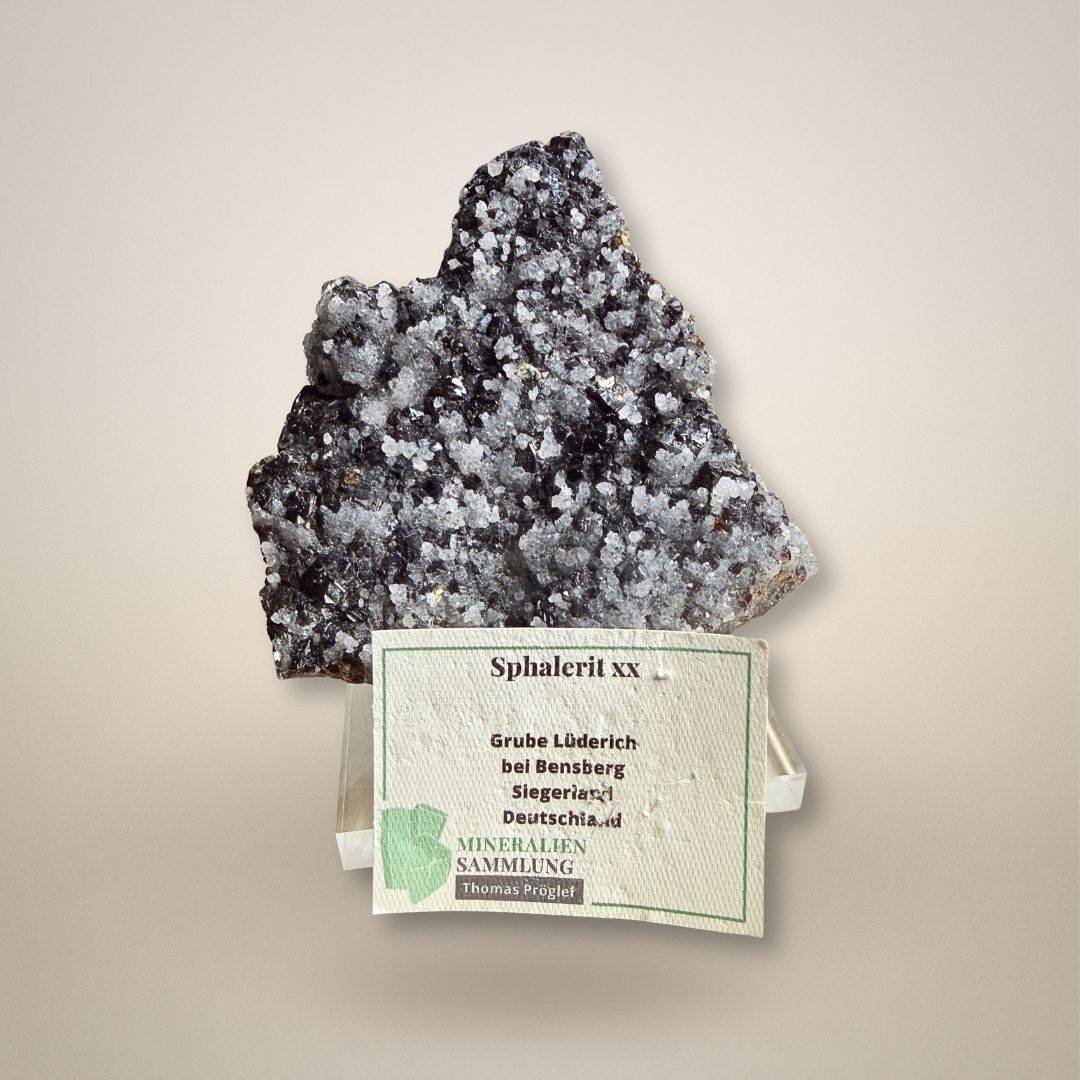
How to Preserve Provenance in Your Own Mineral Collection
You don't need a museum cataloging system to keep a meaningful record. Start with what accompanies the specimen when you receive it.
Keep the original label, even if you create a new display card. Photograph the specimen and both sides of any labels. Save the invoice or dealer description, and note the date you acquired it. If you use specimen numbers, make sure the same number appears in your photographs or collection records.
Record dimensions and weight if they're useful for identifying the piece later. Keep notes on associated minerals, repairs, or treatments when known, but distinguish those observations from documented facts. If new information changes an identification or locality attribution, preserve the earlier label and record the correction rather than quietly replacing the history.
A simple digital folder or spreadsheet can be enough. The important thing is to make it possible for someone else—and your future self—to reconnect the specimen with its story.
How Provenance Fits Into Mystic Parcel
Provenance is one reason I enjoy working with collector specimens. A piece may first catch my attention because of its form or presence, but learning about its origin can make it even more compelling.
Within The Curio Cabinet, specimens are selected for their individual character, formation, and collector interest. Each Curio Cabinet piece comes with a Mystic Parcel Specimen Card identifying the mineral, its locality, and its specimen number. The level of source documentation can vary from one specimen to another, and we don't treat an unverified detail as established fact.
That same thinking is reflected in our Sourcing Standards: we aim to share origin information when it is reasonably reliable, acknowledge the limits of what can be traced, and describe materials as accurately as we can.
It also inspired the Mystic Parcel Atlas. The first Atlas Tumble Set: World brings together five stones associated with five geographic origins—shungite from Russia, Shiva Lingam from India, rutilated quartz from Brazil, malachite from the Democratic Republic of the Congo, and Kambaba jasper from Madagascar. Their places of origin are part of the experience, not an afterthought.
A polished stone and a one-of-a-kind mineral specimen may be collected for different reasons. Both invite the same question: What can I learn about the place this came from?

Questions Worth Asking Before You Buy a Mineral Specimen
Before adding a specimen to your collection, ask how specific its locality information is and where that information came from. Was it recorded by the original collector, supplied by a dealer, or passed along without supporting documentation?
Ask whether the mineral identification is certain, whether any associated minerals have been identified, and whether the piece has been repaired or treated. If a historic label is included, ask that it remain with the specimen.
You don't need an answer to every question before you can enjoy a mineral. You do want to understand which answers are documented and which are provisional.
The Story Worth Keeping
A mineral doesn't need a famous mine name or a century-old label to be worth collecting. Sometimes its beauty is reason enough.
But when a specimen arrives with a name, a locality, or a piece of its collecting history, keep that information close. This is now part of your collection and you may one day send it on. When that happens, those details let the next person see not just what it is, but a little more of where it's been.
The mineral is the treasure. Its story is worth preserving, too.
Frequently Asked Questions
What does provenance mean for a mineral specimen?
Provenance is the known and documented history of a mineral specimen, including where it was found and, when available, its collecting history. This might include a specific mine or locality, the original collector, previous owners, or accompanying records. Some specimens have a detailed history, while others arrive with little more than a country of origin. What matters is preserving the information we have and distinguishing what is documented from what remains uncertain.
What information should a mineral label include?
A useful mineral specimen label should identify the mineral and its locality as specifically as the available information allows. Additional details may include associated minerals, a specimen number, the collecting date, and previous collection history. Original labels are especially worth preserving because they can contain information that might otherwise be lost. Even a simple label becomes part of a specimen's story, connecting it to its origins and helping future collectors understand its history.
Can two minerals of the same species come from different geological settings?
Absolutely. Quartz, for example, can form in pegmatites, hydrothermal veins, and other geological environments. Differences in temperature, chemistry, available space, and growth conditions can influence crystal habit, inclusions, and associated minerals. That's part of what makes mineral collecting so fascinating. Two specimens of the same mineral species can look remarkably different, and understanding their geological origins can help explain why. However, appearance alone generally cannot establish an exact locality.
How should you assess a mineral specimen when its origin is unknown?
Begin with what the specimen itself can tell you. Its crystal habit, color, luster, matrix, and associated minerals may provide clues about its identity and formation. Ask whether the seller has any locality information or documentation, even if it's incomplete. If the origin cannot be reliably established, it's better to record it as unknown than to assign an unsupported locality. A specimen without documented provenance can still be a beautiful and worthwhile addition to your collection. Its story simply has a few unanswered questions.


