
Veracruz Amethyst Cluster on Matrix (642g) — Three Scepters, Mexico
Mexico Veracruz Amethyst cluster with slender lavender-purple quartz, three scepter formations, and lepidocrocite-bearing matrix; approx. 642g / 5.91 × 4.80 × 3.03 in.
 Chakra | Crown
 Primary Intention | Awakening
 Country of Origin | Mexico


Couldn't load pickup availability
Estimated Delivery: …
What's included in your order?
 30-Days Returns
 Ethically Curated
 Authentic Minerals



Veracruz Amethyst Cluster on Matrix (642g) — Three Scepters, Mexico
Veracruz Amethyst Cluster on Matrix (642g) — Three Scepters with Lepidocrocite, Mexico
Balance • Peace • Clarity • Intuition
This Veracruz Amethyst cluster from Mexico is a cabinet-size quartz specimen formed across a natural volcanic matrix and weighing approximately 642g. The piece carries numerous slender lavender to purple amethyst crystals, including three distinct scepter formations where later quartz growth creates broader terminations over earlier crystal development.
The crystal-covered face combines elongated prismatic points with smaller quartz growth across pale and earthy matrix material. Purple color is strongest toward several terminations, while lepidocrocite occurs within the matrix and adds brown to reddish-brown mineral contrast among the lighter quartz-bearing surfaces.
Mystic Parcel selected this specimen for the relationship between its three identifiable scepters, open prismatic growth, mineralized matrix, and substantial cabinet scale. The included display stand supports an upright presentation that keeps both the crystal face and the thickness of the original matrix visible.
Specimen Details
- Material: Veracruz Amethyst, a purple variety of quartz, with lepidocrocite in matrix
- Locality: Piedra Parada area → Tatatila Municipality → Veracruz State → Mexico
- Formation: Hydrothermal quartz growth on altered volcanic matrix with three scepter crystal formations
- Features: Three scepters, slender prismatic amethyst crystals, purple zoning toward several terminations, lepidocrocite-bearing matrix, and upright display form
- Color: Pale lavender to purple quartz with white, cream, gray, and brown matrix tones
- Finish: Natural crystal and matrix surfaces; unpolished
- Size: Approx. 5.91 × 4.80 × 3.03 in. / 150 × 122 × 77 mm
- Specimen Size: Cabinet specimen
- Weight: 642g
- Selection: Exact specimen shown
Geological Notes
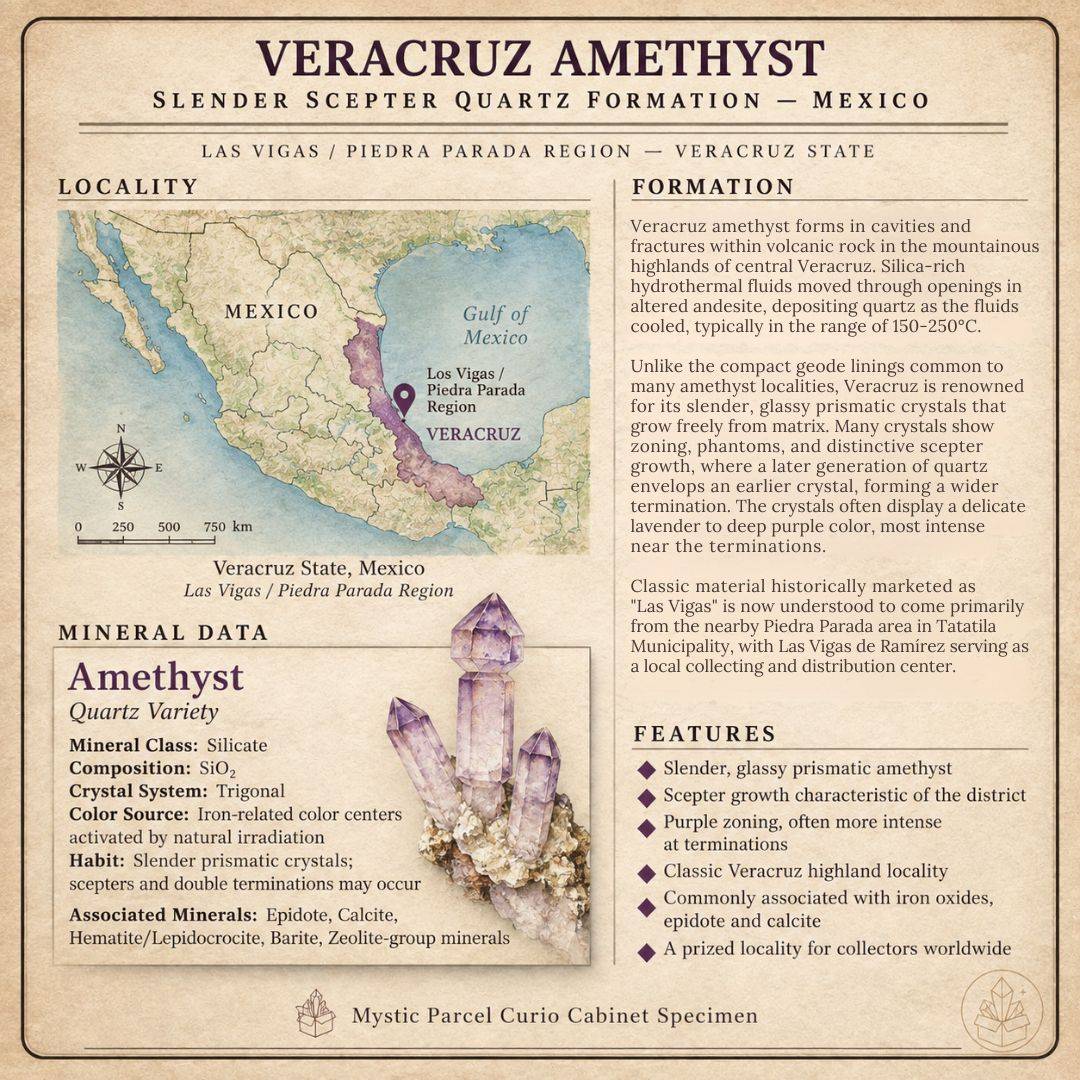
Veracruz amethyst forms in cavities and fractures within volcanic rock in the mountainous highlands of central Veracruz. Silica-rich hydrothermal fluids moved through openings in altered andesite and deposited quartz as those fluids cooled, producing the open crystal growth for which this material is known.
Compared with amethyst that develops as dense geode linings, Veracruz material commonly forms as slender prismatic crystals growing outward from matrix. Scepter growth records more than one stage of quartz development: a later generation grows over an earlier crystal and produces the broader termination that gives the scepter its characteristic profile.
This specimen shows that growth history through three scepters positioned among numerous smaller lavender-purple prisms. Lepidocrocite is present in the matrix, an association consistent with the iron-bearing minerals documented from the Veracruz amethyst locality, while the stronger purple coloration toward several terminations reflects the zoning often seen in this material.
Mystic Parcel Notes
This piece was selected for the way its crystal growth remains legible across a comparatively large section of matrix. The three scepters create distinct focal points, while the smaller surrounding prisms and mineralized matrix preserve enough geological context to read the specimen as more than an isolated group of quartz points.
Amethyst is traditionally associated with balance, peace, clarity, and intuitive reflection. On this specimen, those ideas can be approached through the visible structure itself: repeated crystal growth, changing purple intensity, and later scepter development provide natural points for observing change, continuity, and layered formation.
For collectors, the specimen offers cabinet scale, recognizable Veracruz crystal habit, three scepters, and lepidocrocite-bearing matrix in a single display piece. For intention buyers, its branching crystal arrangement and defined scepter terminations may serve as a visual anchor for reflection related to Balance, Peace, Clarity, or Intuition.
What you’ll receive
- One (1) Veracruz Amethyst cluster on matrix from Mexico — exact 642g specimen shown
- One (1) display stand shown with the specimen
How to use
- Display upright on the included stand in a mineral cabinet, collector shelf, office, or dedicated specimen display.
- Study the three scepter formations alongside the surrounding prismatic crystals to compare stages of quartz growth.
- Use as a locality specimen when comparing Veracruz crystal habit, matrix relationships, zoning, and associated minerals.
- For reflective use, allow the crystal structure to serve as a visual anchor for intentions related to Balance, Peace, Clarity, or Intuition.
Care
- Handle by the matrix whenever possible rather than by the projecting quartz crystals or scepter terminations.
- Keep the specimen securely supported on a stable surface; the slender crystals can chip or break if struck or dropped.
- Remove loose dust with a soft, dry brush rather than scrubbing the crystal-covered matrix.
- Avoid harsh chemical cleaners, acids, ultrasonic cleaning, steam cleaning, and prolonged exposure to strong direct sunlight.
Notes: This is a natural mineral specimen and may show contact areas, incomplete crystals, healed fractures, matrix irregularities, mineral staining, and other features related to its formation and extraction. Photos show the exact specimen you will receive; symbolic crystal associations are interpretive and are not presented as scientific or therapeutic effects.
| Key | Value |
|---|---|
| Material | Veracruz Amethyst with Lepidocrocite |
| Locality | Piedra Parada area, Tatatila Municipality, Veracruz State, Mexico |
| Formation | Hydrothermal quartz growth on altered volcanic matrix |
| Features | Three scepters, slender prismatic amethyst crystals |
| Color | Pale lavender to purple quartz with white, cream, gray, and brown matrix tones |
| Finish | Natural crystal and matrix surfaces; unpolished |
| Size | Approx. 5.91 × 4.80 × 3.03 in. / 150 × 122 × 77 mm |
| Specimen Size | Cabinet specimen |
| Weight | 642g |
| Material | Details |
|---|---|
| Amethyst | Purple variety of quartz known for its tranquility and healing properties |
| Lepidocrocite | Iron-bearing mineral giving reddish-brown contrast within the matrix |
| Volcanic Matrix | Altered volcanic rock providing a rich background for crystal growth |
This piece was selected for the way its crystal growth remains legible across a comparatively large section of matrix. The three scepters create distinct focal points, while the smaller surrounding prisms and mineralized matrix preserve enough geological context to read the specimen as more than an isolated group of quartz points.
Veracruz amethyst forms in cavities and fractures within volcanic rock in the mountainous highlands of central Veracruz. Silica-rich hydrothermal fluids moved through openings in altered andesite and deposited quartz as those fluids cooled, producing the open crystal growth for which this material is known.
Compared with amethyst that develops as dense geode linings, Veracruz material commonly forms as slender prismatic crystals growing outward from matrix. Scepter growth records more than one stage of quartz development: a later generation grows over an earlier crystal and produces the broader termination that gives the scepter its characteristic profile.
This specimen shows that growth history through three scepters positioned among numerous smaller lavender-purple prisms. Lepidocrocite is present in the matrix, an association consistent with the iron-bearing minerals documented from the Veracruz amethyst locality, while the stronger purple coloration toward several terminations reflects the zoning often seen in this material.
Veracruz Amethyst Cluster on Matrix (642g) — Three Scepters with Lepidocrocite, Mexico
Balance • Peace • Clarity • Intuition
This Veracruz Amethyst cluster from Mexico is a cabinet-size quartz specimen formed across a natural volcanic matrix and weighing approximately 642g. The piece carries numerous slender lavender to purple amethyst crystals, including three distinct scepter formations where later quartz growth creates broader terminations over earlier crystal development.
The crystal-covered face combines elongated prismatic points with smaller quartz growth across pale and earthy matrix material. Purple color is strongest toward several terminations, while lepidocrocite occurs within the matrix and adds brown to reddish-brown mineral contrast among the lighter quartz-bearing surfaces.
Mystic Parcel selected this specimen for the relationship between its three identifiable scepters, open prismatic growth, mineralized matrix, and substantial cabinet scale. The included display stand supports an upright presentation that keeps both the crystal face and the thickness of the original matrix visible.
Specimen Details
- Material: Veracruz Amethyst, a purple variety of quartz, with lepidocrocite in matrix
- Locality: Piedra Parada area → Tatatila Municipality → Veracruz State → Mexico
- Formation: Hydrothermal quartz growth on altered volcanic matrix with three scepter crystal formations
- Features: Three scepters, slender prismatic amethyst crystals, purple zoning toward several terminations, lepidocrocite-bearing matrix, and upright display form
- Color: Pale lavender to purple quartz with white, cream, gray, and brown matrix tones
- Finish: Natural crystal and matrix surfaces; unpolished
- Size: Approx. 5.91 × 4.80 × 3.03 in. / 150 × 122 × 77 mm
- Specimen Size: Cabinet specimen
- Weight: 642g
- Selection: Exact specimen shown
Geological Notes
Veracruz amethyst forms in cavities and fractures within volcanic rock in the mountainous highlands of central Veracruz. Silica-rich hydrothermal fluids moved through openings in altered andesite and deposited quartz as those fluids cooled, producing the open crystal growth for which this material is known.
Compared with amethyst that develops as dense geode linings, Veracruz material commonly forms as slender prismatic crystals growing outward from matrix. Scepter growth records more than one stage of quartz development: a later generation grows over an earlier crystal and produces the broader termination that gives the scepter its characteristic profile.
This specimen shows that growth history through three scepters positioned among numerous smaller lavender-purple prisms. Lepidocrocite is present in the matrix, an association consistent with the iron-bearing minerals documented from the Veracruz amethyst locality, while the stronger purple coloration toward several terminations reflects the zoning often seen in this material.
Mystic Parcel Notes
This piece was selected for the way its crystal growth remains legible across a comparatively large section of matrix. The three scepters create distinct focal points, while the smaller surrounding prisms and mineralized matrix preserve enough geological context to read the specimen as more than an isolated group of quartz points.
Amethyst is traditionally associated with balance, peace, clarity, and intuitive reflection. On this specimen, those ideas can be approached through the visible structure itself: repeated crystal growth, changing purple intensity, and later scepter development provide natural points for observing change, continuity, and layered formation.
For collectors, the specimen offers cabinet scale, recognizable Veracruz crystal habit, three scepters, and lepidocrocite-bearing matrix in a single display piece. For intention buyers, its branching crystal arrangement and defined scepter terminations may serve as a visual anchor for reflection related to Balance, Peace, Clarity, or Intuition.
What you’ll receive
- One (1) Veracruz Amethyst cluster on matrix from Mexico — exact 642g specimen shown
- One (1) display stand shown with the specimen
How to use
- Display upright on the included stand in a mineral cabinet, collector shelf, office, or dedicated specimen display.
- Study the three scepter formations alongside the surrounding prismatic crystals to compare stages of quartz growth.
- Use as a locality specimen when comparing Veracruz crystal habit, matrix relationships, zoning, and associated minerals.
- For reflective use, allow the crystal structure to serve as a visual anchor for intentions related to Balance, Peace, Clarity, or Intuition.
Care
- Handle by the matrix whenever possible rather than by the projecting quartz crystals or scepter terminations.
- Keep the specimen securely supported on a stable surface; the slender crystals can chip or break if struck or dropped.
- Remove loose dust with a soft, dry brush rather than scrubbing the crystal-covered matrix.
- Avoid harsh chemical cleaners, acids, ultrasonic cleaning, steam cleaning, and prolonged exposure to strong direct sunlight.
Notes: This is a natural mineral specimen and may show contact areas, incomplete crystals, healed fractures, matrix irregularities, mineral staining, and other features related to its formation and extraction. Photos show the exact specimen you will receive; symbolic crystal associations are interpretive and are not presented as scientific or therapeutic effects.
| Key | Value |
|---|---|
| Material | Veracruz Amethyst with Lepidocrocite |
| Locality | Piedra Parada area, Tatatila Municipality, Veracruz State, Mexico |
| Formation | Hydrothermal quartz growth on altered volcanic matrix |
| Features | Three scepters, slender prismatic amethyst crystals |
| Color | Pale lavender to purple quartz with white, cream, gray, and brown matrix tones |
| Finish | Natural crystal and matrix surfaces; unpolished |
| Size | Approx. 5.91 × 4.80 × 3.03 in. / 150 × 122 × 77 mm |
| Specimen Size | Cabinet specimen |
| Weight | 642g |
| Material | Details |
|---|---|
| Amethyst | Purple variety of quartz known for its tranquility and healing properties |
| Lepidocrocite | Iron-bearing mineral giving reddish-brown contrast within the matrix |
| Volcanic Matrix | Altered volcanic rock providing a rich background for crystal growth |
This piece was selected for the way its crystal growth remains legible across a comparatively large section of matrix. The three scepters create distinct focal points, while the smaller surrounding prisms and mineralized matrix preserve enough geological context to read the specimen as more than an isolated group of quartz points.
Veracruz amethyst forms in cavities and fractures within volcanic rock in the mountainous highlands of central Veracruz. Silica-rich hydrothermal fluids moved through openings in altered andesite and deposited quartz as those fluids cooled, producing the open crystal growth for which this material is known.
Compared with amethyst that develops as dense geode linings, Veracruz material commonly forms as slender prismatic crystals growing outward from matrix. Scepter growth records more than one stage of quartz development: a later generation grows over an earlier crystal and produces the broader termination that gives the scepter its characteristic profile.
This specimen shows that growth history through three scepters positioned among numerous smaller lavender-purple prisms. Lepidocrocite is present in the matrix, an association consistent with the iron-bearing minerals documented from the Veracruz amethyst locality, while the stronger purple coloration toward several terminations reflects the zoning often seen in this material.


